Welcome to the final module. So far, the focus has been on Bank Rate and the rates households and businesses actually face. This module follows the consequences beyond the bank statement: how spending and investment affect demand, wages and prices. In this lesson, you will trace the main chain from a Bank Rate increase to slower inflation, while keeping in view why the outcome is not automatic.
From Bank Rate to spending decisions
The Monetary Policy Committee cannot set the price of a meal, a train ticket or a piece of machinery. It can change Bank Rate, which influences the interest rates offered across the economy. As you have seen, those rates need not change by the same amount or at the same time. The inflation effect begins when changed borrowing costs and savings returns alter decisions to spend.
The following video gives a compact view of both the household and business sides of that process.
How does raising interest rates control inflation?
Watch “How does raising interest rates control inflation?” from The Economist for its explanation of how higher borrowing costs affect spending and investment.
Watch the main mechanism. Pay particular attention to the contrast between borrowers whose mortgage payments change promptly and those on fixed rates, then to the discussion of businesses delaying expansion. The mortgage examples cover several countries; use them to understand how contract terms change the response, not as a timetable for UK mortgages.
A borrower with a mortgage payment that rises may have less money available for other purchases. A person considering a new loan may decide that the purchase is no longer worth its financing cost. If a savings account pays more, someone who can afford to save may choose to put aside money they would otherwise spend. These are different decisions, but they tend to reduce current spending on goods and services.
None of this means every household cuts spending. Some borrowers have fixed payments for now, some households have no debt, and savers may receive more interest income. The useful claim is narrower: a Bank Rate increase tends to make total spending lower than it otherwise would have been. Total spending could still grow, just more slowly.
The household channel
Consider a household whose monthly mortgage payment rises when its rate changes. The extra payment does not make the household stop buying essentials. It may instead postpone replacing furniture, eat out less often or take a less expensive holiday. A prospective borrower may make a similar choice before taking out a loan at all. These individual decisions matter to inflation when enough households make them across the economy.
The Bank of England’s explanation puts this household channel in everyday terms and then connects it to businesses’ pricing decisions.
How do higher interest rates help to lower inflation? | Bank of England – the UK's central bank
Read the Bank of England’s “How do higher interest rates help to lower inflation?” for the link between household budgets, customer demand and firms’ ability to raise prices.
In “Higher interest rates mean I need to spend more on my mortgage. So how will that bring down overall spending (and inflation)?”, read the household explanation, beginning with mortgage and loan payments and ending with reduced spending in shops or online. Notice that it distinguishes essential bills from purchases people can put off. Then, in “Inflation was not caused by people spending too much. So why will higher interest rates work?”, read the pricing discussion, from the paragraph contrasting sources of inflation to the paragraph ending with businesses offering more competitive prices. Treat its account of particular inflation shocks as an example from the time it was written; focus on the distinction between the original shock and the later pressure on prices.
The extra mortgage payment is a budget pressure on the borrower, not a direct command to every shop to cut prices. The link runs through choices: with less room in the budget, customers become more selective. A shop that expected strong sales may find it harder to sell the same quantity after a price rise.
The business investment channel
Households are only part of the story. Firms also borrow to buy equipment, open premises or expand production. A higher interest rate raises the financing cost of a proposed project. A business may conclude that an expansion still makes sense, that a smaller project makes sense, or that it should wait.
Suppose a business expects a new machine to bring in more revenue, but only slightly more than it would cost to buy and finance. If borrowing becomes more expensive, the project may no longer look worthwhile. Delaying it reduces investment spending now: orders for the machine, installation work and related services may not happen when planned.
Businesses can also respond to weaker customer demand. A firm receiving fewer orders has less reason to add shifts or hire for an expansion. That can mean fewer vacancies or slower growth in hours worked. The point is not that every rate increase causes job losses; it is that hiring plans, like investment plans, depend partly on expected sales.
There is a complication worth retaining. Higher borrowing costs can themselves raise expenses for an indebted firm. Some firms may try to pass those costs on to customers. The demand channel works in the other direction: if customers are cutting back, passing on a cost increase becomes harder. Which pressure dominates for a particular firm depends on its costs, customers and competitors.
From demand to wages and prices
When households buy less and businesses invest less than they otherwise would, demand for goods and services grows more slowly. Firms facing softer demand may compete harder for customers, offer discounts or limit planned price increases. Reduced pressure to expand can also mean fewer vacancies. If employers are competing less intensely for staff, wage growth may ease over time.
That wage link needs careful wording. Slower wage growth is not the same as falling wages. Nor does a worker asking for higher pay cause inflation by itself. The relevant question is whether pay and other costs are rising persistently, and whether firms can keep raising their selling prices to cover them. Cooler demand can make repeated price increases more difficult.
Here is the central chain, with each step understood as a tendency rather than a certainty:
- Bank Rate rises and influences the rates households and firms face.
- Some households reduce or defer purchases; some firms postpone investment.
- Spending and demand are lower than they otherwise would have been.
- Firms have less scope to raise prices, while reduced hiring pressure may ease wage growth.
- Inflation may slow: the general price level rises less quickly.
“Inflation slows” does not usually mean prices return to where they were. If a representative basket costs £100, then £110 a year later, and £112 the year after that, its price is still rising in the second year—but much more slowly. Monetary policy is generally trying to moderate the rate of increase, not reverse every earlier price rise.
A useful map, not a guaranteed route
The diagram below shows why a single Bank Rate change cannot produce one predictable price outcome. For this lesson, follow the paths through bank rates and credit to spending, then through demand in goods and labour markets to wage and price-setting.
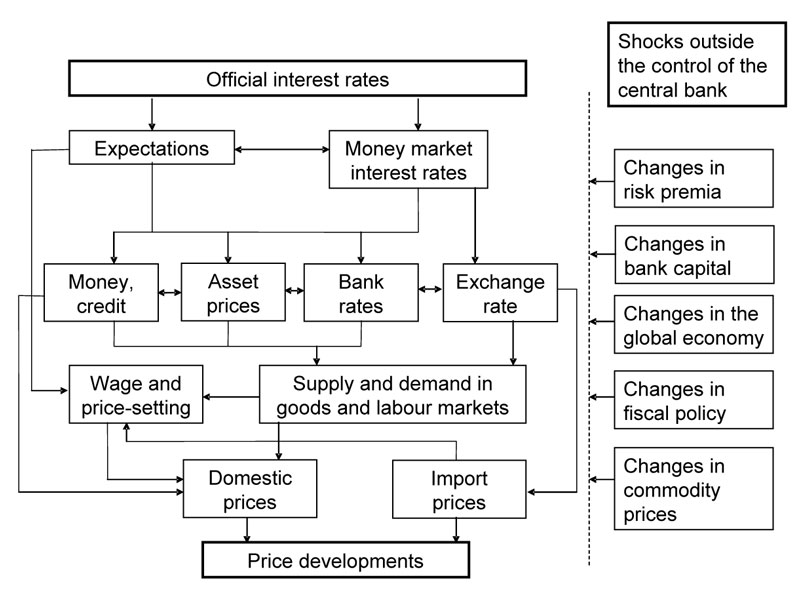
The diagram also includes paths this lesson has not traced in detail, such as exchange rates and import prices. Its right-hand side is an important qualification: energy prices or other outside shocks can push prices up even while higher rates are restraining spending. A rate increase cannot directly undo such a shock. It can, however, reduce the risk that the initial rise is followed by continuing price and wage pressures across the economy.
Key takeaway: higher Bank Rate can slow inflation chiefly by making some borrowing dearer and saving more attractive, which restrains household spending and business investment. Softer demand can limit firms’ price increases and ease pressure in the labour market. Each link depends on how people, firms and lenders respond.
The next lesson examines when those responses appear—including why a household on a fixed-rate mortgage may not feel a change until refinancing, and why spending and prices adjust gradually.