Hello! Welcome back to our module on Modern Sequence Modeling with Transformers.
In our last lesson, we introduced the powerful encoder-decoder architecture, the foundation for many sequence-to-sequence (seq2seq) tasks like machine translation. We saw how the encoder reads an entire input sequence and compresses it into a single, fixed-size context vector, which the decoder then uses to generate the output sequence. We ended with a crucial question: what is the weakness of relying on this single vector?
Today, we will answer that question. Your learning outcome is to explain the limitation of the fixed-size context vector in traditional encoder-decoder models. Understanding this limitation is not just a historical detail; it's the critical insight that motivated the development of the attention mechanism, the core component of the Transformer models we're building towards.
1. The Context Vector Bottleneck
The core limitation of the traditional encoder-decoder architecture is often called the information bottleneck. The encoder is forced to compress all the information from the input sequence—its meaning, grammatical structure, and nuances—into one fixed-size vector.
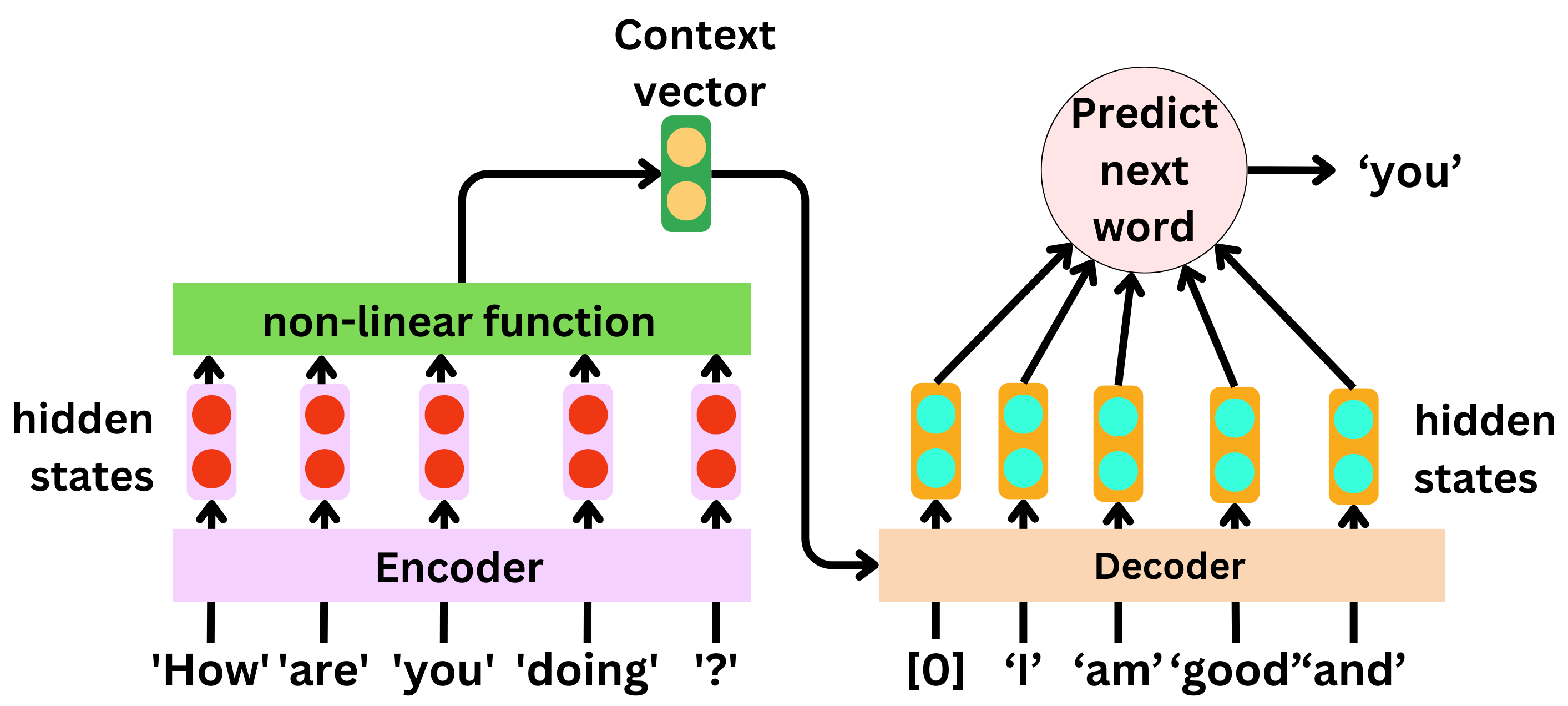
This design creates a significant problem: as the input sequence gets longer, it becomes increasingly difficult to cram all the relevant information into this fixed-size representation. This is the bottleneck: the flow of information from the encoder to the decoder is constrained by the limited capacity of the context vector.
To build an intuition for this, let's watch a short clip that clearly demonstrates the consequences.
Attention for Neural Networks, Clearly Explained!!!
This clip from StatQuest with Josh Starmer provides an excellent intuitive explanation of why compressing a long sentence into a single vector is problematic. It uses a simple but effective example to show how crucial information can be lost.
Watch from 01:10 to 03:15. Pay close attention to the example of translating 'Don't eat the delicious looking and smelling Pizza'. This illustrates how forgetting a single word from the beginning of a long sentence can completely change its meaning.
As the video explains, even with LSTMs designed to handle long-range dependencies, information from early in the sequence can get diluted or overwritten by the time the encoder finishes processing. The final hidden state, which becomes the context vector, will naturally have a stronger memory of the last few words it saw compared to the first few.
2. Information Degradation and Its Consequences
The bottleneck isn't just an abstract idea; it has concrete, measurable effects on model performance. Let's explore the mechanics and evidence of this problem in more detail.
How Information is Lost
The problem is inherent in the recurrent nature of the encoder. The hidden state is updated at each step, carrying information forward. For a sentence with words, information from the first word must "survive" updates to be fully present in the final context vector. This is analogous to signal degradation over a long transmission line; the further the information has to travel, the weaker it gets.
The following reading provides a great summary of how this bottleneck manifests.
Encoder-Decoder Framework: Seq2Seq Architecture for Machine ...
This article provides a concise and clear explanation of the bottleneck problem, detailing the specific ways in which it harms the model's ability to handle long sequences.
Please read the section titled 'The Context Vector Bottleneck'. Focus on the three key consequences mentioned: the drop in translation quality for long sentences, the decoder's inability to 'look back' at specific words, and the potential loss of word order information.
The Empirical Evidence
This performance degradation is not just theoretical. When these models were first developed, researchers quickly found a clear pattern: translation quality was good for short sentences but dropped off dramatically as sentences got longer.
The video below provides the hard evidence for this phenomenon.
Attention for RNN Seq2Seq Models (1.25x speed recommended)
Seeing the data is crucial. This clip from a lecture by Shusen Wang shows a graph that plots translation quality against sentence length, providing clear, empirical proof of the bottleneck's impact.
Watch the segment from 02:57 to 04:23. The key element is the graph showing the BLEU score (a standard metric for translation quality) versus sentence length. Notice the sharp decline for the model 'without attention' once sentences exceed about 20 words.
The graph you just saw is one of the most famous results in the history of modern NLP. It was a clear signal to the research community that while the encoder-decoder framework was a brilliant idea, the fixed-size context vector was a fundamental flaw that needed to be addressed.
Test your understanding!
Imagine you are using a seq2seq model to summarize news articles. Based on what you've learned, would you expect the model to perform better on summarizing short news briefs (e.g., 50 words) or long-form articles (e.g., 1000 words)? Why?
Show answer
You would expect the model to perform much better on summarizing the short news briefs. The information bottleneck of the fixed-size context vector means the model would struggle to compress all the key information from a 1000-word article into a single vector. It's likely to 'forget' details from the beginning of the article, leading to a less accurate and incomplete summary. The 50-word brief is short enough that its entire meaning can be more effectively encoded in the context vector.
3. A Final Analogy
To solidify this concept, let's consider one more analogy. Given your engineering background, you can think of this in terms of information capacity. A fixed-size vector has a finite information capacity.
The following reading explains this using a simple but powerful analogy.
Understanding the attention mechanism in sequence models
This blog post offers a very intuitive way to think about the bottleneck in terms of information capacity, which should resonate well with an engineering perspective.
Read the section titled 'The context vector bottleneck'. The author's analogy of dividing a fixed '100 bits of information' among a growing number of input tokens is a very clear way to visualize why each word gets less 'representation' as a sequence grows.
This idea—that each word contributes less and less information to the final context vector as the input grows—perfectly captures the essence of the bottleneck problem.
Conclusion
In this lesson, we dissected the primary limitation of the traditional encoder-decoder architecture. This is a crucial step in your journey to understanding modern ML models, as it explains the why behind the next big innovation.
Key Takeaways:
- Information Bottleneck: The standard seq2seq model forces the encoder to compress the entire input sequence into a single, fixed-size context vector.
- Information Loss: This compression is lossy. Information from the beginning of long sequences tends to be forgotten or diluted by the time the encoder produces the final context vector.
- Performance Degradation: This bottleneck leads to a measurable and significant drop in performance (e.g., translation quality) as input sequences become longer.
Preview of the Next Lesson:
We have now clearly defined the problem. So, what's the solution? How can the decoder generate an output word without having to rely on a single, overburdened context vector? The answer is to let the decoder pay attention to different parts of the input sequence at each step of the decoding process. In the next lesson, we will explore the revolutionary concept of the attention mechanism, which directly solves the bottleneck problem and paves the way for the Transformer.