Introduction
In our previous lesson, we delved into the deep-seated criticisms levelled against the collegium system, focusing on its inherent opacity, lack of defined criteria, and the resulting absence of public accountability. You saw how this system, born from a desire to protect judicial independence, came to be viewed by many as an unaccountable "empire within an empire." This widespread discontent set the stage for one of the most significant constitutional reforms attempted in recent Indian history.
This lesson directly addresses that reform. We will now examine the Parliament's proposed solution to the collegium's perceived failings: the National Judicial Appointments Commission (NJAC). Your learning outcome for this session is to explain the proposed structure of the National Judicial Appointments Commission (NJAC) Act, 2014. We will dissect the composition of this new body, understand its intended functions, and analyze the specific mechanisms designed to foster transparency and accountability in judicial appointments.
The Answer to the Collegium: The 99th Amendment
By 2014, there was a rare and powerful political consensus that the collegium system needed to be replaced. This led the Parliament to pass two landmark pieces of legislation with near-unanimous support:
- The Constitution (99th Amendment) Act, 2014: This amended the Constitution to replace the collegium system with a new body.
- The National Judicial Appointments Commission (NJAC) Act, 2014: This Act detailed the functions and procedures of the new body.
Together, these acts sought to create a new, broad-based, and transparent constitutional body for appointing judges.
National Judicial Appointments Commission (NJAC), Compositions ...
This article from Vajiram and Ravi provides a concise introduction to the NJAC's purpose.
Please read the introductory sections, starting from the beginning down to the heading "National Judicial Appointments Commission (NJAC) Composition". Focus on how the 99th Amendment established the NJAC by inserting new articles (124A, 124B, and 124C) into the Constitution.
The Structure of the NJAC: A Hybrid Model
The core innovation of the NJAC was its composition. It was designed as a six-member body, deliberately mixing members from the judiciary, the executive, and civil society to create a system of checks and balances.
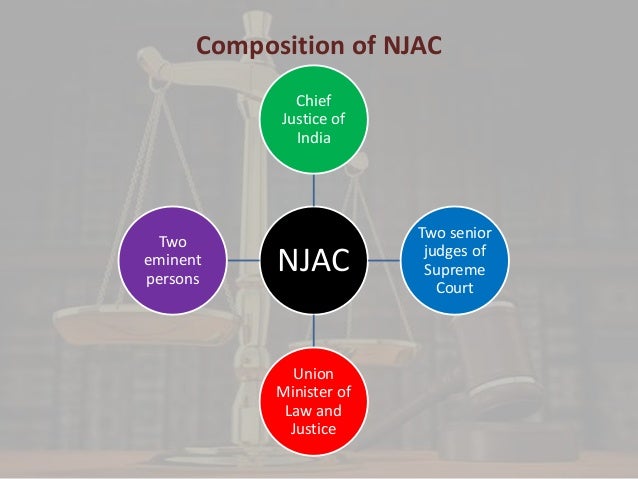
As you can see, the NJAC was to be composed of:
- The Chief Justice of India (as Chairperson, ex-officio)
- Two senior-most Supreme Court judges (next in seniority to the CJI, ex-officio)
- The Union Minister of Law and Justice (ex-officio)
- Two "eminent persons" from civil society
This structure sought to end the judiciary's exclusive control over appointments by giving a formal seat at the table to the executive and to independent members representing the public.
To grasp the specifics of this composition and the crucial role of the "eminent persons," let's turn to a more detailed resource.
Why did the SC strike down the NJAC Act in 2015?
This article from the Supreme Court Observer breaks down the constitutional changes and the NJAC's composition.
Please read the section under the heading "What was the NJAC?". Pay close attention to the description of the six-member composition. Note the specific committee formed to nominate the two "eminent persons" and the diversity requirement for one of them.
Key Mechanisms: The "Eminent Persons" and the Veto
Two features of the NJAC's structure were particularly significant and became central to the later debate about its constitutionality.
1. The Selection of "Eminent Persons":
As you just read, these two members were not to be chosen by the government alone. They were to be nominated by a high-powered committee consisting of:
- The Prime Minister
- The Chief Justice of India
- The Leader of the Opposition in the Lok Sabha
This was intended to ensure that the civil society members were chosen through a process that involved all three major pillars of governance—the executive, the judiciary, and the legislature's opposition—lending them a degree of bipartisan legitimacy.
2. The Veto Power:
Perhaps the most crucial operational aspect of the NJAC was its decision-making process. The NJAC Act stipulated that the commission could not recommend a candidate if any two of its members objected. This created a veto power. This meant that the two "eminent persons" together, or the Law Minister and one eminent person, could block a name even if all three judicial members supported it. This mechanism was designed to force consensus but also became the primary point of attack for those who feared it would undermine judicial primacy.
The following video provides an excellent summary of the NJAC's composition and these key functional details.
Collegium System | Appointment of Judges in India | Indian Polity for UPSC Prelims & Mains 2022-2023
This lecture from BYJU'S IAS clearly explains the structure and functioning of the proposed NJAC.
Please watch the segment from this discussion on the NJAC. The speaker details the six-member composition, the process for selecting eminent persons, the commission's functions, and critically, the veto power of any two members.
The Intended Functions of the NJAC
With this structure in place, the NJAC was tasked with taking over all the functions previously performed by the collegium. According to Article 124B, its main responsibilities were:
- Recommending persons for appointment as the Chief Justice of India, Judges of the Supreme Court, Chief Justices of High Courts, and Judges of High Courts.
- Recommending the transfer of Chief Justices and other Judges of High Courts from one High Court to another.
In essence, the NJAC was designed to be a one-stop body for all high-level judicial appointments and transfers, operating on the principles of shared authority and transparency, a stark contrast to the closed-door proceedings of the collegium.
Conclusion
In this lesson, we have dissected the architecture of the National Judicial Appointments Commission. You saw how it was established through a constitutional amendment to be the institutional answer to the criticisms of the collegium system.
Key Takeaways:
- A Constitutional Reform: The NJAC was created via the 99th Constitutional Amendment Act, 2014, to replace the judge-led collegium system.
- A Hybrid Composition: Its core feature was a six-member body comprising three senior judges, the Union Law Minister, and two "eminent persons" from civil society, aiming to balance judicial independence with democratic accountability.
- Checks and Balances: Key mechanisms included the selection of eminent persons by a committee of the PM, CJI, and Leader of Opposition, and a veto power where any two members could block a recommendation.
- Centralized Function: The NJAC was designed to handle all appointments and transfers for the higher judiciary, making the process more structured and ostensibly more transparent.
The NJAC represented a monumental effort by the political class to reclaim a stake in the judicial appointments process. However, this new structure was immediately challenged before the very institution whose powers it sought to reform. In our next lesson, we will analyze the Supreme Court's rationale for striking down the NJAC as unconstitutional in the landmark Fourth Judges Case (2015), a decision that has defined the ongoing power struggle between India's judiciary and its executive.