Hello. This course begins with the mismatch that prompted your interest: the Railroad Commission of Texas regulates oil and gas, yet its name points to trains. The name is a record of the agency’s first assignment, not a description of everything it does today.
This lesson follows the changes that explain that mismatch. You will see why Texas created a railroad regulator in 1891, how lawmakers added pipeline and oil-and-gas responsibilities, and when the Commission lost its remaining railroad function. Later lessons will examine how its commissioners are elected and what its current authority means in practice.
The first assignment: railroad rates and operations
In the late nineteenth century, railroads were essential to moving people and goods within Texas. Shippers complained that railroad companies could charge unjust or discriminatory rates. Railroad regulation became a prominent issue in the 1890 governor’s election, and the legislature established the Railroad Commission of Texas in 1891.
Its initial jurisdiction concerned the rates and operations of railroads, along with terminals, wharves, and express companies. The agency was not created in anticipation of oil regulation. For roughly its first quarter-century, railroad matters dominated its work.
Read the Commission’s account of that history before following the changes in detail:
Read the Railroad Commission of Texas's history for the dates and legal additions behind its changing responsibilities. Pay particular attention to the difference between adding a new responsibility and giving up an old one.
Under “History of the Railroad Commission of Texas,” begin with the paragraph starting “Created in April 1891.” Read the founding and expansion through the 1919 law. Continue from the paragraph beginning “The Railroad Commission adopted the first statewide rules” through the paragraph on the Gas Utilities Act of 1920; read these early rules. Farther down the same history section, find the paragraph beginning “In the early 1930s the global price of crude oil dropped dramatically” and read the proration example. Near the end, start at “By the early 1990s the Railroad Commission consisted of four regulatory divisions” and read the rail transfer through the statement that the Commission has had no railroad-related functions since 2005.
One distinction will help throughout the course: an agency’s name, its history, and its current legal authority are not interchangeable. The 1891 name described the problem Texas first assigned to the Commission. Later legislatures could give that same institution additional jobs without changing its name.
That is what happened here. The transition was not a single decision to replace trains with oil wells. Railroad and energy responsibilities overlapped for decades.
The pipeline bridge to oil and gas
Oil development expanded while the Commission was still principally a railroad regulator. The photograph below shows a Texas oilfield in 1902—well before the laws that gave the Commission its principal oil-and-gas powers.
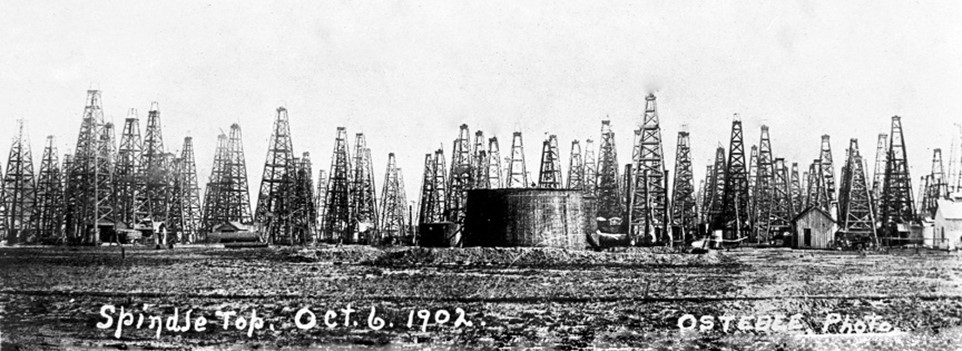
The first major bridge was transportation. In 1917, Texas passed the Pipeline Petroleum Law. It declared petroleum pipelines common carriers and placed them under the Railroad Commission’s jurisdiction. The connection to the existing agency was understandable: a regulator already dealing with transportation and access to transportation networks was assigned a new kind of network. That does not mean a pipeline was treated as a railroad in every respect. It means the legislature expressly extended the Commission’s authority to pipelines.
The next step reached beyond transportation. The 1919 Oil and Gas Conservation Law gave the Commission jurisdiction to regulate the production of oil and gas. This is the pivotal distinction in the timeline: a law about pipelines concerned movement of petroleum; the 1919 law concerned producing the resource itself. The Commission subsequently adopted statewide oil-and-gas rules addressing conservation and safety. One example was a rule requiring minimum distances between wells, intended to help protect underground reservoir pressure and the rights of different owners with interests in the resource. A later module will examine the reasoning behind well spacing more closely.
In 1920, the Gas Utilities Act added regulatory and rate authority involving natural gas production, transportation, and distribution in Texas. By then, the Commission’s remit included several connected but distinct activities: petroleum pipelines, oil-and-gas production, and aspects of natural gas service. None of these laws, by itself, erased its railroad responsibilities.
The agency’s growing role became especially visible in the early 1930s, when it limited how much individual oil wells could produce through a practice called proration. The Commission’s history describes this in the context of plentiful production and falling crude-oil prices, as well as conservation of resources. Proration is useful here as evidence of how consequential the Commission’s production authority had become. It should not be mistaken for an explanation of every power the Commission exercises today.
The key dates can be kept compact:
| Year | Change relevant to this lesson |
|---|---|
| 1891 | Texas establishes the Commission to regulate railroad rates and operations, among other transportation-related matters. |
| 1917 | Petroleum pipelines are placed under its jurisdiction as common carriers. |
| 1919 | It gains authority to regulate oil-and-gas production. |
| 1920 | It gains authority involving natural gas utilities. |
| 2005 | Its remaining rail function, rail safety regulation, is transferred to the Texas Department of Transportation. |
The pattern is accumulation first, transfer later. Remembering that pattern prevents the misleading impression that the discovery of oil somehow converted a railroad agency into an oil agency overnight.
What remained of railroad regulation—and what changed in 2005
The Commission continued to have railroad-related duties long after oil and gas became central to its work. Its Rail Division’s activities included attention to equipment and track, railroad and signal operations, hazardous-material handling, and investigations of railroad accidents and complaints. Those were substantive rail-safety functions, not merely a historical title.
The Texas State Archives’ agency history adds useful detail about both the original transportation role and the eventual transfer:
Use the Texas State Archives' agency history to distinguish the Commission's long-running railroad work from its later oil-and-gas authority. Its account also identifies what the Rail Division was doing before the 2005 transfer.
Find “Agency History.” In the part beginning “The RRC was the first regulatory agency created in the state of Texas,” read the early remit, including the paragraphs on the Commission’s first 25 years and the 1917 pipeline law. Later in “Agency History,” locate the paragraph beginning “Railroad regulation was initially overseen by the Main Office.” Read the Rail Division account through the 2005 transfer. Focus on the concrete rail-safety duties listed before the transfer.
In 2005, legislation transferred the Rail Division and its remaining function—rail safety regulation—to the Texas Department of Transportation. The Railroad Commission states that it has had no railroad-related functions since that time. Its oil-and-gas responsibilities did not disappear in that transfer.
This provides a precise way to interpret the agency’s name today. “Railroad” tells you where the institution began; it does not give you authority to assume that it currently inspects railroad track or handles railroad-safety complaints. Conversely, the absence of “oil and gas” from the name does not diminish the production and pipeline responsibilities the legislature assigned to it. Current jurisdiction has to be established from the applicable laws and assignments, not inferred from the sign on the office door.
A final nuance matters for the rest of the course. Saying that the Railroad Commission has no railroad-related functions does not mean that every matter involving energy belongs to it. Different laws assign different decisions to different authorities. The historical explanation answers why this agency came to regulate oil and gas; later lessons will establish which specific decisions it can make now.
The historical explanation in one account
Texas established the Railroad Commission in 1891 to address railroad rates and operations. As petroleum transportation and production grew, the legislature assigned the existing regulator new responsibilities: pipelines in 1917, oil-and-gas production in 1919, and natural gas utility matters in 1920. Rail and energy duties coexisted for many years. In 2005, the Commission’s remaining rail-safety function moved to the Texas Department of Transportation, leaving the Commission with no railroad-related functions despite its unchanged name.
That history resolves the apparent contradiction without treating the name as a guide to present-day powers. Next, you will look at another feature inherited from the Commission’s early history: how its three commissioners came to be elected, and how those elections work today.