Hello! Welcome to the penultimate lesson of the course.
In our last session, you designed a robust journaling process, creating the essential feedback loop for your trading. You now have a system to capture the "what" (quantitative data) and the "why" (qualitative context) behind every trade.
Today, we will use that system to give your trading direction and purpose. The learning outcome is to set realistic performance goals and a review schedule for your trading plan. This isn't about wishful thinking; it's about engineering your success. We will define what to aim for, how to measure progress, and how to create a structured cycle of review and improvement. This lesson will turn your trading plan from a static document into a dynamic guide for your career.
1. The Philosophy of Trading Goals: Process Over Outcome
In a field with uncertain outcomes, the most common mistake is setting goals based on results you can't control, like "make $10,000 this month." This approach leads to frustration and poor decisions. Professional traders know that long-term profitability comes from focusing on the one thing you can control: your process.
Let's start with a video that clearly explains this crucial distinction.
How To Set Trading Goals and ACTUALLY Achieve Them
In the video 'How To Set Trading Goals and ACTUALLY Achieve Them,' YouTuber JORFX explains why your primary goals should be based on actionable steps rather than monetary targets.
Please watch the following two clips: Actionable Steps vs. Outcomes (01:42 - 03:34): Pay close attention to the argument for setting goals like 'achieve 10 hours of backtesting' or 'take three quality trades' instead of a specific P&L target. Break Goals Down (03:34 - 05:36): Observe the example of breaking a large goal (getting $1.2M in funding) into small, manageable daily tasks. This is the blueprint for turning a vision into a concrete plan.
As the video highlights, your goals should fall into two main categories:
- Process Goals: These relate to your actions and adherence to your plan. They are 100% within your control.
- Example: "I will follow my entry checklist for 100% of trades this week."
- Example: "My risk will not exceed 1% on any single trade."
- Performance Goals: These relate to the results of your process. They are not fully in your control, but they measure the effectiveness of your edge over time.
- Example: "I will aim for a weekly profit factor greater than 1.5."
- Example: "I will keep my maximum drawdown under 6% for the month."
Your primary focus should always be on achieving your process goals. If you do that consistently, your performance goals will eventually take care of themselves.
2. Defining Your Key Performance Indicators (KPIs)
To set meaningful goals, you need to know what to measure. Your quantitative journal is the source for these metrics, known as Key Performance Indicators (KPIs). For your hybrid trading approach, we'll have KPIs for both your manual trading and, eventually, your automated systems.
Key Manual Trading KPIs:
- Adherence to Plan (%): The percentage of trades where you followed all your rules. This is your most important KPI.
- Profit Factor: Gross profits divided by gross losses. A value > 1 means your strategy is profitable.
- R-Multiple Net P&L: The sum of all your trades, measured in R (risk units).
- Win Rate (%): The percentage of trades that are profitable.
- Average R-Multiple per Trade: The average R value of all trades (both wins and losses).
- Maximum Drawdown (%): The largest peak-to-trough drop in your account equity.
The Phidias Prop Firm guide offers some excellent context on how your KPIs might differ based on the ICT setups you trade.
ICT Trading Strategy: Complete Guide for Prop Firm ...
This article, 'ICT Trading Strategy: Complete Guide for Prop Firm...,' discusses how different ICT setups have distinct performance characteristics, which should influence your goal-setting.
Read the subsection 'Risk Management for ICT Setups,' and focus on the paragraph beginning with 'Drawdown management requires understanding...'. Notice the distinction made between order block trades and liquidity sweep trades.
This tells us that if you specialize in Order Block setups, you might set a goal for a higher win rate. If you focus on Liquidity Sweeps, you might accept a lower win rate but aim for a higher average R-multiple on your winning trades.
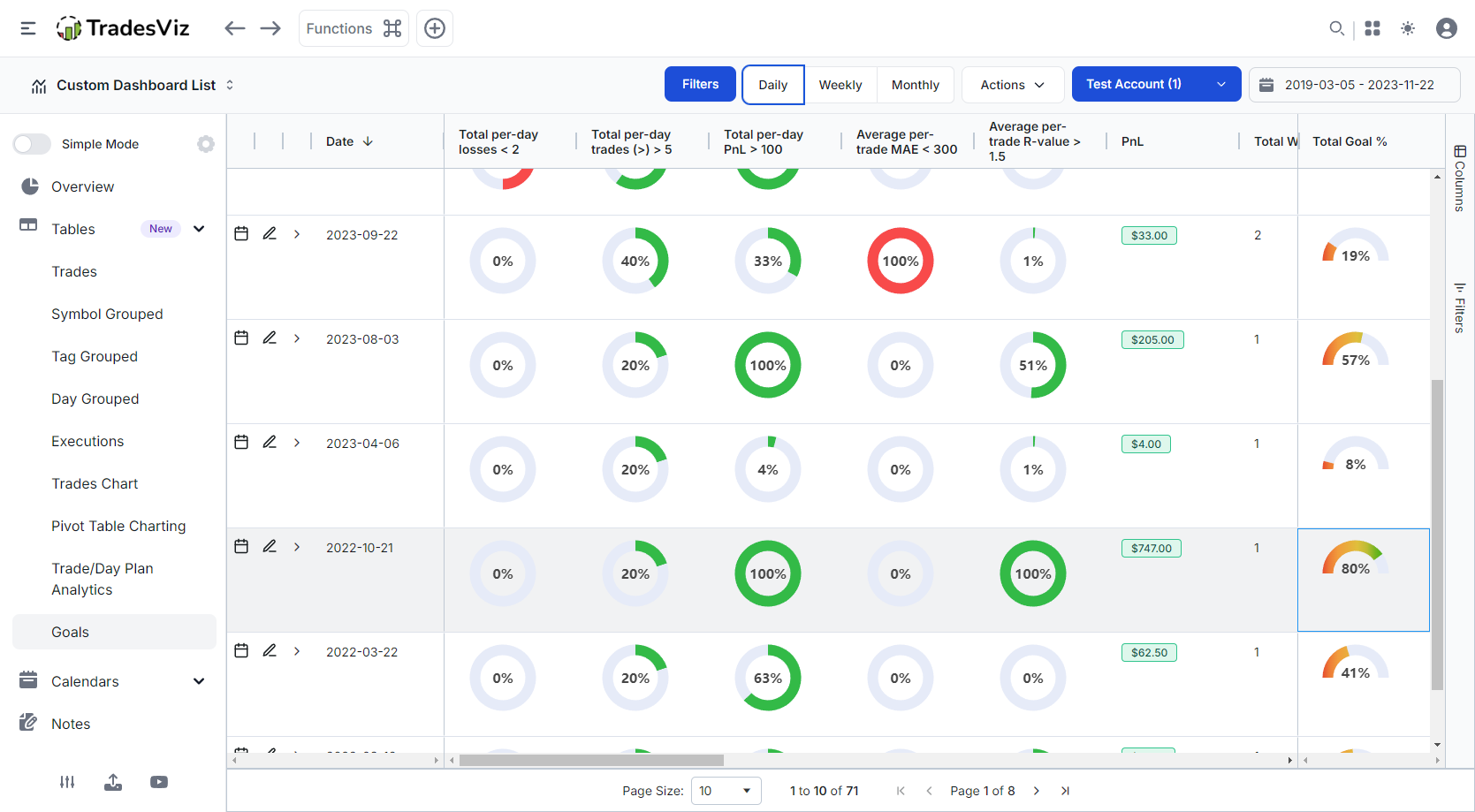
This dashboard is a great example of how a trading journal can visualize your progress towards specific, measurable goals.
KPIs for Your Automation Journey:
As you develop your trading bots, your goals will be project-based.
- Example: "Complete the Python function for FVG detection by the end of the week."
- Example: "Backtest the Silver Bullet script on 1 year of EURUSD data and calculate the performance metrics."
This is what the output of that backtest might look like—the KPIs for your automated strategy.

3. Formalizing Your Review Schedule
Setting goals is pointless without a regular process to review your progress. Building on the last lesson, let's formalize your review schedule. This is the heartbeat of your trading business.
The following video provides a practical look at a trader's daily and weekly review templates, which are the cornerstone of a structured review process.
How to Optimize Your Trading Journal
In 'How to Optimize Your Trading Journal,' trader Kyle from JadeCap walks through his personal review process, showing the exact templates he uses to stay on track.
Watch the section from 16:29 to 25:22. Pay attention to the distinction between the 'Daily Game Plan,' 'Day Recap,' and the 'Weekly Review.' This is a model for the system you will build.
Based on these best practices, here is your official review schedule. I recommend blocking this time out in your calendar as non-negotiable appointments with yourself.
-
Daily Review (~15-20 minutes):
- When: At the end of your trading session.
- Agenda:
- Log all trades in your qualitative (chart markups) and quantitative (spreadsheet/journal software) journals.
- For each trade, check the "Followed Plan?" box (Yes/No).
- Write one sentence in your recap: "What is the key lesson from today?"
-
Weekly Review (~60-90 minutes):
- When: Every Saturday or Sunday.
- Agenda:
- Qualitative Review: Go through all your annotated charts for the week. Look for patterns in your winning and losing trades. Are your losses random, or are you repeatedly making the same mistake?
- Quantitative Review: Calculate your weekly KPIs (Profit Factor, Net R, Win Rate, Adherence %).
- Goal Assessment: Compare your KPIs to your weekly goals. Did you meet them? Why or why not?
- Set Next Week's Goals: Based on your review, set 1-3 specific process goals for the upcoming week. (e.g., "This week, I will not enter any trade outside of a Killzone window.").
-
Monthly Review (~2-3 hours):
- When: On the last weekend of the month.
- Agenda:
- Aggregate your weekly data to get a monthly KPI dashboard.
- Analyze your performance by setup type. Which ICT model is working best for you?
- Read through all your weekly review notes. What are the recurring themes?
- Review and, if necessary, make minor tweaks to your trading plan based on what the data is telling you.
Test your understanding!
Your weekly review reveals that you had a -3R week. However, your "Adherence to Plan" KPI was 100%, and your average losing trade was exactly -1R. Your Profit Factor was 0.7.
Is this a "bad" week? What kind of process goal might you set for next week?
Show answer
This is not necessarily a "bad" week; in fact, from a process perspective, it was a perfect week.
- Why it was good: You demonstrated perfect discipline by following your plan and respecting your stop losses. This is the hardest part of trading and the foundation for success. You had a drawdown, but it was controlled.
- What the data says: A Profit Factor of 0.7 means your strategy was not profitable this week. This could be due to normal statistical variation (a string of losses) or a slight issue with your setup selection criteria.
- Potential Goal for Next Week: Instead of changing the strategy, a good goal would be to continue the excellent discipline while focusing on setup quality. A great process goal would be: "I will only take A+ setups that meet all 7 criteria on my checklist, and I will pass on any 'B' grade setups, even if it means I take fewer trades."
4. Your Initial Goals: The First Month
Let's put this all together into a concrete set of goals for your first month of trading with this new plan. These are designed to be realistic, challenging, and focused on building a strong foundation.
Long-Term Vision (1 Year):
- Achieve consistent profitability with manual ICT trading.
- Develop a suite of Python scripts that can automatically identify and alert you to high-probability FVG, Silver Bullet, and SMT setups.
First Month Goals:
-
Process Goals:
- Discipline: Achieve >= 90% adherence to the trading plan rules.
- Journaling: Log 100% of trades in both qualitative and quantitative journals.
- Review: Complete all scheduled daily and weekly reviews.
-
Performance Goals:
- Profitability: End the month with a positive Net R-multiple (even +0.5R is a success).
- Risk Management: Ensure the maximum drawdown does not exceed 5% of the starting balance.
-
Learning Goals:
- Manual Trading: Perform and journal a detailed, top-down analysis of at least 10 historical examples of a Market Maker Model (MMBM/MMSM).
- Automated Trading: Complete the "Python Fundamentals" module of this course and successfully set up your development environment.
This framework directly connects to the wisdom shared in the article on manual vs. automated trading.
Manual Day Trading vs. MT5 Automated Trading
The article 'Manual Day Trading vs. MT5 Automated Trading' contains lessons from legendary trading coach Van K. Tharp that perfectly summarize our approach to goal-setting.
Read the section '10 Lessons from Van K. Tharp's "Trading Beyond the Matrix"'. Pay special attention to points 2, 4, 7, and 9. These encapsulate the mindset of a professional systems trader.
Your goals and review schedule are your commitment to Tharp's principles: taking 100% responsibility (Point 2), defining your objectives (Point 4), knowing your system's performance (Point 7), and treating any deviation from your plan as a mistake to be corrected (Point 9).
Conclusion
You have now established the final operational component of your trading business. Your trading plan tells you what to do, your journal tracks what you did, and your goals and review schedule ensure you are constantly improving.
Key Takeaways:
- Focus on Process: Your primary goals should be actionable and within your control, such as adhering to your plan and completing your reviews.
- Measure What Matters: Use KPIs from your journal (like Adherence %, Net R, and Profit Factor) to objectively measure your performance.
- Break It Down: Deconstruct your long-term vision into quarterly, monthly, and weekly goals that you can act on today.
- The Review is Everything: Your daily, weekly, and monthly reviews are where learning and growth occur. They are non-negotiable.
Preview of the Final Lesson:
This is it. You have built a complete, professional-grade trading plan from the ground up. In our final capstone lesson, you will put it all into practice. You will be tasked to synthesize all learned concepts to analyze a chart and articulate a full trade idea. It will be a comprehensive demonstration of your entire skillset, from market structure analysis to final trade execution. Get ready to put it all together.