Hello! Welcome back to our course.
In our previous lessons on property regimes, we explored how couples can proactively define their financial future through marriage settlements and how donations can be made in consideration of marriage. But what happens when couples, like the majority in the Philippines, enter marriage without a formal prenuptial agreement?
This lesson addresses that very question. Our learning outcome is to determine the default property regime that applies in the absence of a valid marriage settlement. We will identify the two possible default regimes under Philippine law and, crucially, understand the one factor that determines which one applies: the date of the marriage.
1. The Legal Hierarchy for Property Relations
The law provides a clear order of preference for what rules govern a couple's property. When a couple doesn't make their own rules via a marriage settlement, the Family Code steps in to provide a default framework.
To understand this legal foundation, please read the following excerpt from a publication by the UP College of Law.
Philippine Law on Personal and Property Relations of Couples
This section explains the hierarchy of rules that govern property relations between spouses, as laid out in Article 74 of the Family Code.
Please read the section titled 'B. Property Relations Between Spouses', starting from 'Article 74 of the Family Code...' down to where it first mentions that the presumed property regime is the 'system of absolute community of property ('ACP')'.
As you've read, Article 74 of the Family Code establishes the following order:
- By marriage settlements executed before the marriage.
- By the provisions of this Code (the Family Code).
- By the local custom.
Since this lesson deals with the absence of the first item, we turn to the second: the provisions of the Family Code, which establish the default or "presumed" property regime.
2. The Decisive Factor: The Date of Marriage
The "default" is not a single rule. It changed significantly with the enactment of the Family Code. Therefore, the specific property regime that applies depends entirely on when the marriage took place.
The video below explains this critical distinction.
[TOPIC 11] GROSS ESTATE OF MARRIED DECEDENT | Conjugal Partnership and Absolute Community
In the absence of a marriage settlement, the default regime is determined by a single, crucial factor: the date the marriage was celebrated. This video provides a very clear explanation of the cutoff date.
Watch the segment from 03:17 to 04:31. The speaker explains the two default regimes and the specific date that separates them.
To summarize the key rule:
- For marriages celebrated before August 3, 1988, the default property regime is the Conjugal Partnership of Gains (CPG).
- For marriages celebrated on or after August 3, 1988, the default property regime is the Absolute Community of Property (ACP).
The date is significant because August 3, 1988, is when the Family Code of the Philippines took effect, replacing the property regime provisions of the old Civil Code.
3. A Brief Comparison of the Two Regimes
Now that you know how to identify the applicable default regime, let's briefly introduce what each one entails. The next two modules will explore them in detail, but a high-level comparison is essential here.
A. Absolute Community of Property (ACP)
ACP is the current default. Its core concept is the near-total fusion of the spouses' assets into a single, co-owned fund.
Family Code - Absolute Community Property
Let's get a basic understanding of the current default regime, the Absolute Community of Property (ACP). This video gives a great introduction to its fundamental concept.
Watch the first two minutes of the video (00:00 to 02:21). It explains that ACP is the default and describes the general rule that properties owned before marriage and acquired during marriage are pooled together.
Under ACP, all property owned by the spouses at the time of the marriage and everything they acquire thereafter becomes part of the community property. There are specific exceptions, which we will cover in the next module, but the general rule is a comprehensive merger of assets.
B. Conjugal Partnership of Gains (CPG)
CPG was the default under the old Civil Code. It operates on a different principle. Spouses retain individual ownership of what they brought into the marriage, and only the "gains" or "profits" of the partnership are shared.
Philippine Law on Personal and Property Relations of Couples
Now for the historical default regime, the Conjugal Partnership of Gains (CPG). The same UP Law article we read earlier provides a concise description of how CPG works, which is quite different from ACP.
Read the paragraph starting with 'Under the Civil Code that was in effect from August 30, 1950 until August 2, 1988...'. This explains the core mechanism of CPG, where spouses retain their separate properties.
Under CPG, the spouses keep what is called their "separate property" (or "capital" for the husband and "paraphernal" for the wife). The common fund consists of:
- The fruits and income from their separate properties.
- Property acquired by either spouse through their efforts or by chance during the marriage.
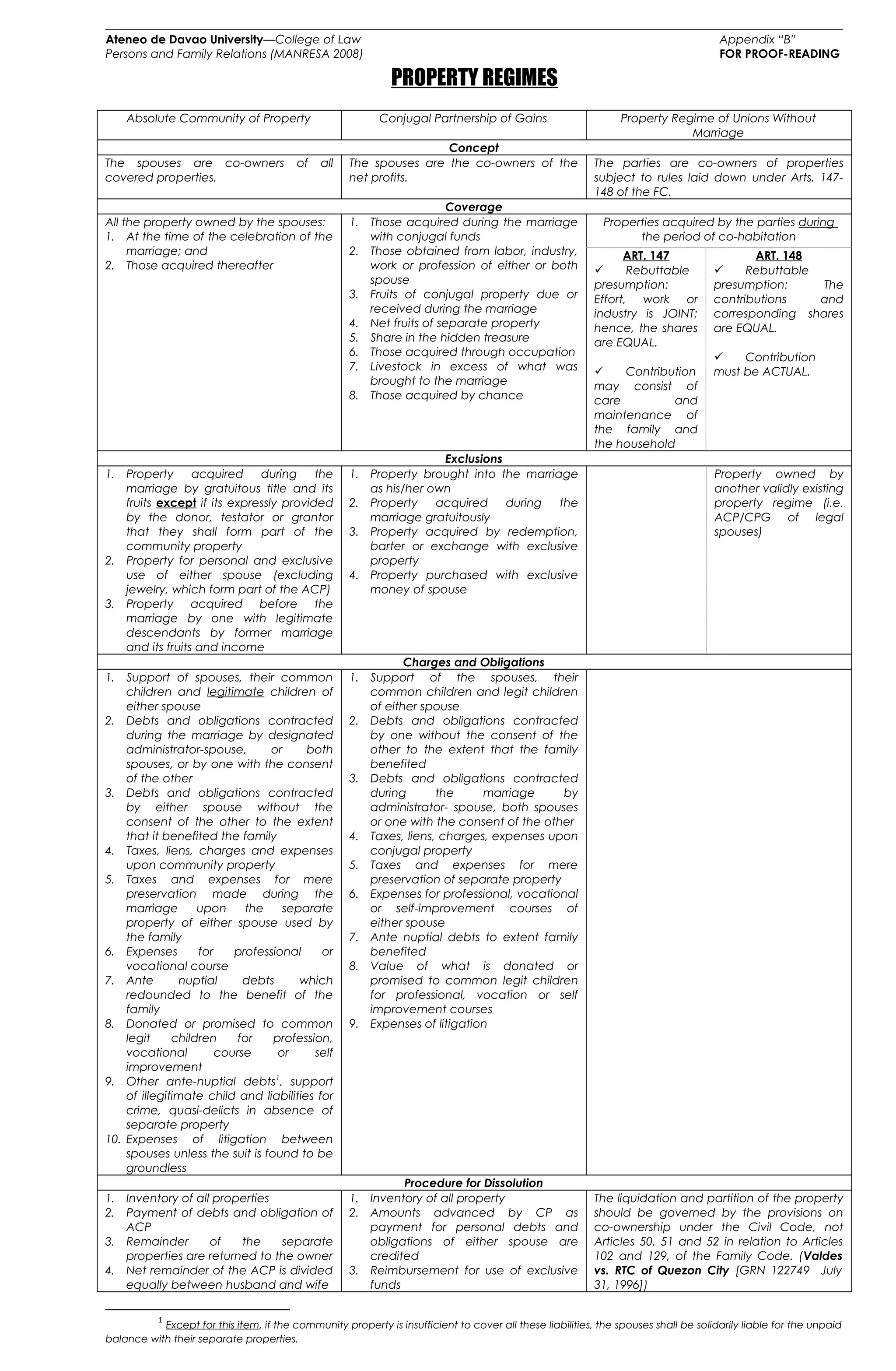
The following table provides a useful visual summary of the key differences.
4. Application: A Bar Exam Problem
Your background in law will make this practical application straightforward. Let's use the rules we've learned to solve a problem from the 2015 Philippine Bar Examinations.
2015 Bar Examination Suggested Answers
This resource presents a bar exam question and the suggested answer. It's a perfect test of your understanding of how to determine and apply the correct default property regime.
Read question II and its 'SUGGESTED ANSWER'. Pay close attention to the logical flow: the answer first determines the property regime based on the date of marriage before ruling on the validity of the sale.
The reasoning in the suggested answer is a model of legal analysis:
- Identify the facts: The marriage took place in 1989, and no marriage settlement was mentioned. The property was purchased by the husband before the marriage.
- Determine the regime: Since the marriage was after August 3, 1988, and there was no settlement, the default regime is the Absolute Community of Property (ACP).
- Apply the regime's rules: Under ACP (Article 91), property owned at the time of the marriage becomes community property.
- Reach the conclusion: The sale of community property without the other spouse's consent is void under Article 96 of the Family Code.
This problem perfectly illustrates why determining the correct default regime is the critical first step in resolving property disputes between spouses.
Conclusion
You have now completed the final piece of this module on how property regimes are established. We've seen that while couples have the freedom to choose their regime via a marriage settlement, the law provides a robust default system when they do not.
Key Takeaways:
- In the absence of a marriage settlement, the property regime is determined by the provisions of the Family Code.
- The governing default regime depends on the date of the marriage:
- Before August 3, 1988: Conjugal Partnership of Gains (CPG).
- On or after August 3, 1988: Absolute Community of Property (ACP).
- ACP is a system of "merger," where most pre-marital and all marital assets become co-owned.
- CPG is a system of "sharing gains," where spouses retain ownership of their pre-marital assets, and only the fruits and acquisitions during the marriage become common property.
Having established that ACP is the current default regime, our next lesson will begin a deeper exploration of its rules. We will move into the next module and address the learning outcome: Describe the composition of the absolute community of property (ACP) under Article 91.