Hello! Welcome to the next lesson in our course on Philippine marriage law.
In our previous session, we established the rules for the administration and disposition of the Absolute Community of Property (ACP), emphasizing the principle of joint management and the critical rule that a disposition without the other spouse's consent is void.
Now, we will address what happens when the marital union ends or is fundamentally altered. This lesson will explain the grounds for the dissolution of the ACP and the specific procedure for its liquidation. This process of "winding up" the financial affairs of the marriage is governed by strict rules, ensuring a just and orderly division of assets and liabilities.
1. Grounds for the Dissolution of the ACP
The Absolute Community of Property is co-terminus with the marriage itself. Therefore, the events that legally end or alter the marriage are the primary grounds for the dissolution of the ACP.
To begin, let's watch a segment that outlines these specific grounds as provided in the Family Code.
Family Code - Absolute Community Property
This video from 'Basic Philippine Law and Jurisprudence' provides a clear enumeration of the grounds for terminating the ACP under Article 99 of the Family Code.
Please watch from 00:31:54 to 00:33:31. The speaker details the four primary causes for the dissolution of the absolute community.
As explained in the video, Article 99 of the Family Code enumerates the grounds for the termination of the ACP:
- Upon the death of either spouse.
- When there is a decree of legal separation.
- When the marriage is annulled or declared void.
- In case of judicial separation of property during the marriage under Articles 134 to 138.
An Important Distinction: Separation in Fact
A common point of confusion is the effect of a de facto separation, where spouses simply decide to live apart without a court order. Does this dissolve the ACP? The Family Code is unequivocal on this matter.
The same video explains the rule and its exceptions.
Family Code - Absolute Community Property
Let's continue with the same video to understand the legal status of the ACP when spouses are separated in fact.
Please watch the segment from 00:33:31 to 00:36:12. Focus on the general rule that separation in fact does not affect the ACP and the specific exceptions listed in Article 100.
To summarize the key points from Article 100:
- General Rule: Separation in fact between the spouses shall not affect the regime of absolute community. The ACP continues to exist.
- Exceptions/Consequences:
- The spouse who leaves the conjugal home without just cause loses the right to be supported.
- For transactions requiring mutual consent, judicial authorization is needed if one spouse's consent cannot be obtained.
- The separate properties of both spouses become solidarily liable for family support if community property is insufficient.
Furthermore, Article 101 allows an aggrieved spouse to petition the court for receivership, judicial separation of property, or sole administration in cases of abandonment by the other spouse.
2. The Procedure for Liquidation: A Step-by-Step Guide
Once the ACP is dissolved by one of the grounds under Article 99, the law mandates a specific procedure for liquidation. This is the process of inventorying assets, paying debts, and dividing the net estate. The procedure is laid out in Article 102 of the Family Code.
The chart below provides a high-level overview of the liquidation process for both ACP and the Conjugal Partnership of Gains (which we will discuss in the next module).
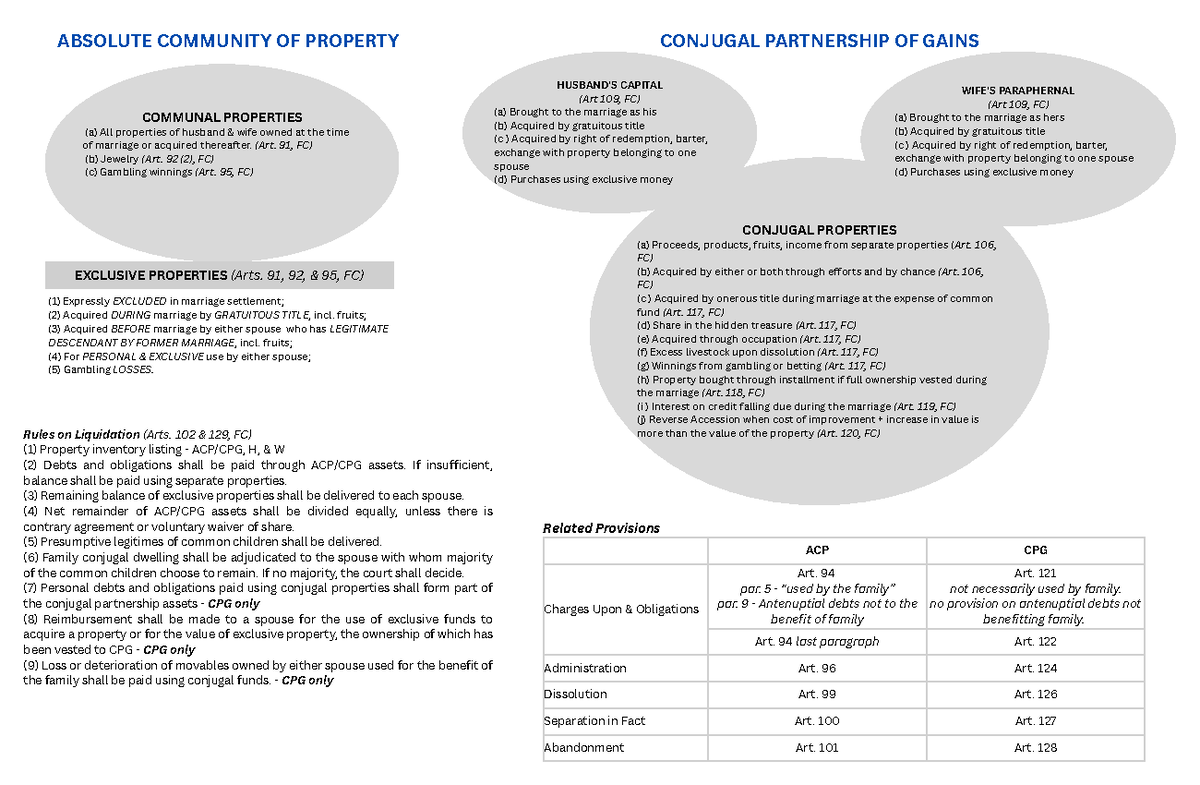
Now, let's dive into the details of each step. The following reading provides a clear and practical breakdown of the entire process, complete with helpful examples.
ACP Liquidation, A102 Family Code
The article 'ACP Liquidation, A102 Family Code' from Legal Resource PH meticulously walks through the six-step liquidation procedure mandated by law.
Please read the entire section titled '1. ACP Liquidation Procedure'. It is divided into six sub-sections, each corresponding to a step in Article 102. Pay close attention to the order of the steps, as it is mandatory.
Having completed the reading, let's synthesize the six steps of liquidation under Article 102:
- Prepare an Inventory: Create a list that separately identifies the community properties and the exclusive properties of each spouse.
- Pay Debts and Obligations: All debts of the absolute community are paid out of the community assets. If these are insufficient, the spouses' separate properties become solidarily liable for the balance.
- Return Exclusive Properties: Whatever remains of the exclusive properties of each spouse is delivered back to them.
- Divide the Net Remainder: The remaining community assets (the "net assets") are divided equally between the spouses, unless a different proportion was agreed upon in a marriage settlement or one spouse waived their share.
- Forfeiture: Note the rule on forfeiture. If a spouse acted in bad faith (e.g., in a void marriage under Art. 43) or is the offending spouse in a legal separation (Art. 63), their share in the net profits is forfeited in favor of the common children, children from a previous marriage, or the innocent spouse.
- Deliver Presumptive Legitimes: The presumptive legitimes of the common children are calculated and delivered to them in cash, property, or sound securities. This acts as an advance on their future inheritance.
- Adjudicate the Conjugal Dwelling: The family home is typically awarded to the spouse with whom the majority of the children choose to remain. The law presumes children below seven years of age choose the mother. If there is no majority, the court decides based on the children's best interests.
3. Jurisprudence: The Consequence of Non-Liquidation
Your law background will appreciate the practical importance of this next point. What happens if a surviving spouse enters a subsequent marriage without first liquidating the ACP of the first marriage? The Family Code imposes a strict penalty to prevent the co-mingling of assets from different marriages.
Let's examine a case that illustrates this rule.
Family Code - Absolute Community Property
We will return to the 'Basic Philippine Law and Jurisprudence' video to analyze the discussion of the 'Kabai versus Cis' case. This illustrates the consequences of failing to liquidate a prior property regime.
Please watch from 00:42:07 to 00:47:47. The speaker analyzes a complex scenario involving two marriages and an unliquidated property regime from the first, explaining how it impacts the validity of a subsequent sale and the property regime of the second marriage.
The Kabai case, interpreting the relevant provisions, highlights a critical rule (now primarily under Article 103 of the Family Code): If a surviving spouse remarries without liquidating the property of the prior marriage, the property regime for the subsequent marriage will mandatorily be a regime of complete separation of property.
This rule is designed to protect the interests of the heirs of the first marriage and prevent the assets due to them from being treated as part of the community property of the second marriage.
Conclusion
Today, we've mapped out the end-of-life process for the Absolute Community of Property. We identified the specific legal events that cause its dissolution and walked through the mandatory, six-step procedure for its liquidation.
Key Takeaways:
- Grounds for Dissolution: The ACP is terminated only by death, a decree of legal separation, annulment/nullity, or judicial separation of property. De facto separation is not a ground.
- Mandatory Liquidation Procedure: Upon dissolution, the six steps in Article 102 must be followed in order: inventory, payment of debts, return of separate property, division of net assets, delivery of presumptive legitimes, and adjudication of the family home.
- Forfeiture of Profits: A spouse in bad faith or an offending spouse in legal separation forfeits their share in the net profits of the community.
- Non-Liquidation Penalty: Remarrying without liquidating a prior marriage's property regime results in a mandatory regime of complete separation of property for the subsequent marriage.
The liquidation procedure you've just learned is foundational. In our next lesson, we will begin our study of the Conjugal Partnership of Gains (CPG), the default property regime for marriages celebrated before the Family Code. As we will see, while the composition of the CPG is different from the ACP, the procedure for its liquidation is virtually identical.