Hello! Welcome to our lesson.
In our previous session, we established the fundamental differences between the Absolute Community of Property (ACP) and the Conjugal Partnership of Gains (CPG). We highlighted that CPG was the default regime for marriages before August 3, 1988, and its core principle is forming a partnership of gains, where spouses retain exclusive ownership of property they bring into the marriage.
Today, we will build directly on that foundation. Our goal is to master the rules for identifying what constitutes conjugal partnership property versus the exclusive property of each spouse under the CPG regime. This involves a detailed look at the specific provisions of the Family Code that govern this classification.
1. The Starting Point: What is Exclusive Property?
Under the CPG, the partnership does not absorb pre-existing assets. Therefore, the logical starting point is to clearly define what each spouse owns exclusively. The Family Code lays this out in Article 109.
Let's watch a video segment that enumerates the categories of exclusive property.
Family Code - Conjugal Partnership of Gains
The following clip from the 'Basic Philippine Law and Jurisprudence' channel provides a clear, article-based explanation of what remains as exclusive property under the CPG.
Please watch the segment from 07:51 to 12:10. Focus on the four distinct categories of property that are excluded from the conjugal partnership.
As the video explained, Article 109 of the Family Code specifies that the following shall be the exclusive property of each spouse:
- Property brought to the marriage as his or her own. This is the most fundamental distinction from the ACP. Whatever you owned before getting married remains yours alone.
- Property acquired during the marriage by gratuitous title. This includes property received through inheritance or donation. The property is exclusive to the recipient spouse.
- Property acquired by right of redemption, by barter, or by exchange with property belonging to only one of the spouses. If you trade your exclusive property for another asset, that new asset is also exclusive. This is the principle of subrogation.
- Property purchased with the exclusive money of the wife or husband. Similar to the point above, if you use your separate funds to buy something, the resulting property is also separate.
2. The Partnership's Assets: What is Conjugal Property?
Now that we've cordoned off the exclusive properties, let's define the common fund. The "gains" in CPG are broadly defined and come from various sources. The next video segment details what constitutes conjugal property under Articles 106 and 117.
Family Code - Conjugal Partnership of Gains
This next segment details the composition of the conjugal partnership, covering everything from salaries to lottery winnings.
Please watch from 03:33 to 06:35 and then from 15:54 to 19:13. These sections identify the properties that form the common fund.
To summarize Articles 106 and 117, the following are considered conjugal partnership property:
- Proceeds, products, fruits, and income from their separate properties. This is a crucial rule. For example, the rent collected from an exclusive property or the dividends from exclusively owned stocks become conjugal.
- Those acquired by either or both spouses through their efforts or by chance. This is a broad category that includes:
- Anything obtained from their labor, industry, work, or profession (e.g., salaries, professional fees).
- Winnings from gambling, betting, or hidden treasures found during the marriage.
- Fruits (natural, industrial, or civil) due or received during the marriage from the common property.
3. The Rebuttable Presumption of Conjugality
In practice, tracing the source of every asset acquired during a long marriage can be difficult. To address this, the law establishes a powerful presumption.
Article 116 of the Family Code states: "All property acquired during the marriage, whether the acquisition appears to have been made, contracted or registered in the name of one or both spouses, is presumed to be conjugal unless the contrary is proved."
Let's watch a final clip that discusses this presumption and its importance in case law.
Family Code - Conjugal Partnership of Gains
This segment explains the legal presumption that property acquired during marriage is conjugal and the burden of proof required to overturn it.
Watch from 13:50 to 15:54. Note the legal effect of this presumption and who carries the burden of proof.
The key takeaway is that the party alleging a property is exclusive must prove it with "strong, clear, and convincing evidence." Simply having a title registered in one spouse's name is not enough to rebut the presumption. This rule is a cornerstone of jurisprudence on CPG, as seen in cases like Anastacio v. Coloma and Malabanan v. Malabanan.
4. Synthesizing the Rules
To bring these rules together, let's look at a comparative table. While it shows other regimes, focus your attention on the column for Conjugal Partnership of Gains.
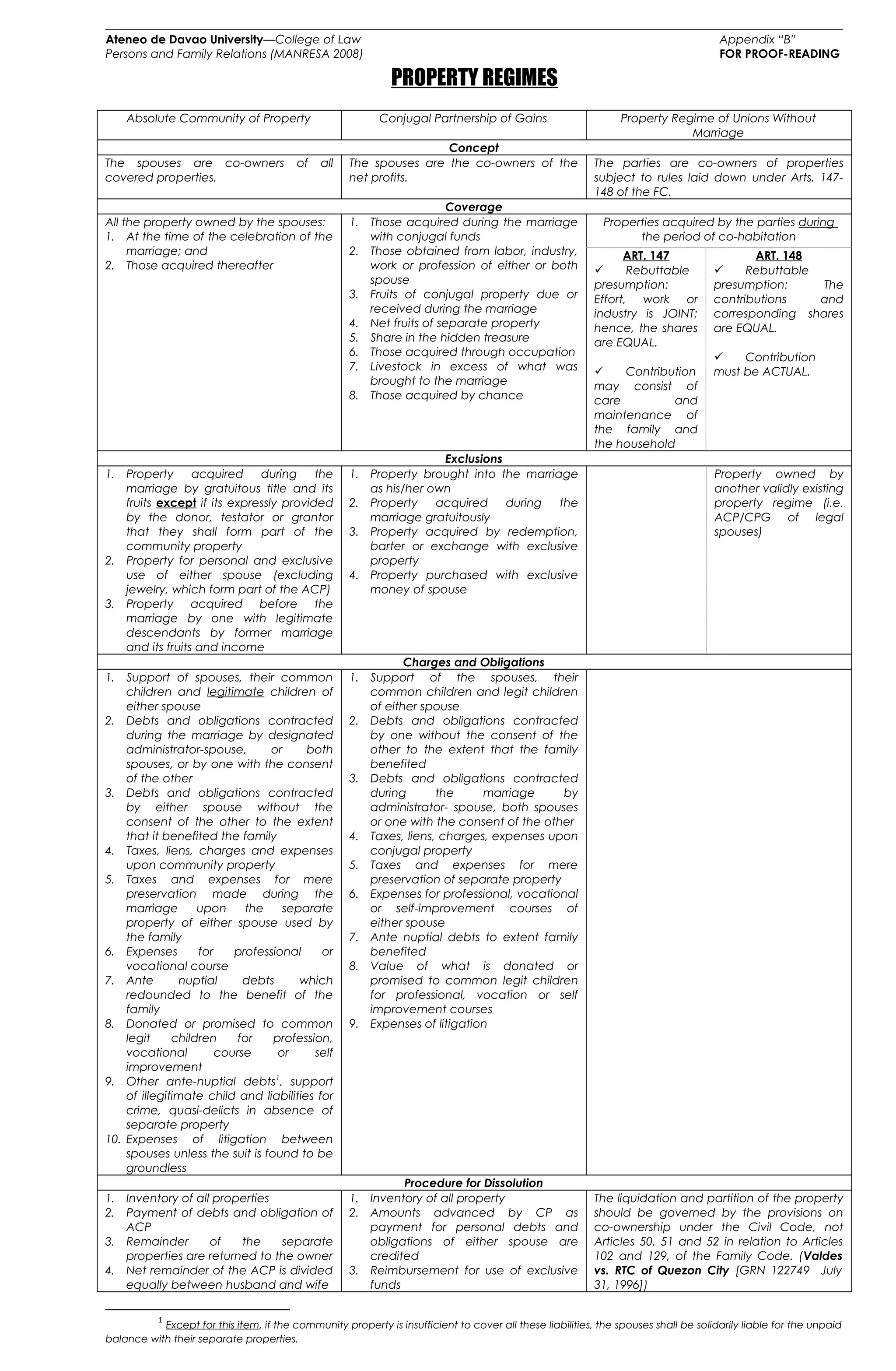
5. Application: A Short Problem
Given your background, applying these rules to a factual scenario is the best way to test your understanding.
Scenario:
Spouses Harry (H) and Wendy (W) were married in 1985 without a marriage settlement. During their marriage, the following assets were acquired:
- A condominium unit that H owned before the marriage.
- Monthly rental income of P30,000 from H's condominium unit.
- A parcel of land that W inherited from her father in 1990.
- The salary H earned as a surgeon.
- P1 million in lottery winnings won by W in 1992.
- A family car purchased in 1993 using W's lottery winnings.
Task: Classify each of the six items as either Exclusive Property (and of whom) or Conjugal Property.
Answers and Explanations:
- Condominium Unit: Exclusive Property of H. Property brought into the marriage remains exclusive under CPG (Art. 109(1)).
- Rental Income: Conjugal Property. The fruits and income from separate properties, received during the marriage, are part of the conjugal partnership (Art. 117(3)).
- Parcel of Land: Exclusive Property of W. Property acquired during the marriage by gratuitous title (inheritance) is exclusive (Art. 109(2)).
- Salary: Conjugal Property. Anything obtained from the labor, industry, work, or profession of either spouse is conjugal (Art. 117(1)).
- Lottery Winnings: Conjugal Property. Winnings from gambling or betting acquired by chance during the marriage are conjugal (Art. 117(7)).
- Family Car: Conjugal Property. While it was bought using W's winnings, the winnings themselves became conjugal property the moment they were acquired. Therefore, the car was purchased with conjugal funds.
Conclusion
In this lesson, we have dissected the composition of the Conjugal Partnership of Gains. You are now equipped to distinguish between exclusive and conjugal assets based on the specific rules laid out in the Family Code.
Key Takeaways:
- Exclusive Property (Art. 109): Includes assets owned before marriage, acquired by gratuitous title, or acquired through exchange with other exclusive property/funds.
- Conjugal Property (Arts. 106, 117): Comprises income from work/profession, fruits from both exclusive and conjugal properties, and acquisitions by chance.
- The Presumption (Art. 116): Property acquired during the marriage is presumed conjugal. The burden to prove otherwise is on the person claiming exclusivity.
Now that we have a firm grasp of what constitutes the conjugal partnership property, our next lesson will address the logical follow-up question: How is this property managed? We will explore the rules on the administration, disposition, and encumbrance of conjugal assets.