Hello! Welcome back.
In our last lesson, we examined the principles of joint decision-making for fixing the family domicile and managing the household. We saw how Articles 69 and 71 of the Family Code established a partnership of equals, moving away from outdated, unilateral models of authority within a marriage.
Today, we continue exploring this theme of spousal equality by focusing on a crucial aspect of modern life: professional and economic activity. Our learning outcome is to analyze the rules governing the right of either spouse to exercise a profession or occupation. We will dissect Article 73 of the Family Code, which balances individual autonomy with the collective interest of the family.
1. The Right to a Profession: A Rule of Equality
The Family Code is unequivocal about the right of each spouse to pursue a career. The old paradigm, where a husband could effectively veto his wife's professional aspirations, has been completely abandoned. This modern principle is captured well in the following image.
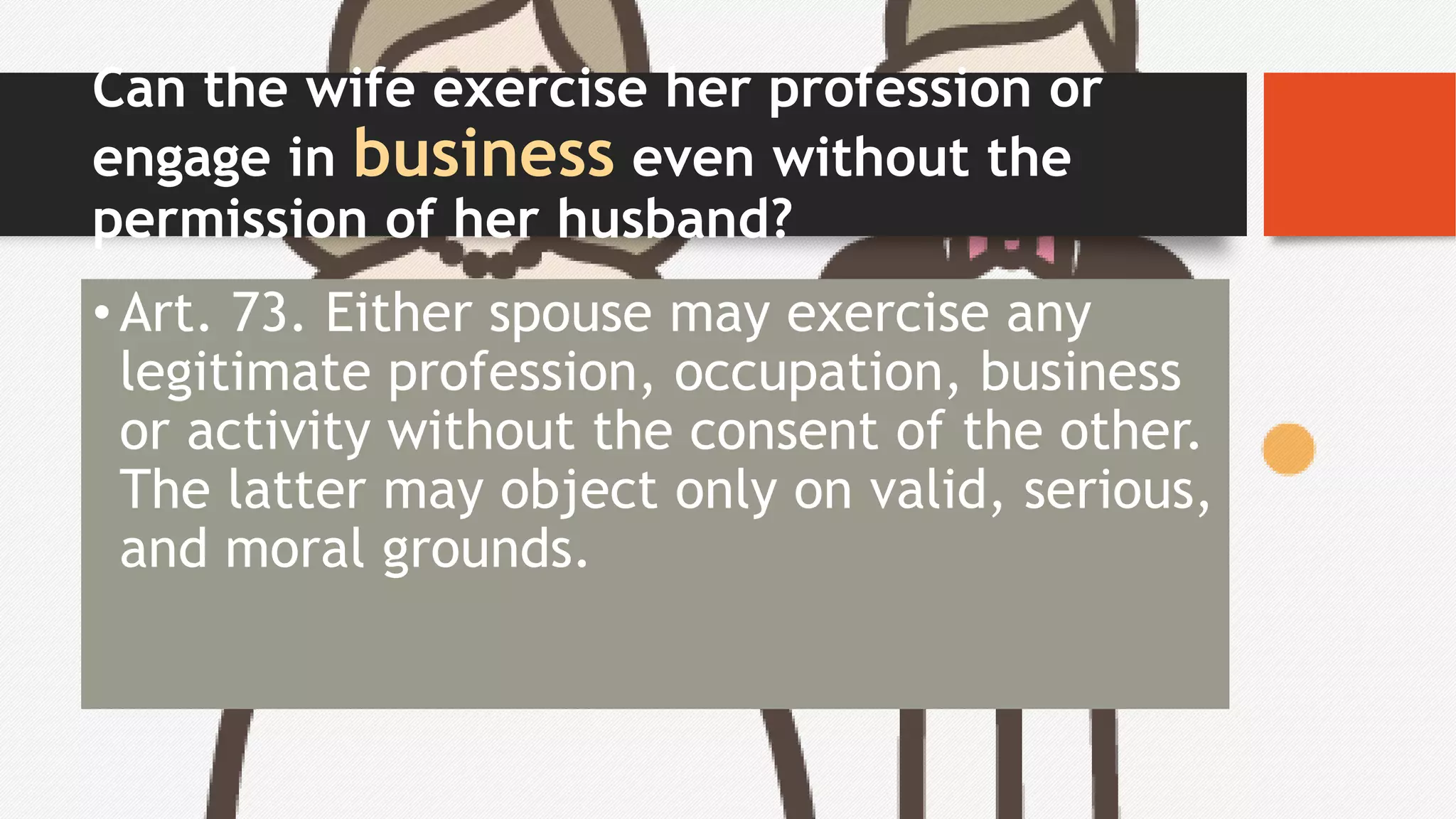
The image directly references Article 73, which is the cornerstone of our lesson today. Let's read the full text of this provision to understand its scope and nuances.
Marital Obligations, A68-73 Family Code
The article 'Marital Obligations, A68-73 Family Code' from Legal Resource PH provides the full and amended text of Article 73. Please focus on the wording that establishes the right, the grounds for objection, and the procedure for resolving disputes.
Please read the section under the heading 'd. To exercise legitimate profession, occupation, business', which contains the full text of Article 73 of the Family Code.
As you've read, Article 73 establishes two core ideas: the right to work is inherent, but it is not absolute. Let's break down its components.
2. Deconstructing Article 73
a. The General Rule
The first sentence lays down the clear, default rule:
"Either spouse may exercise any legitimate profession, occupation, business or activity without the consent of the other."
This provision codifies the economic and professional autonomy of each spouse. The consent of the other is not a prerequisite. The only initial limitation is that the activity must be "legitimate"—that is, lawful.
b. The Exception: Grounds for Objection
The right to work is not absolute if it conflicts with the welfare of the family. The other spouse may object, but only on specific grounds:
"The latter may object only on valid, serious, and moral grounds."
The law sets a high bar for a valid objection. It cannot be based on a spouse's mere whim, jealousy, or personal preference. Let's consider what these grounds might entail:
- Valid: The objection must have a basis in law or fact that is material to the family's well-being. For example, if the profession would disqualify the family from a benefit it currently enjoys.
- Serious: The objection must relate to a grave concern, not a trivial one. For instance, a job that poses a clear and present danger to the spouse's life or to the family's safety, or one that requires such prolonged absence that it would endanger family solidarity (connecting back to our discussions on cohabitation).
- Moral: The objection must be based on the profession being contrary to public morals. Examples could include working in an establishment connected to illegal gambling or prostitution.
c. Court Intervention and Financial Consequences
If the spouses cannot agree, the court's intervention is required. The court will decide two things:
- Whether the objection is proper: The court will evaluate if the objection meets the "valid, serious, and moral" standard.
- The financial consequences of the activity: This is where the law becomes particularly interesting, as it determines which set of assets will be liable for obligations arising from the disputed profession.
The rule is as follows:
- If a benefit (and a corresponding obligation, like a loan for capital) accrued before the objection was raised, the obligation is chargeable to the community property (or conjugal partnership). The logic is that the family stood to benefit, so the family's common property should be liable.
- If a benefit accrued after the objection was raised (and the court later upholds the objection), the obligation is chargeable to the separate property of the spouse who pursued the activity. Here, the spouse proceeded at their own risk against a valid objection, so their personal property should answer for any resulting debts.
Finally, the article protects "creditors who acted in good faith." A supplier or lender who transacted with the working spouse is entitled to be paid. Article 73 simply governs which property—community or separate—the payment will be sourced from.
3. Application: A Hypothetical Case
Let's apply these rules to a scenario.
Scenario: Carla, a physician with a background in epidemiology, is offered a two-year contract with a global health organization to work in a region experiencing a dangerous viral outbreak. The job is prestigious and pays extremely well, but the risk of infection is high. Her husband, Marco, objects, fearing for her safety and the potential emotional trauma to their young children. Carla, feeling a professional and moral calling, accepts the position. To prepare, she takes out a substantial loan to purchase specialized protective gear and medical equipment.
How does Article 73 apply?
- Grounds for Objection: Marco can object on serious grounds—namely, the grave and demonstrable risk to Carla's life and the potential negative impact on the family's emotional well-being.
- Court Action: Since they disagree, Marco can petition the court. The court will determine if his objection is proper. Given the circumstances, a court could find the fear for her safety to be a serious and valid concern.
- Financial Liability:
- Let's assume the court upholds Marco's objection. Because Carla took the loan after Marco objected, the debt would be enforced against her separate property. The family's community assets would be protected.
- Conversely, if the court finds the objection improper (perhaps concluding the risks were manageable and the career opportunity was a significant benefit to the family), the loan would be chargeable against the community property.
- Creditor's Rights: Regardless of the outcome between Carla and Marco, the company that supplied the equipment (the creditor) acted in good faith and has the right to collect on the loan. The court's decision only determines which of the spouses' properties will be used to pay the creditor.
This scenario highlights how Article 73 provides a structured legal process for balancing a spouse's individual professional fulfillment against the fundamental duty to protect the family's welfare.
Conclusion
In this lesson, we have analyzed the right of a spouse to engage in a profession, a key component of the marital partnership.
Key Takeaways:
- Either spouse has the right to exercise any legitimate profession or business without the other's consent (Article 73).
- An objection to this right is only valid if it is based on "valid, serious, and moral grounds."
- In case of disagreement, the court will decide if the objection is proper.
- The financial liability for obligations arising from the disputed profession depends on whether the benefit accrued before or after the objection, affecting whether community or separate property will be used.
This discussion on how professional activities impact community and separate property serves as a perfect bridge to our next module. Having covered the personal rights and obligations between spouses, we will now shift our focus to the financial dimension of marriage: the different property regimes that govern a couple's assets. We will begin by exploring the role of marriage settlements and the default systems of property relations.