Welcome to the final lesson in our course on building your Meta Ads scaling playbook. In our last session, we established the specific KPI thresholds that trigger your scaling actions, creating the "Rules of Engagement" for your playbook. You now have clear, data-driven rules for when to increase budget or expand your audience.
However, scaling is not just about turning up the budget; it's about sustaining performance as you grow. The single biggest threat to sustained performance at scale is creative fatigue. This is where your audience sees your ads too often and simply stops responding. Without a system to combat this, your carefully scaled campaigns will inevitably decline.
Today, we will build the final, crucial component of your playbook. This lesson directly addresses the learning outcome: Document a standard operating procedure (SOP) for integrating creative refresh cycles into scaled campaigns. We will create a repeatable system that ensures your scaling engine is constantly fueled with fresh, high-performing creative, making your growth both predictable and profitable.
The Inevitability of Creative Fatigue
Before we build the SOP, it's vital to understand the problem we're solving. Creative fatigue isn't a sign of failure; it's a natural and guaranteed consequence of successful advertising. The more you spend, the faster it happens.
Your job isn't to prevent fatigue entirely, but to manage it proactively. To do that, you first need to recognize its warning signs.
How Creative Fatigue Kills Meta Performance
This article from Advisible provides an excellent overview of creative fatigue and, most importantly, its early warning signs.
Read the introduction, the section "What Is Creative Fatigue and Why Does It Matter," and pay close attention to the list in "The Early Warning Signs of Creative Fatigue." These are the reactive triggers you need to monitor.
As the article highlights, you can't fix tired creative by adjusting your budget. The solution is a new creative. The key metrics that signal fatigue are:
- Rising Frequency: Your audience is seeing the same ad more often. In prospecting, a frequency climbing past 3.0 is a red flag.
- Dropping Click-Through Rate (CTR): People are no longer stopping to engage with your ad.
- Climbing CPMs (Cost Per Mille): Meta charges you more to show an ad that users are ignoring.
- Increasing Cost Per Acquisition (CPA): Your efficiency drops as the creative loses its power to persuade.
- Negative Social Proof: You see comments like "I've seen this ad 10 times."
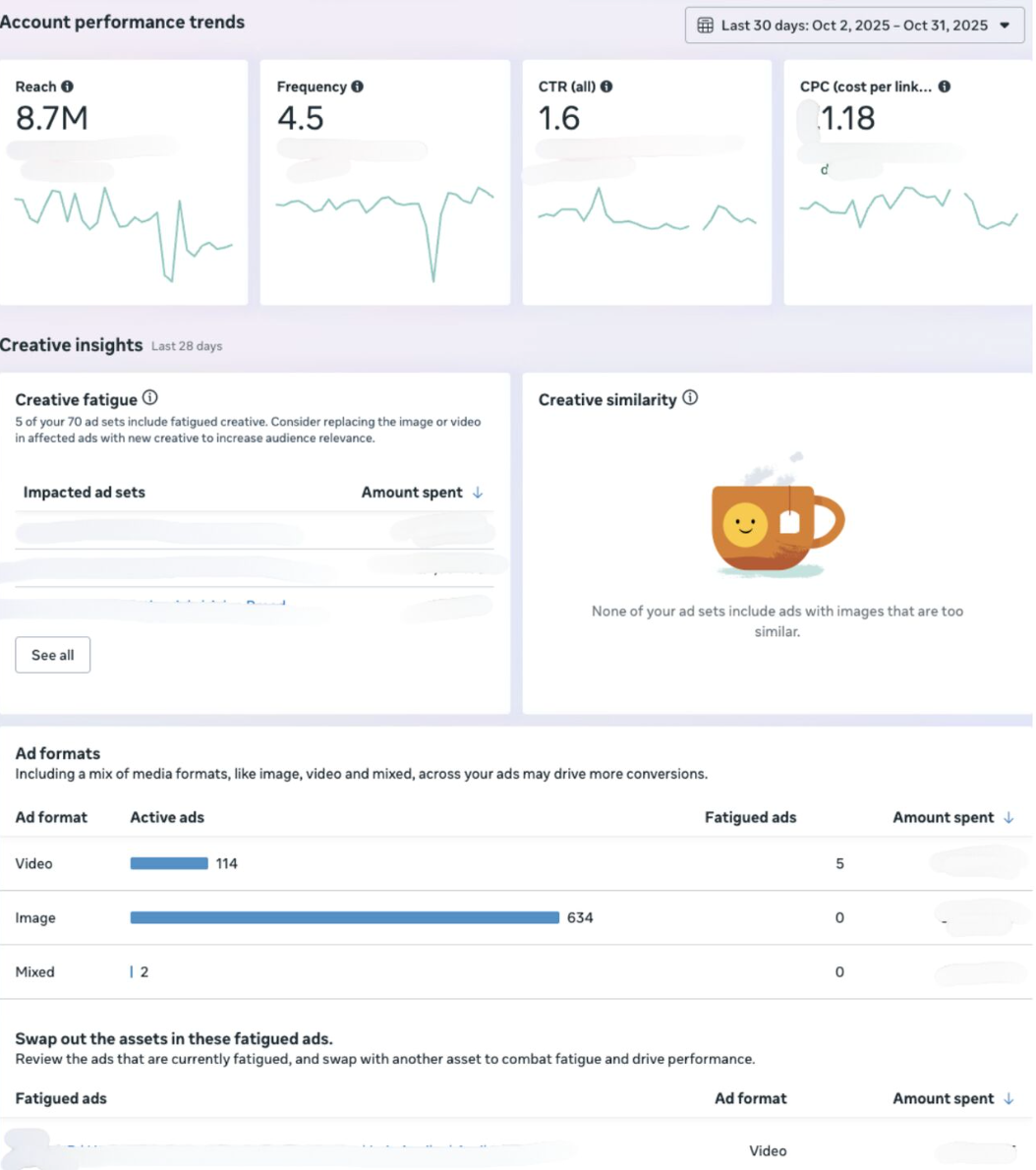
Part 1: Your Creative Refresh SOP - The "When"
Monitoring the metrics above is a reactive approach. A professional playbook relies on a proactive system. You should be introducing new creative before performance crashes, not after.
Your SOP should define a proactive refresh cadence.
Preventing Creative Fatigue in Meta Ads
This LinkedIn post by Tom Anderson offers a powerful insight: your refresh cadence should match your spending velocity.
Read the opening section that outlines the "3-layer prevention system" and the section that begins "Your Meta creatives aren’t failing randomly." Note the relationship between spend, creative supply, and burnout speed.
Based on this, the first part of your SOP is the refresh trigger.
SOP Section 1: Refresh Cadence
- Baseline Cadence: We will introduce a new batch of creative concepts into our testing campaign every 2-4 weeks, regardless of performance.
- Accelerated Cadence: This cadence accelerates based on daily ad spend.
- At $1,000/day, new creative is tested weekly.
- At $5,000/day, new creative is tested every 3-4 days.
- At $10,000/day or more, new creative is tested continuously (every 1-2 days).
- Reactive Trigger: If any scaled campaign shows 2 or more signs of creative fatigue for 3+ consecutive days (e.g., CPA up 20% and CTR down 20%), an immediate creative refresh is prioritized for that campaign.
Part 2: Your Creative Refresh SOP - The "What"
Knowing when to refresh is half the battle. Knowing what to create is the other. Your SOP needs a system for generating new ideas that have a high probability of success. This system is often called a "creative flywheel" or a growth cycle.
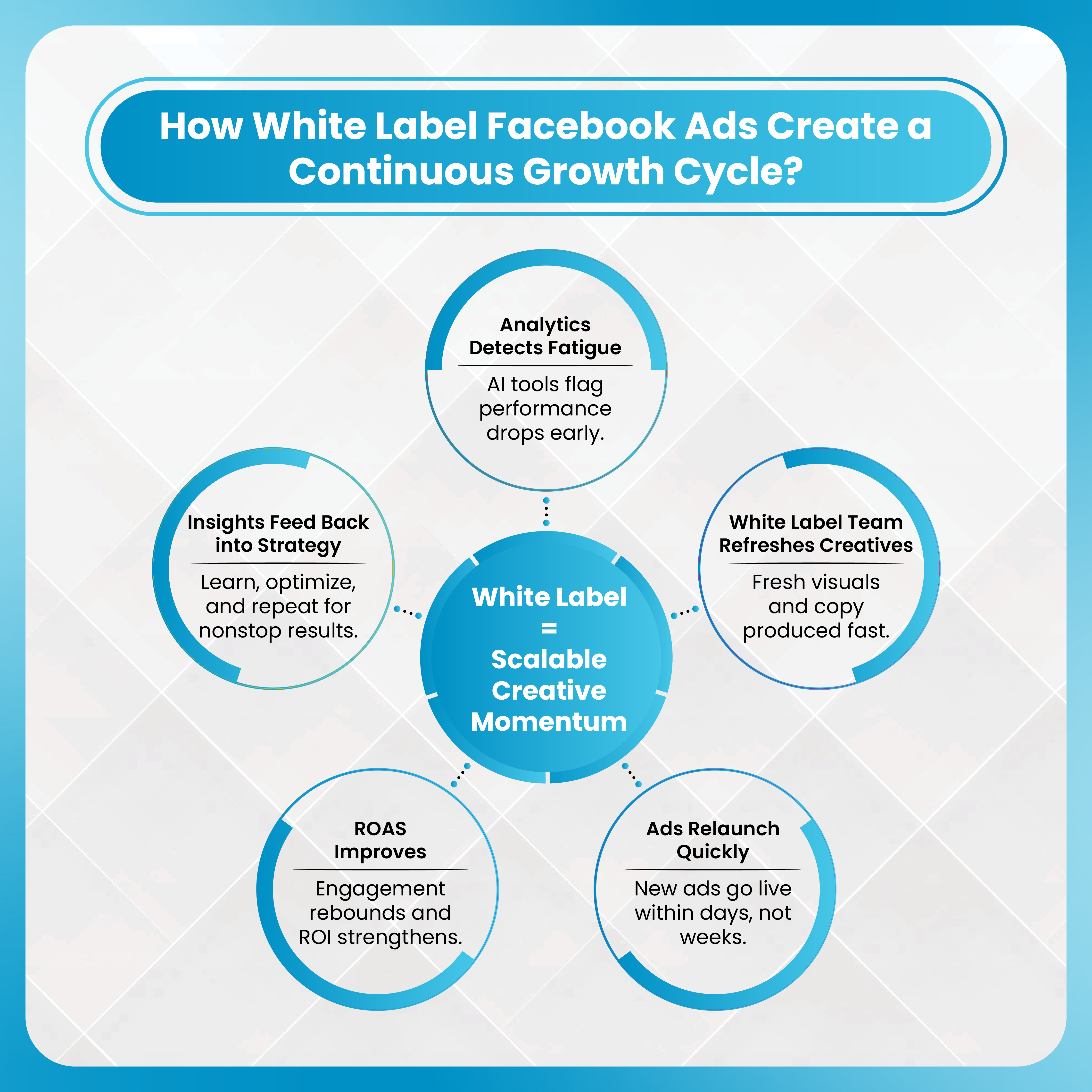
Your SOP for creative ideation should draw from two primary sources: your own data and your competitors' successes.
The Best Facebook Ad Creative Strategy for 2026
Sam Piliero's video on creative strategy outlines this "flywheel" concept perfectly, covering how to find inspiration and how to analyze your own winners to fuel the next cycle.
First, watch the introduction to the creative flywheel concept. Then, see how he uses competitor research for inspiration. Finally, watch the section on analysis to understand how to identify and iterate on your own winning concepts.
SOP Section 2: Creative Ideation & Development
-
Analyze Internal Winners (Iterate):
- On a weekly basis, sort all ads in the main scaling campaign by "Amount Spent" over the last 14 days.
- Identify the top 1-3 ads that have high spend and are performing above the target ROAS/below the target CPA.
- These are your "winning concepts." For each winner, develop a batch of micro-variations and angle pivots for the next testing cycle.
-
Analyze External Winners (Remix):
- On a bi-weekly basis, use the Meta Ad Library to research 3-5 direct and aspirational competitors.
- Filter to see ads that have been running the longest (30+ days). These are their proven winners.
- Do not copy these ads. Instead, "remix" the underlying concept: What angle are they using? What pain point are they highlighting? How is their visual structured? Use these insights to develop entirely new concepts for your brand.
-
Structure the Creative Batch: Each new testing batch should contain a strategic mix of creative diversity. Referencing Tom Anderson's 3-layer system, a batch should include:
- Micro-variations: Small changes to a proven ad (e.g., new first 3 seconds, different headline, new background music).
- Angle Pivots: A new message for the same product (e.g., shifting from a "save time" benefit to a "save money" benefit).
- Format Rotations: A mix of formats targeting the same concept (e.g., a static image, a Reel-style video, and a carousel).
Part 3: Your Creative Refresh SOP - The "How"
You have your triggers and your new creative ideas. Now, how do you safely test them in a live, scaled account without disrupting your profitable campaigns? Your playbook needs a precise testing protocol.
The industry best practice is a two-campaign structure:
- A CBO Scaling Campaign: Contains only your proven, winning ads.
- A CBO Testing Campaign: Where all new creative is launched and validated.
A common problem is that in a CBO testing campaign with many ad sets, new ones often don't get enough budget to be properly tested. We need to solve this.
The New Meta Ads Creative Testing Framework for 2026
This video from Ole Strand provides the most critical and nuanced part of the testing protocol: how to balance trusting the algorithm while ensuring new creative gets a fair shot.
Watch his explanation of why you should trust Meta's algorithm at the ad level. Then, pay close attention to the crucial caveat: you must force spend at the ad set level to test new batches. He shows you exactly how to do this using ad set spending limits. Finally, listen to his summary of the strategy.
This leads us to the final, most tactical part of your SOP.
SOP Section 3: Creative Testing Protocol
- Campaign Setup: All new creative will be launched into a dedicated CBO Testing Campaign, separate from our main CBO Scaling Campaign.
- Batch Launch: Launch each new batch of 4-8 creative variations inside a new ad set within the testing campaign.
- Force Spend: To ensure the new batch is tested, set an ad set minimum daily spend limit.
- Rule: The minimum spend will be equal to 1x our target CPA. (e.g., if target CPA is $50, the minimum is $50/day).
- Duration: This minimum spend limit will run for 7 consecutive days to gather data across a full week. It will be removed after 7 days.
- Analysis & Graduation:
- During the 7-day test, do not turn off individual ads within the ad set, even if they have low spend. Trust the algorithm to prioritize within the batch.
- After 7 days, review the performance of the ad set.
- If any single creative within the ad set has generated significant spend and is performing at or better than the target CPA/ROAS, it is declared a "winner."
- "Graduation": Winning creatives are duplicated and moved into the main CBO Scaling Campaign to run alongside other proven ads.
- The original testing ad set is then turned off. Learnings from the test (both winners and losers) are documented and used to inform the next creative ideation cycle.
Conclusion: Your Playbook is Complete
Congratulations! You have just documented the engine of your scaling machine. This SOP for creative refresh cycles ensures you have a predictable system for combating creative fatigue and consistently feeding your campaigns with new, high-potential ads. When combined with the scaling triggers from our last lesson, your playbook is now a comprehensive guide to profitable growth.
Key Takeaways from this Lesson:
- Proactive vs. Reactive: Don't wait for performance to crash. Implement a proactive refresh cadence based on your daily ad spend.
- The Creative Flywheel: Systematically generate new ad ideas by iterating on your internal winners and remixing successful concepts from your competitors.
- Strategic Diversity: Ensure each new batch of creative includes a mix of micro-variations, new angles, and different formats.
- The Testing Protocol: Use a separate CBO testing campaign and enforce a minimum daily spend on new ad sets for 7 days to give them a fair test before graduating winners to your main scaling campaign.
You have now constructed a complete, reusable scaling playbook from foundation to execution. You have the strategic framework, the operational rules, the growth engine, and the safety nets. Your goal is within reach. The next step is to put this playbook into action, continually refining it with real-world data to drive your performance marketing efforts forward.