Hello! In our last lesson, we established a static framework for allocating your Meta Ads budget, separating spend into distinct campaigns for prospecting and retargeting based on your business stage. This structure gives you essential strategic control.
Today, we'll make that framework dynamic. The goal of this lesson is to learn how to adjust your budget ratios between prospecting and retargeting based on real-time performance data and audience saturation signals. Mastering this will allow you to continuously optimize for profitability, ensuring your scaling efforts remain efficient and sustainable. This is a key skill for building a robust scaling playbook.
From Static Ratios to Dynamic Flow
While baseline ratios like 70/30 are excellent starting points, they fail to adapt to the ever-changing dynamics of your ad account. A successful scaling strategy requires thinking not in fixed "buckets," but in terms of a constant "flow" of potential customers.
To understand this, let's start with a foundational article.
Facebook Prospecting vs Retargeting Budget Strategy
This article from LeadEnforce introduces the core concepts of why fixed budget ratios often fail and frames the relationship between prospecting and retargeting.
Please read the introduction and the sections titled "The Functional Difference Between Prospecting and Retargeting" and "Why Fixed Budget Ratios Often Fail." Focus on the idea that prospecting generates inflow while retargeting maximizes yield.
As the article highlights, the two campaign types serve different functions. Prospecting fills the top of your funnel with new users, while retargeting converts the interest you've already generated. The critical mistake is over-investing in retargeting to the point of "saturation," where you're showing ads to the same limited audience repeatedly with diminishing returns.
Identifying Audience Saturation: Your Key Signals
Your most important task is to identify when your retargeting audience is saturated. Pouring more budget into a saturated audience is like over-watering a plant—it doesn't help it grow faster and can even harm it by driving up costs.
There are two primary metrics you will use to diagnose saturation: Frequency and CPM.
1. Frequency
Frequency tells you the average number of times a person in your target audience has seen your ads within a specific time frame. For retargeting, once this number gets too high, you're likely experiencing ad fatigue and wasting money. But what is "too high"?
Let's get some practical benchmarks from an expert.
How To Overcome Facebook Ad FATIGUE
In his video "How To Overcome Facebook Ad FATIGUE," Ben Heath provides clear guidelines for interpreting the frequency metric.
Watch the segment from "Look at your frequency number". Pay close attention to the different frequency thresholds he suggests for cold audiences (prospecting) versus warm audiences (retargeting).
As Ben Heath explains, the acceptable frequency for retargeting is much higher than for prospecting, but it still has its limits.
- Prospecting: A frequency above 2.0-2.5 can be an early warning sign.
- Retargeting: This depends on the audience's intent. Website visitors might fatigue with a frequency of 5, while cart abandoners might tolerate a frequency of 10 or more. The key is to watch for the point where your performance (CPA/ROAS) degrades as frequency rises.
2. Cost Per Mille (CPM)
CPM measures the cost to show your ads 1,000 times. In a saturated retargeting audience, CPM will often rise sharply. This happens because the audience pool is small and finite. To spend the increased budget, Meta's algorithm must bid more aggressively to win ad placements to show to the same limited group of people, driving up your costs.
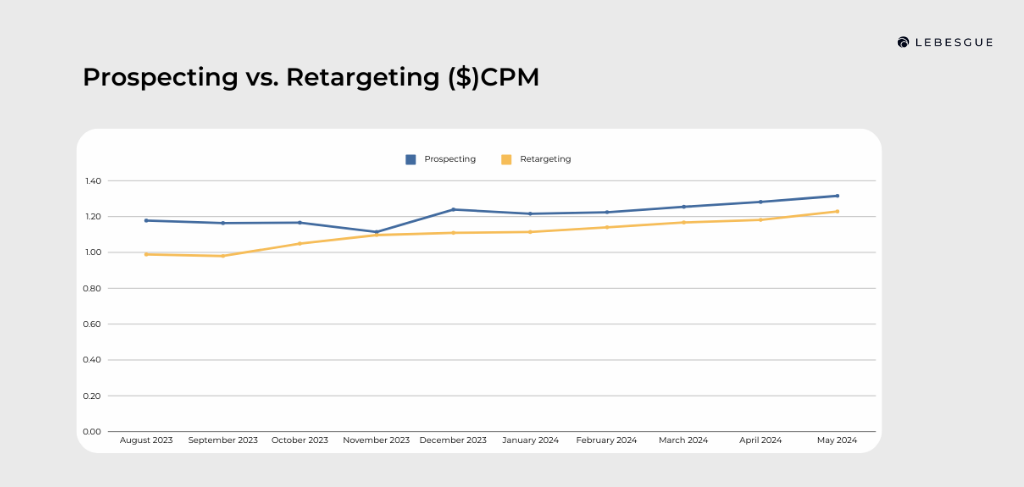
If you see your retargeting CPM climbing significantly while your prospecting CPM remains stable, it's a strong indicator that you are saturating your warm audience.
A Dynamic Framework for Budget Adjustments
Now that you can identify the signals, you can build a decision framework. Instead of asking, "What's the right ratio?" you should ask, "Where is the structural constraint in my system right now?"
Is the constraint inflow (you don't have enough new potential customers) or is it yield (you aren't converting the potential customers you already have)? The answer tells you where to shift your budget.
Let's return to the LeadEnforce article for a clear framework.
Facebook Prospecting vs Retargeting Budget Strategy
This article outlines specific scenarios that tell you when to prioritize one campaign type over the other.
Read the sections "When Prospecting Should Dominate Budget," "When Retargeting Deserves More Budget," and the conclusion, "The Strategic Shift: Think in Flow, Not Buckets."
Let's consolidate this into a clear decision-making guide.
Shift Budget TO PROSPECTING When:
- Retargeting Frequency is high and performance is stalling (e.g., CPA is rising).
- Retargeting CPM is increasing disproportionately compared to prospecting.
- Your overall website traffic growth has slowed, indicating a lack of new users entering the funnel.
- Your goal is to expand into new markets or launch new offers.
In these cases, the constraint is inflow. You need to feed the machine with new, qualified users.
Shift Budget TO RETARGETING When:
- Prospecting is generating strong, cheap traffic, but your overall conversion rate is low.
- You have a high volume of mid-funnel actions (e.g., Add to Carts) but a low purchase rate.
- Retargeting Frequency is low, indicating your warm audiences have the capacity to absorb more budget without immediate saturation.
- You are running a short-term promotional campaign (e.g., a flash sale) where you want to maximize conversions from your most engaged audiences.
In these cases, the constraint is yield. You have enough traffic, but you need to do a better job converting it.
Practical Guidelines for Reallocation
When you make these adjustments, it's important to do so in a disciplined way that doesn't disrupt Meta's algorithm.
Facebook Campaign Budget Allocation: Complete Guide
This guide from AdStellar provides practical advice on the cadence and process of budget reallocation.
Read the sections "Step 4: Allocate Budget Across Your Campaign Funnel" and "Step 5: Implement Daily Monitoring and Weekly Reallocation Cycles." Focus on the advice regarding frequency caps, the audience-to-budget ratio, and the importance of a weekly review cycle.
Here are the key tactical rules for adjusting your budgets:
- Review Weekly, Adjust Weekly: Look at your data daily to spot trends, but only make budget changes once a week. This gives the algorithm stability and provides you with enough data to make informed, non-reactive decisions.
- Make Incremental Changes: Avoid drastic budget shifts. Increase or decrease budgets in increments of 20-30% at a time. This helps prevent your campaigns from being forced back into the learning phase.
- Use ABO for Control: As we've discussed, using Ad Set Budget Optimization (ABO) for your retargeting campaigns gives you precise control, ensuring you don't overspend on a small, saturated audience. This is crucial when managing finite audience pools.
Conclusion
You've now upgraded your static budget framework to a dynamic, responsive system. By monitoring performance data and saturation signals, you can intelligently shift your investment to where it will have the greatest impact, ensuring you maintain profitability as you scale.
Key Takeaways:
- Move beyond fixed budget ratios and think in terms of inflow (prospecting) and yield (retargeting).
- Diagnose retargeting audience saturation by monitoring Frequency and CPM. Rising metrics are a red flag.
- Shift budget to prospecting when your retargeting campaigns are saturated and you need more new customer inflow.
- Shift budget to retargeting when you have strong traffic but weak conversion, and your warm audiences have capacity.
- Implement changes incrementally (20-30%) and on a weekly review cycle to maintain campaign stability.
In our next lesson, we will bring together everything we've learned in this module. You will learn how to synthesize performance data to make a final go/no-go decision on scaling a specific campaign. This will serve as the capstone of our work on maintaining profitability at scale and will be a critical component of your scaling playbook.