Hello! In our last lesson, we constructed a powerful framework for developing a creative iteration roadmap. You learned how to turn performance data into testable hypotheses and use the 60-30-10 budget rule to systematically improve your ads. This sets up a continuous cycle of optimization.
However, even the most successful ad has a finite lifespan. Today, we'll tackle the inevitable challenge of creative decay. This lesson is dedicated to helping you establish a data-driven creative refresh cadence by identifying the clear indicators of creative fatigue. Mastering this will ensure your campaigns remain profitable and prevent the sudden performance drops that can derail scaling efforts.
1. The Inevitable Lifecycle of a Winning Ad
In performance marketing, it's easy to fall into the trap of finding a "winning creative" and trying to ride it for as long as possible. As you know from experience, this strategy always ends the same way: a period of great results followed by a slow, then rapid, decline. This phenomenon is called creative fatigue.
Creative fatigue occurs when your target audience has seen your ad so many times that they become "blind" to it, leading to lower engagement and, consequently, poorer performance and higher costs.
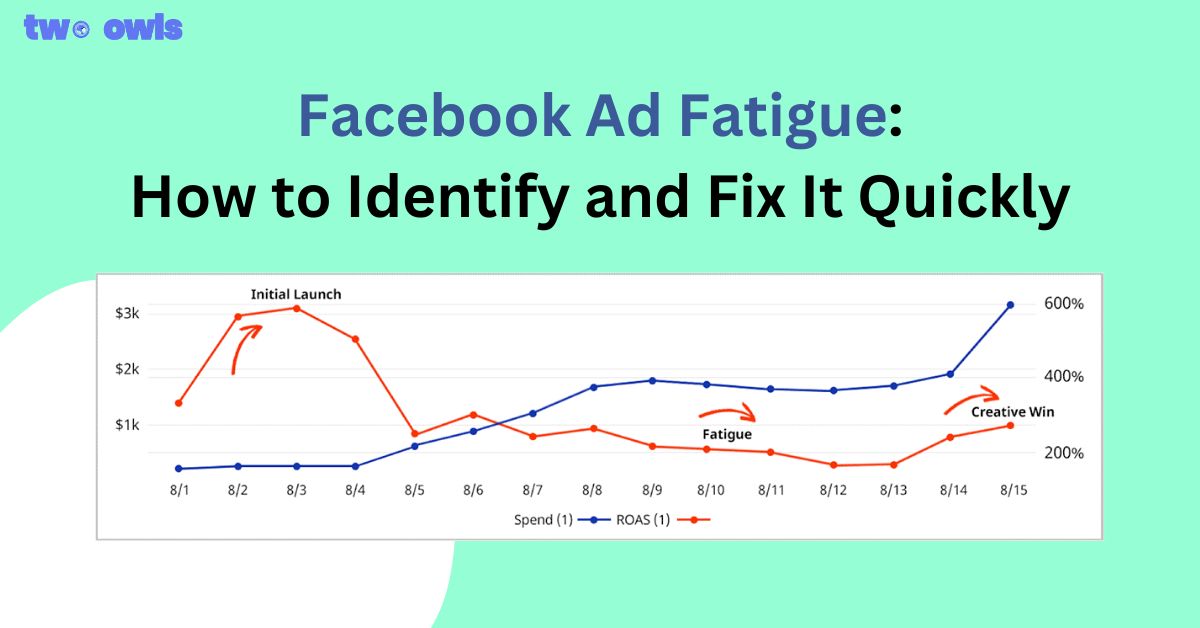
This isn't just a minor dip; it's a significant financial drain. The resource "Creative Fatigue Is Killing Your Ad Performance" estimates that for an account spending $50,000/month, fatigue can lead to $7,500-$12,500 in wasted ad spend every month. For a performance marketer, preventing this waste is a primary responsibility.
2. Your Diagnostic Toolkit: How to Spot Creative Fatigue
To combat fatigue, you first need to diagnose it accurately and early. Your ad account provides all the signals you need, if you know where to look. Let's build your diagnostic toolkit.
The Primary Indicator: Frequency
The most direct measure of audience exposure is Frequency, which tells you the average number of times each person has seen your ad. As frequency rises, the risk of fatigue increases.
How To Overcome Facebook Ad FATIGUE
This video from marketing expert Ben Heath provides a great introduction to creative fatigue and the central role of the Frequency metric.
Watch the first section on what ad fatigue is and how to check frequency. Pay close attention to the general frequency benchmarks he provides for cold versus warm audiences.
As Ben Heath explains, the acceptable frequency level varies:
- Cold Audiences: Fatigue can set in when frequency rises above 2.0 - 2.5. People who don't know your brand are less tolerant of seeing the same ad repeatedly.
- Warm Audiences (Retargeting): You can often get away with much higher frequencies (e.g., 6.0 to 10.0+), as this audience is already engaged. However, performance will still eventually decline.
The Data-Driven Diagnostic Formula
While frequency is a critical leading indicator, true diagnosis comes from combining it with performance metrics. Industry best practices suggest a clear formula for identifying fatigue.
Creative Fatigue Is Killing Your Ad Performance
This article from Yume provides a more quantitative and detailed approach to diagnosing creative fatigue.
Read the sections "How to Diagnose Creative Fatigue" and "The Five Warning Signs." Focus on the specific formula it presents and the checklist of signals to monitor.
Based on this, here is a comprehensive checklist of warning signs. If you see several of these happening at once, it's a clear signal that your creative is fatiguing.
The 5 Warning Signs of Creative Fatigue:
- Click-Through Rate (CTR) Declining: This is the earliest reliable signal. A drop of 15-20% from its peak over a 7-14 day period is a major red flag.
- Frequency Climbing: A frequency consistently above 2.5 for cold audiences is the tipping point. The Admetrics guide, "Creative Scaling," even suggests a more generous threshold of 4.0, but acting earlier is safer.
- Cost Per Acquisition (CPA) or Cost Per Click (CPC) Rising: If your targeting and bid haven't changed, but your costs are going up, the creative itself is losing efficiency.
- Cost Per Mille (CPM) Spiking: A sudden jump in CPM (e.g., 50-100%) while CTR stays flat is a sign that Meta's algorithm is penalizing your ad for low engagement, forcing you to pay more for impressions.
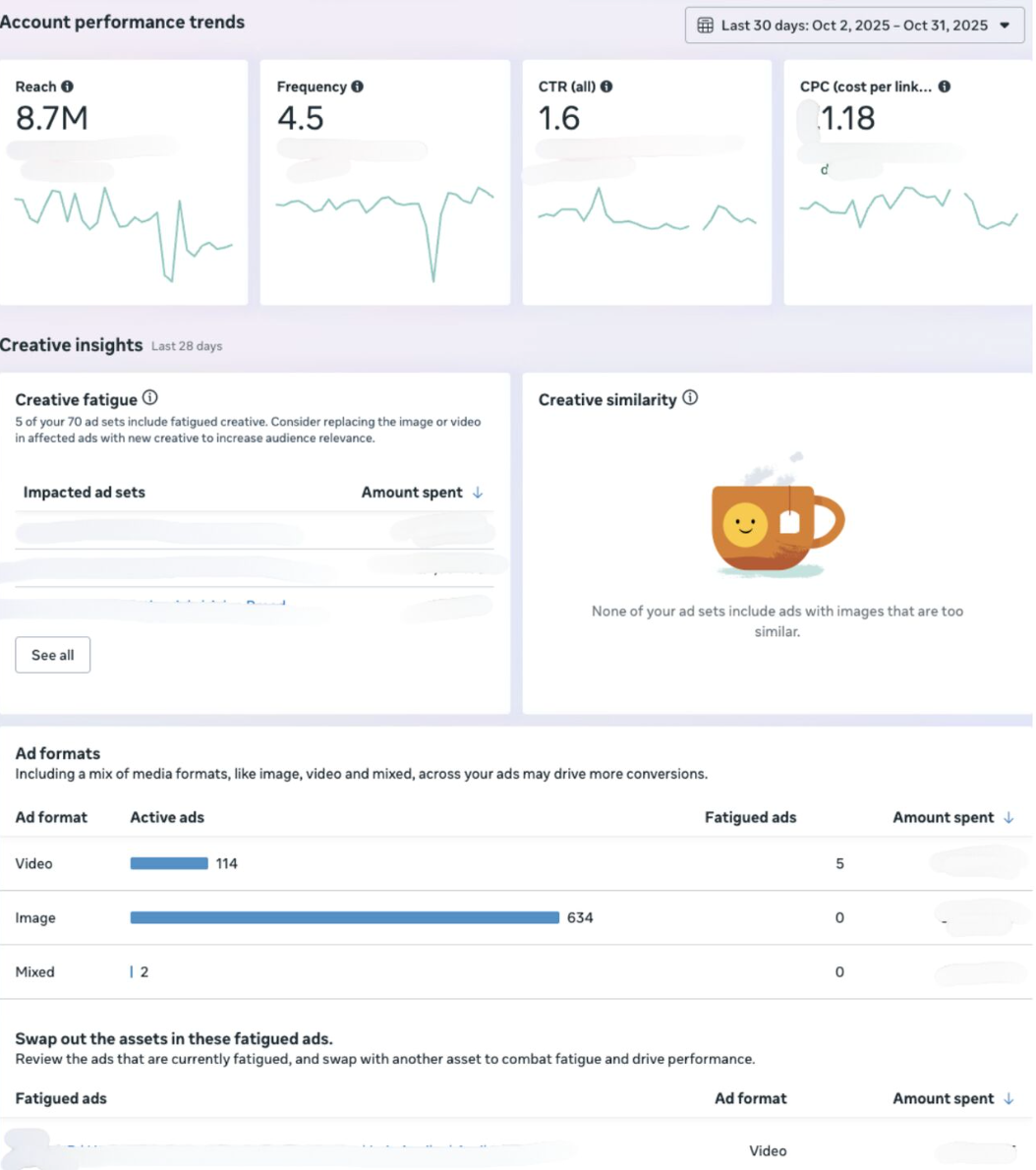
- Meta's In-Platform Warning: Meta Ads Manager will sometimes explicitly flag your creatives as fatigued. This is the platform directly telling you to take action.
Creative Fatigue vs. Audience Saturation
It's crucial to distinguish creative fatigue from a related but different problem: audience saturation. Misdiagnosing this will lead you to apply the wrong solution.
| Signal | Creative Fatigue | Audience Saturation |
|---|---|---|
| The Fix | New creatives | New/broader audiences |
| A new creative recovers performance | Yes | No |
| Frequency is high | Yes | Can be high or low |
| Expanding the audience helps | No (the creative is the issue) | Yes (the audience is the issue) |
| Multiple creatives decline at once | No (usually one at a time) | Yes (all ads struggle) |
The simplest test is to launch a net-new creative concept (from the 10% bucket in your iteration roadmap) into the same ad set. If performance recovers, you had creative fatigue. If the new creative also struggles, your audience pool is likely exhausted, and it's time to explore horizontal scaling (which we'll cover in a later module).
3. From Reactive to Proactive: Establishing Your Refresh Cadence
Diagnosing fatigue after it has already hurt your performance is a reactive approach. The goal of a professional is to be proactive, refreshing creatives before significant decay sets in. This is your creative refresh cadence.
Your refresh cadence is determined primarily by two factors: ad spend and audience size. Higher spend and smaller audiences lead to higher frequency more quickly, thus requiring a faster refresh cadence.
So, how many creatives do you actually need?
How Many Ad Creatives Do You Actually Need?
Let's return to the "Creative Fatigue Is Killing Your Ad Performance" article. It provides an excellent, spend-based framework for determining creative volume.
Read the section "How Many Ad Creatives Do You Actually Need? (The Math by Spend Level)". Focus on the table that breaks down "Meta Creative Volume by Monthly Spend" and internalize the numbers for your typical budget levels.
Here’s a summary of that tactical framework:
| Monthly Meta Spend | New Creatives Needed per Month | What This Means for You |
|---|---|---|
| $0 - $10K | 1-3 | Fatigue is slow. Focus on testing big new concepts occasionally. |
| $10K - $25K | 3-5 | You need a basic system. Use the diagnostic signs to trigger refreshes. |
| $25K - $50K | 4-8 (~1-2/week) | Proactive refreshes are required. Your iteration roadmap becomes essential. |
| $50K - $100K+ | 8-20+ (2-4+/week) | Creative production is a primary focus. A constant flow of iterations and new concepts is needed to maintain performance. |
A Note on Modern Creative Diversity
It's important to understand that "new creative" no longer means just changing the background color. As the Yume article mentions, Meta's algorithm has evolved. It now uses a Creative Similarity Score to group visually and conceptually similar ads together. If your "new" ads are too similar to the old ones, the algorithm treats them as the same ad, and you get no benefit from the refresh.
This reinforces the importance of the testing framework from our last lesson. You need a mix of:
- Iterations (e.g., new hooks) to extend a winner's life.
- Variations (e.g., static vs. video format).
- Net-New Concepts to introduce genuine diversity into the ad account.
Your iteration roadmap, with its 60-30-10 structure, is the perfect engine to produce this variety and maintain your refresh cadence. The 30% and 10% budget allocations are your dedicated pipeline for creating the assets you need before your main winners fatigue.
Conclusion
You are now equipped to manage the entire lifecycle of your ad creatives. By moving from a reactive to a proactive approach, you can protect your campaign profitability and create the stability needed for aggressive scaling.
Here are your key takeaways:
- Creative fatigue is inevitable: It's when audience overexposure to an ad leads to declining performance (lower CTR, higher CPA/CPM).
- Use your diagnostic toolkit: The primary warning signs are a CTR drop of 15-20% combined with a frequency rising above 2.5 for cold audiences.
- Distinguish fatigue from saturation: If a new creative fixes performance, it was fatigue. If not, the audience is exhausted.
- Establish a proactive refresh cadence: Use your monthly ad spend as a guide to determine how many genuinely new creatives you need to produce each month to stay ahead of decay.
- Your iteration roadmap is the solution: The 60-30-10 framework you built previously is the operational process for feeding this refresh cadence.
This lesson concludes our module on the Creative Optimization Cycle. You now have a complete system for testing, iterating, and refreshing your creatives.
In our next lesson, we will begin the Foundations of Profitable Scaling module. We'll start by defining the essential financial metrics, like target CPA and ROAS, that serve as the guardrails for knowing when and how much you can afford to scale.