Hello! In our last lesson, we established the crucial financial guardrails for scaling by calculating target CPA and ROAS based on your business's unique unit economics and LTV. You now have a clear definition of what profitable scaling looks like on paper.
Today, we shift from the "what" to the "how." Knowing your target CPA is one thing; actually increasing your budget to hit that target without causing performance to collapse is another. This lesson will explore the core mechanism governing this process: the Meta Ads learning phase. Our goal is to explain the intricate relationship between budget increases, audience size, and the learning phase, so you can scale your campaigns with confidence and stability.
1. The Learning Phase: Meta's Internal "R&D" Period
Before we can scale a campaign, we must understand the environment we're operating in. Every new ad set, or any ad set with significant edits, enters the learning phase. This isn't a sign of a problem; it's a fundamental part of how Meta's algorithm works. Think of it as a mandatory research and development period for your ad set.
So, what is the algorithm actually doing during this time?
NEW Learning Phase is Great News for Facebook Ads!
This video from media buyer Ben Heath offers a clear explanation of what Meta's machine learning is trying to figure out during the learning phase.
Watch the opening segment on what the learning phase is. Pay attention to the specific questions the algorithm is trying to answer, such as which subset of your audience is best, what impression frequency is optimal, and what time of day works best.
As you just saw, the algorithm is exploring and testing to find the most efficient way to deliver your ads. During this period, performance can be volatile—your CPA might fluctuate significantly day-to-day. This is normal. Resisting the urge to make reactive changes is one of the most important disciplines in media buying.
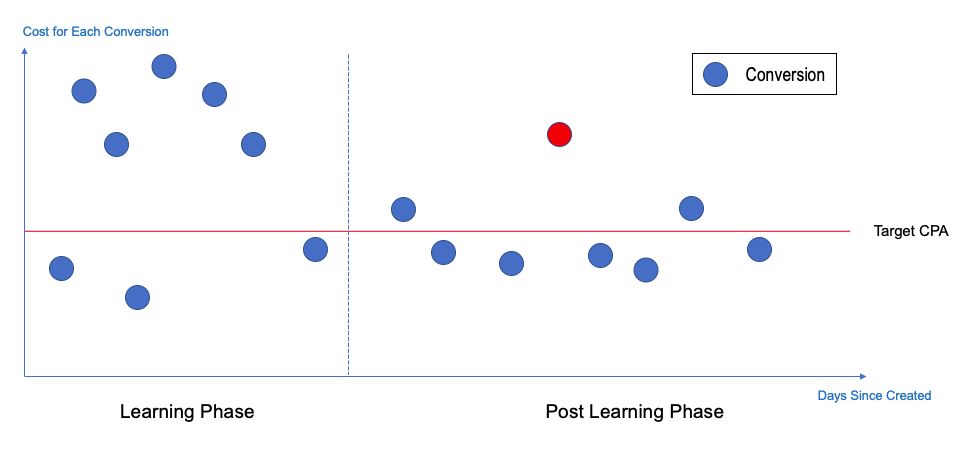
The image below illustrates this perfectly. During the learning phase, conversion costs are erratic. Once the campaign exits learning, the CPA stabilizes, becoming more predictable and often lower.
2. The Fuel for the Algorithm: Conversions, Budget, and Audience
To exit the learning phase and achieve stable performance, the algorithm needs one thing above all else: data. Specifically, it needs to see a sufficient number of conversion events to identify patterns. The speed and success of the learning phase depend directly on how effectively you provide this data.
This brings us to the three interconnected variables:
- Conversion Volume: The number of optimization events.
- Budget: The funding required to generate those events.
- Audience Size: The pool of people the algorithm can test.
Conversion Volume: The Magic Number
For years, Meta's guideline was that an ad set needed approximately 50 conversions within a 7-day period to exit the learning phase. While this number has recently been updated, understanding the old rule and its implications provides a solid foundation for planning.
The video below explains the old rule, the problems it caused, and the new, more accessible requirement.
NEW Learning Phase is Great News for Facebook Ads!
Let's return to the video from Ben Heath to understand the evolution of the learning phase requirements.
First, watch the section covering the previous 50-conversion rule and the challenges it presented, leading to the "Learning Limited" status. Then, watch the next part explaining the new learning phase requirement of approximately 10 conversions in 3 days and its implications.
As you learned, the new guideline is roughly 10 conversions in 3 days. While this makes exiting the learning phase technically easier, the underlying principle remains the same: the algorithm needs a consistent flow of data. For robust planning, especially when preparing to scale, using the older, more demanding 50/7 rule as a budgeting heuristic is still a very sound practice.
Budget: Funding the Data Acquisition
Your budget is the direct enabler of conversion volume. If your budget is too low relative to your CPA, you will never generate enough conversions to exit learning. This is the single most common reason campaigns fail to stabilize.
The following article provides a simple but powerful formula for calculating the minimum budget needed.
How To Improve Facebook Ads Learning Phase
This article from Cometly provides a tactical approach to budgeting for the learning phase.
Read "Step 1: Calculate and Set Your Budget to Generate 50 Weekly Conversions." Focus on the specific calculation provided and the logic behind it.
The math is straightforward:
If your target CPA (which you calculated in the last lesson) is $40, you should aim for a budget of at least $286/day ($2000/week) for that ad set. Launching with a $50/day budget in this scenario is setting the campaign up to fail, as it will languish in a state of permanent learning.
Audience Size: Giving the Algorithm Room to Explore
The final piece of the puzzle is your audience. A common mistake is to split a limited budget across many small, hyper-targeted ad sets. While this feels like precise testing, it's counterproductive. You're fragmenting your data, and no single ad set gets enough conversion volume to learn effectively.
How To Improve Facebook Ads Learning Phase
This section of the Cometly article explains why consolidating your ad sets is crucial for learning.
Read "Step 3: Consolidate Ad Sets to Pool Your Conversion Data." The core idea is that broader audiences allow you to pool your budget and conversion data, helping the algorithm find winners faster.
In the current state of Meta's platform, broader audiences often outperform narrow ones. By consolidating your audiences and budget, you give the algorithm a larger data pool to work with, which accelerates learning and often leads to the discovery of more efficient user pockets.
3. "Learning Limited": The Consequence of Insufficient Fuel
When an ad set doesn't get enough conversions to exit the learning phase, it gets stuck in a state Meta calls "Learning Limited." This is a clear signal that the algorithm has determined it won't be able to gather enough data to optimize performance. Your delivery will be inefficient and your costs unstable.
The causes of "Learning Limited" directly map back to the factors we just discussed.
Facebook ads learning phase: how to break out faster & spend smarter
This article from Bïrch clearly defines the "Learning Limited" status and how to troubleshoot it.
First, read the section "Understanding 'learning limited'" to understand what this status means. Then, jump to the "Troubleshooting common challenges" section and focus on the bullet point: "The ad set is stuck in learning limited."
As a recap, the primary causes of "Learning Limited" are:
- Insufficient Budget: Your daily spend is too low to generate enough conversions.
- Narrow Audience: Your targeting is too restrictive, or your frequency is too high.
- Low Conversion Volume: You are optimizing for an event that happens too infrequently (e.g., a high-ticket purchase for a new brand). In this case, you might temporarily optimize for a higher-funnel event like "Add to Cart" to exit learning before switching back to "Purchase."
4. Scaling Your Budget Without Breaking Performance
Now, let's address the core of scaling: increasing your budget. You have a winning ad set that has exited the learning phase and is hitting your target CPA. The natural impulse is to significantly increase the budget to capture more volume. However, doing this abruptly can be disastrous.
Any significant edit to an ad set—including a large budget increase—will reset the learning phase.
This forces the algorithm to start its "R&D" process all over again, leading to renewed volatility and potentially destroying the stable performance you worked hard to achieve. The key is to scale gradually.
Facebook Ads Learning Phase Explained: How to Optimize Your Ads for Better Results
This video from HubSpot Marketing gives a clear, tactical rule for how to increase your budget safely.
Watch the segment on scaling your budget the right way. This provides a specific, actionable guideline for vertical scaling.
The general rule of thumb is to increase your budget by no more than 20-30% every 3 to 5 days. This gradual increase allows the algorithm to adapt to the new spend level without being forced into a full reset. It preserves the learning you've already paid for while allowing you to scale up. If you need to make a more drastic change, the recommended best practice is to duplicate the ad set and apply the new, higher budget to the copy.
Conclusion
In this lesson, we demystified the Meta learning phase and established its central role in scaling. You now have a framework for understanding how budget, audience, and conversion volume interact to produce stable, predictable results.
Here are your key takeaways:
- The learning phase is a necessary data-gathering period. Performance is expected to be volatile; patience is critical.
- The algorithm needs a steady flow of conversions to optimize. Your campaign structure must be designed to provide this "fuel."
- Budget and audience size are your primary levers. Use a sufficient budget to support your target CPA and favor broader audiences to give the algorithm room to learn. A budget that's too low or an audience that's too narrow will lead to "Learning Limited" status.
- Scale your budget gradually. Abrupt budget increases will reset the learning phase. Stick to incremental increases of 20-30% every few days to maintain stability.
You now understand the financial guardrails for scaling (from the previous lesson) and the mechanical constraints of the platform (from this lesson). In our next session, we'll bring these concepts together by focusing on the specific quantitative and qualitative signals that indicate a campaign is ready to scale.