Introduction
In the previous lesson, we compared the architectural models of RabbitMQ and Kafka, highlighting how they handle message delivery through "push" vs. "pull" mechanisms and the role of acknowledgements (ack). An ack confirms that a message has been successfully processed, signaling the broker to remove it from the queue (or advance the consumer's offset).
This brings up a critical question for any production system: what happens during a failure? Consider this scenario: a consumer processes a message (e.g., charges a credit card) but crashes right before it can send the ack back to the broker. The broker, never receiving the ack, will assume the message failed and redeliver it to another consumer. Now, the customer might be charged twice.
This lesson directly tackles this problem. Your learning outcome is to analyze the trade-offs between at-least-once, at-most-once, and exactly-once message delivery guarantees. Understanding these guarantees is fundamental to designing reliable distributed systems and is a topic you will almost certainly discuss in a senior backend interview.
The Spectrum of Reliability
In distributed systems, ensuring a message is delivered and processed exactly one time is surprisingly complex. Failures can occur at any point: the producer sending the message, the network, the message broker itself, or the consumer processing it. Different systems handle these failures with different promises, or delivery guarantees.
Let's watch a segment from a talk by a Meta Staff Engineer that clearly explains these guarantees and their practical implications.
Message Queues in System Design Interviews w/ Meta Staff Engineer
The video 'Message Queues in System Design Interviews' explains the edge case that leads to duplicate processing and then breaks down the three delivery guarantees. It also gives the most important piece of advice for your interview.
Watch from 08:53 to 12:43. Focus on understanding: The failure scenario described: a crash after processing but before acknowledgement. The definition and implication of at-least-once delivery. The concept of an idempotent consumer and why it's crucial. The definitions of at-most-once and exactly-once delivery. The practical advice given for which guarantee to choose in an interview.
The video makes it clear that these guarantees represent a trade-off between reliability, performance, and implementation complexity. Let's break down each one.
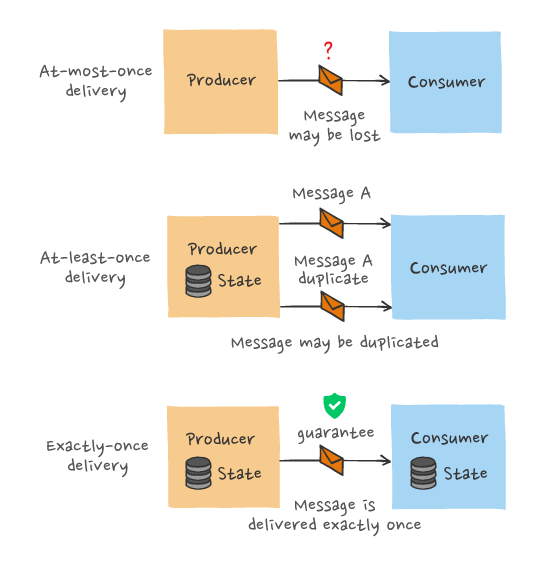
1. At-Most-Once: "Fire and Forget"
This is the simplest and fastest guarantee. The producer sends a message, and the broker delivers it once. There are no retries.
- How it works: A consumer might acknowledge the message before processing it. If the consumer crashes while processing, the message is lost forever because the broker already thinks it was handled.
- Trade-offs:
- Pro: Highest performance, lowest latency, and simplest implementation.
- Con: Messages can be lost. There is no guarantee of delivery.
- When to use it: Use this only for non-critical data where occasional loss is acceptable.
- Production Example: Sending real-time metrics for monitoring dashboards. If a few data points are missed, the overall trend is still visible.
- Production Example: A "user is typing" indicator in a chat application. If one of these events is dropped, it's not a significant issue.
2. At-Least-Once: The Production Workhorse
This is the most common guarantee in distributed systems. It ensures that every message is processed, but accepts that it might be processed more than once.
- How it works: A consumer fully processes a message and only sends the
ackafter the work is complete. If the consumer crashes before theack, the broker will redeliver the message to another consumer. - The Idempotency Requirement: This guarantee shifts the responsibility of handling duplicates to the consumer. Your message handler must be idempotent. An idempotent operation is one that can be applied multiple times without changing the result beyond the initial application.
Let's consider this in the context of your Python backend experience.
Non-Idempotent Operation (BAD):
# Assume 'order' is an object from your Django ORM
def process_order_payment(order_id, amount):


    # Every time this runs, a new payment record is created.
    # Running this twice for the same order_id results in a double charge.
    Payment.objects.create(order_id=order_id, amount=amount, status='completed')


    # ... more logic
Idempotent Operation (GOOD):
# This pattern is often called "Idempotency Key"
def process_order_payment(order_id, amount, idempotency_key):


    # Check if we've already processed this specific transaction
    if PaymentAttempt.objects.filter(key=idempotency_key).exists():
        return # Already processed, do nothing.


    # If not, process it within a database transaction
    with transaction.atomic():


        # Create a record of the attempt first
        PaymentAttempt.objects.create(key=idempotency_key)


        # Then create the actual payment
        Payment.objects.create(order_id=order_id, amount=amount, status='completed')


        # ... more logic
- Trade-offs:
- Pro: Guarantees no data loss. It's a robust default for most systems.
- Con: Requires careful design of consumer logic to ensure idempotency, which adds complexity. Can cause duplicate processing if not handled correctly.
- When to use it: This is the default for most business-critical operations.
- Production Example: Processing an e-commerce order. You want to ensure the order is processed, and you build your consumer to handle potential duplicates (e.g., by checking the order status before trying to process it again).
- Production Example: Sending a password reset email. You can tolerate the user getting two emails, but you cannot tolerate them getting zero.
3. Exactly-Once: The "Holy Grail"
This guarantee promises that each message is delivered and processed precisely one time.
- How it works: True "exactly-once" delivery is a misnomer. In practice, it's almost always achieved by building a system that has at-least-once delivery semantics plus consumer-side deduplication within a transaction. This is often called "effectively-once" processing.
A common pattern to achieve this is the Transactional Outbox.

In this pattern:
- The consumer starts a database transaction.
- Inside the transaction, it does its business logic (e.g., updates a user's balance).
- It also writes an "event" record to an
outboxtable in the same database. - The transaction is committed. Both the business data and the event are saved atomically.
- A separate process reads from the
outboxtable and publishes the event to the message broker.
This ensures that an event is only published if and only if the business logic was successfully committed.
- Trade-offs:
- Pro: Provides the strongest reliability guarantee.
- Con: Extremely complex and costly to implement correctly. It requires coordination between the message broker, the consumer application, and the database (e.g., using distributed transactions or a transactional outbox pattern). This often leads to higher latency.
- When to use it: Reserve this for systems where duplicates are absolutely unacceptable and costly.
- Production Example: Financial systems processing money transfers or stock trades. A duplicate transaction could have severe financial consequences.
Choosing the Right Guarantee: A Practical Framework
To solidify your understanding, let's review a resource that provides a structured way to think about these trade-offs and applies them to real-world scenarios.
At‑least‑once vs at‑most‑once vs exactly‑once: where to use each?
The article 'At-least-once vs at-most-once vs exactly-once' from DesignGurus is an excellent reference. It provides clear definitions, real-world examples, and a fantastic comparison table that you can mentally reference during an interview.
First, read the section 'Real World Example'. Notice how different guarantees are applied to different parts of the same retail system. Then, study the 'Table of Comparison' carefully. This table is an excellent summary of the key trade-offs (latency, complexity, use cases) for each guarantee.
Interview-Style Question
Interviewer: "You are designing a system to process user-uploaded videos. The workflow involves several steps: transcoding the video into different resolutions, extracting a thumbnail, and running it through a content moderation service. Which delivery guarantee would you choose for this workflow, and why?"
-
Your Thought Process:
- Analyze the stakes: Is it okay to lose a user's video? No. So
at-most-onceis out. - Analyze the operations: What happens if we transcode the video twice? We waste CPU cycles and storage, but the final outcome is the same (we have the transcoded files). What if we extract the thumbnail twice? Same result. The operations are naturally idempotent or can be made so easily (e.g., by naming files based on video ID and resolution).
- Evaluate complexity: Does this require the complexity of
exactly-once? Probably not. The cost of a duplicate process (wasted computation) is far lower than the engineering complexity of building a true exactly-once system. - Formulate the answer: The best choice is
at-least-oncedelivery combined with idempotent consumers.
- Analyze the stakes: Is it okay to lose a user's video? No. So
-
Ideal Answer: "For this system, I would choose at-least-once delivery. It's critical that we don't lose a user's video, so
at-most-onceis not an option. The operations themselves—transcoding, thumbnail generation—are idempotent. If a worker crashes and a video is processed twice, the end result is the same, though we incur some extra processing cost. This is an acceptable trade-off. Implementing a fullexactly-oncesystem would introduce significant complexity and latency for little practical benefit in this specific use case. Therefore,at-least-onceprovides the right balance of reliability and practicality. We'd just need to ensure our workers can handle retries gracefully, for example, by overwriting output files or checking if they already exist before starting a task."
Conclusion
You've now dissected one of the most important concepts in asynchronous systems. In a senior interview, simply knowing the definitions isn't enough. You must demonstrate that you can analyze the business requirements and technical trade-offs to justify your choice.
Key Takeaways:
- At-Most-Once: Fast but unreliable. Use for non-critical, transient data (e.g., metrics, ephemeral UI updates).
- At-Least-Once: The reliable default. Guarantees delivery but requires the consumer to be idempotent to handle duplicates. This is the most common and practical choice.
- Exactly-Once: Strongest guarantee but highest complexity and cost. It's typically achieved via
at-least-onceplus transactional deduplication. Reserve it for critical systems like financial ledgers where duplicates are catastrophic. - Interview Strategy: For most interview scenarios, proposing at-least-once delivery with idempotent consumers is the safest and most pragmatic answer. Clearly state the trade-offs and explain how you would make your consumer idempotent.
Preview of the Next Lesson:
With at-least-once delivery, we retry failed messages. But what if a message is malformed or contains bad data, causing it to fail every single time? This is a "poison pill" message that can block your queue indefinitely. In our next lesson, we will design a solution for this by learning how to use a Dead-Letter Queue (DLQ).