Introduction
Welcome back! In our previous lesson, we established a 5-step framework for navigating system design interviews. You saw how a structured approach—from clarifying requirements to identifying bottlenecks—can turn a daunting, open-ended question into a manageable process. During Step 4, "Identify Bottlenecks and Scale the Design," we briefly touched upon the idea of making a system handle more load, either by making servers bigger or by adding more of them.
Today, we will dive deep into that fundamental concept. This lesson focuses on the two primary strategies for scaling a system: vertical scaling (scaling up) and horizontal scaling (scaling out). Understanding the nuances of these approaches is non-negotiable for a backend engineering role, as it forms the basis of almost every architectural decision related to growth and reliability.
By the end of this lesson, you will be able to explain the trade-offs between horizontal and vertical scaling in terms of cost, complexity, and performance limits, enabling you to articulate and justify your design choices confidently in an interview.
Defining Vertical and Horizontal Scaling
At its core, scalability is about designing a system that can handle growth. When traffic increases, how do you add capacity? There are two ways to answer this question.
Let's start with a short, clear video that defines both approaches.
Vertical Vs Horizontal Scaling: Key Differences You Should Know
The ByteByteGo channel provides excellent, concise explanations of system design concepts. This video, 'Vertical Vs Horizontal Scaling', will give you a clear definition of each strategy and its core pros and cons.
Watch the video from 00:18 to 02:22. Pay close attention to the analogy for each type of scaling and the initial list of advantages and disadvantages.
To summarize and reinforce what you just saw:
-
Vertical Scaling (Scaling Up): This means making a single server more powerful. You add more resources—like a faster CPU, more RAM, or a larger SSD—to an existing machine. Think of it as upgrading your laptop to a high-end model.
-
Horizontal Scaling (Scaling Out): This means adding more servers to your system to distribute the load. Instead of one powerful machine, you have a fleet of standard machines working together. This requires a load balancer to distribute incoming traffic among the servers.
The following diagram illustrates this core difference perfectly.

The Core Trade-Offs: A Detailed Comparison
Choosing between vertical and horizontal scaling is a classic architectural trade-off. There is no universally "correct" answer; the right choice depends entirely on the specific requirements of the system you're designing. In an interview, your ability to discuss these trade-offs is what demonstrates seniority.
Let's break down the comparison across four critical dimensions: Performance & Limits, Reliability & Availability, Complexity, and Cost.
This table provides a high-level overview of the key differences.
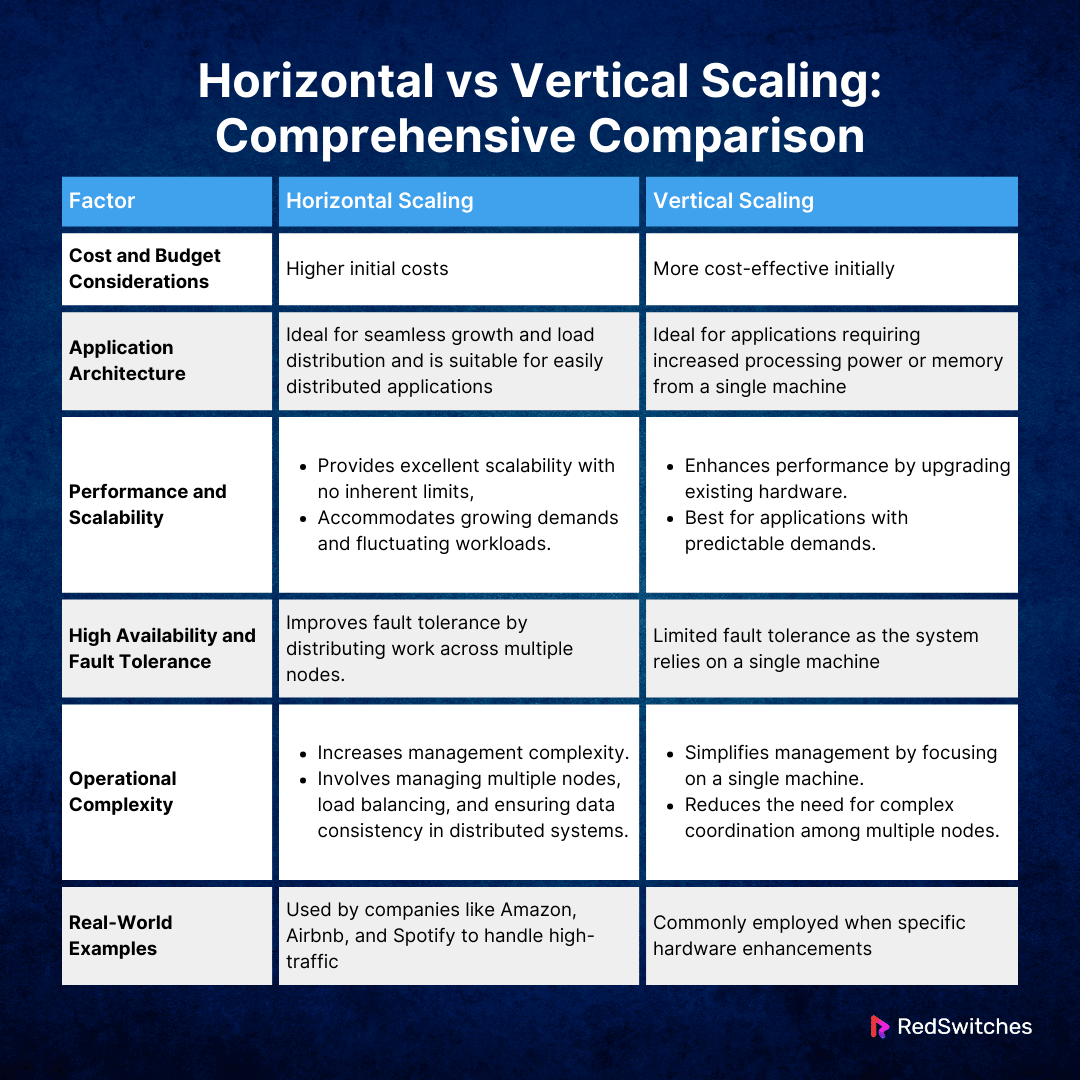
Now, let's explore these points in more detail.
Scale Up vs. Scale Out: An In-Depth Comparison of Database Scaling Strategies
The article 'Horizontal Scaling vs. Vertical Scaling' from Pingcap offers a very thorough, database-centric comparison. We'll read the section that directly compares the two strategies across key dimensions.
Read the section titled 'Scale Up vs. Scale Out: An In-Depth Comparison of Database Scaling Strategies'. Focus on the 'Key Comparison Points' and the summary table. This will solidify your understanding of the trade-offs.
Building on that reading, let's analyze each trade-off from an interviewer's perspective.
1. Performance Limits & Scalability
-
Vertical Scaling:
- Pro: Can achieve very low latency because all communication happens within a single machine (inter-process communication), eliminating network overhead. This is ideal for workloads that cannot be easily parallelized.
- Con (The Hard Ceiling): There is a physical limit to how powerful a single machine can be. You will eventually hit a "hardware ceiling" where no bigger server is available or the cost becomes prohibitive for marginal gains. Scalability is finite.
-
Horizontal Scaling:
- Pro (Theoretically Limitless): You can keep adding more commodity servers to handle increasing load. This is the foundation of how hyperscale companies like Google and Netflix operate. It's perfect for handling high concurrency and parallelizable tasks.
- Con (Network is the Bottleneck): Communication between servers happens over the network, which is inherently slower and less reliable than communication within a single machine. This can introduce latency.
2. Reliability & Availability
-
Vertical Scaling:
- Con (Single Point of Failure - SPOF): Your entire system resides on one machine. If that server fails due to a hardware fault, a power outage, or a software crash, your entire application goes down.
- Con (Downtime for Upgrades): Scaling up almost always requires taking the server offline to perform the hardware upgrade, resulting in planned downtime.
-
Horizontal Scaling:
- Pro (High Availability & Fault Tolerance): The load is distributed across many servers. If one server fails, the load balancer simply redirects traffic to the remaining healthy servers. There is no single point of failure, making the system resilient.
- Pro (Zero-Downtime Deployments): You can perform rolling updates, taking down a few servers at a time to update them while the rest of the fleet continues to serve traffic.
3. Complexity & Implementation
-
Vertical Scaling:
- Pro (Simplicity): It's often the simpler path, especially initially. You don't need to change your application's architecture. Your Django/FastAPI application can remain as-is; you just run it on a bigger machine. Data consistency is simple because all data lives on one node.
-
Horizontal Scaling:
- Con (Architectural Complexity): This is a significant undertaking. Your application must be designed for it. A key prerequisite is making your application stateless. This means no user session data should be stored on the application server itself; instead, it should be externalized to a cache (like Redis) or a database.
- Con (Operational Overhead): You introduce new components that must be managed, such as load balancers, service discovery mechanisms, and potentially complex data replication and sharding strategies.
4. Cost
-
Vertical Scaling:
- Pro: Can be cheaper for small-scale applications.
- Con (Exponential Cost Growth): The cost of high-end, enterprise-grade hardware increases exponentially. A server that is twice as powerful often costs much more than twice the price. Software licensing fees (often priced per CPU core) can also skyrocket.
-
Horizontal Scaling:
- Pro (Linear Cost & Lower TCO): You can use cheaper, "commodity" hardware. The cost scales more linearly with your capacity needs. The total cost of ownership (TCO) at scale is often much lower.
- Con (Higher Initial Cost): The initial setup might be more expensive because you need multiple servers and a load balancer from the start.
When to Use Each Strategy (The Interview Discussion)
In a system design interview, you'll be expected to choose a scaling strategy and justify it. Here’s how you can frame that discussion:
"For the initial design, I would recommend starting with vertical scaling for component X, but architecting our application to be stateless so we can easily switch to horizontal scaling as we grow."
This shows pragmatism and foresight.
Scenarios for Vertical Scaling:
- Stateful Components: Especially traditional relational databases (like PostgreSQL). Managing data consistency, transactions, and joins across a distributed database is extremely complex. It's often pragmatic to scale the primary database server vertically as long as possible before attempting complex sharding.
- Early-Stage Systems: When speed of development is more important than massive scale, vertical scaling offers a simpler, faster path to get a product to market.
- Latency-Sensitive Workloads: For applications where every microsecond counts (e.g., high-frequency trading), the overhead of network calls in a horizontal setup is unacceptable.
Scenarios for Horizontal Scaling:
- Stateless Services: This is the ideal use case. Web servers and API gateways (like the ones you build with Django/FastAPI) are perfect candidates. Since they don't store session state, any server can handle any request, making it easy to add or remove servers.
- High-Availability Requirements: If the system cannot tolerate downtime (e.g., an e-commerce platform), the fault-tolerant nature of horizontal scaling is a requirement.
- Unpredictable or Bursty Traffic: Horizontal scaling combined with auto-scaling allows the system to automatically add more servers during peak traffic (like a flash sale) and remove them when traffic subsides, optimizing for both performance and cost.
The Hybrid Approach: The Reality
Most real-world, large-scale systems use a hybrid approach.
- The stateless parts of the system (web/application tier) are scaled horizontally.
- The stateful parts (databases, caches) might be scaled vertically up to a point, and then eventually scaled horizontally through more complex techniques like sharding and clustering.
Conclusion
You now have a deep understanding of one of the most fundamental trade-offs in system design. This isn't just a theoretical exercise; in your interview, discussing scaling strategies is your opportunity to demonstrate architectural maturity.
Key Takeaways:
- Vertical scaling (scale up) means a bigger server. It's simple and fast for single-node tasks but has a hard performance ceiling and creates a single point of failure.
- Horizontal scaling (scale out) means more servers. It offers near-infinite scalability and high availability but requires significant architectural and operational complexity.
- The Trade-offs are Key: The choice is a balance between Simplicity vs. Complexity, Finite Limits vs. Elastic Scale, Single Point of Failure vs. Resilience, and Upfront Cost vs. Long-Term TCO.
- Statelessness is a Prerequisite: To effectively scale horizontally, your application services must be stateless.
- Start Simple, Plan for Growth: A common, pragmatic strategy is to start with a simpler vertical model for some components while designing the overall architecture to support a future transition to horizontal scaling.
Preview of the Next Lesson:
We've established that horizontal scaling is essential for building resilient, large-scale systems and that it relies on a load balancer. In our next lesson, we will dive into "Load Balancing Strategies." We'll explore different algorithms (like Round Robin, Least Connections, and IP Hash) and discuss how to choose the right one based on your application's needs.