Introduction
Welcome back! In our previous lesson, we analyzed the fundamental architectural decision between a monolith and microservices. We concluded that once you move to a microservices architecture, you've created a distributed system where services must communicate effectively. This lesson directly addresses that challenge.
Today, your learning outcome is to compare RESTful and event-driven architectures, articulating the trade-offs in coupling, scalability, and data consistency.
This is a classic senior backend interview topic. The interviewer is not looking for a "correct" answer, but for your ability to analyze trade-offs and justify an architectural choice based on specific requirements. Your experience with RESTful APIs in Django and FastAPI provides a strong foundation, which we'll now contrast with the asynchronous, decoupled world of event-driven systems—a key area for senior-level thinking.
Core Concepts: Two Styles of Communication
At a high level, the difference comes down to how services ask for and receive information.
1. RESTful (Request-Response) Architecture
You're already very familiar with this pattern. It's a synchronous communication model where a client sends a request to a server and waits for a response.
- How it works: The client (consumer) actively pulls data from the server (producer). The communication is direct and synchronous; the client is blocked until the server responds.
- Key Characteristics:
- Synchronous: The caller waits for an answer.
- Coupled in Time: The client and server must both be online and available at the same time to communicate.
- Point-to-Point: Communication is typically between two specific services.
- Stateless: Each request from a client contains all the information needed to be understood by the server, without relying on any stored context.

2. Event-Driven Architecture (EDA)
This is an asynchronous communication model where services communicate through the production and consumption of events. A producer service emits an event to a central message broker, and consumer services subscribe to and react to those events.
- How it works: The producer pushes an event (a record of something that happened, e.g.,
OrderPlaced) to a message broker (like Kafka or RabbitMQ) and then moves on. It doesn't know or care which services will consume that event. Consumers listen for events they are interested in and process them independently. - Key Characteristics:
- Asynchronous: The producer fires an event and doesn't wait for a response.
- Decoupled: The producer and consumers don't need to know about each other; they only need to know about the broker and the event format. They are decoupled in both time and space.
- Pub/Sub Model: Producers publish events to a "topic," and consumers subscribe to that topic.
To get a quick and clear overview of these two patterns in action, watch the beginning of this video.
Event Driven VS Request Response - What's the Difference?
The video 'Event Driven VS Request Response' from the Be A Better Dev channel provides a concise e-commerce example that clearly demonstrates how each architecture would handle a new order.
Please watch the following segments: (00:20 - 00:51): The setup of the e-commerce scenario. (00:51 - 01:42): The explanation of how this works in an event-driven architecture. (02:28 - 03:02): The explanation of how this would work using a request-response model.
The Trade-Off Analysis: Structuring Your Interview Answer
Now, let's break down the comparison using the key criteria an interviewer will be listening for. For a deeper, more nuanced view that goes beyond the basics, the following video from Confluent is excellent.
Event-Driven Architecture (EDA) vs Request/Response (RR)
The video 'Event-Driven Architecture (EDA) vs Request/Response (RR)' by Confluent (the company behind Kafka) offers a senior-level perspective on these trade-offs, particularly around coupling and consistency.
As you watch, focus on these key comparisons: (00:35 - 02:07): Notice how EDA is inherently reactive, while request-response requires the calling service to drive the workflow explicitly. (02:07 - 03:24): Pay close attention to the explanation of temporal coupling. This is a critical concept to use in your interview. (03:24 - 04:35): This section introduces eventual consistency, a fundamental trade-off of EDA that we will discuss in detail.
Here is a summary table of the core trade-offs, which you can use as a mental framework.
| Dimension | RESTful (Synchronous Request-Response) | Event-Driven (Asynchronous) |
|---|---|---|
| Coupling | Tightly Coupled | Loosely Coupled |
| Scalability | Limited / Complex | Highly Scalable |
| Data Consistency | Strongly Consistent (within request) | Eventually Consistent |
| Fault Tolerance | Low (Cascading Failures) | High (Resilient) |
| Developer Experience | Simpler (for basic cases) | More Complex |
Let's dive into each of these.
1. Coupling
- RESTful: Services are tightly coupled.
- Temporal Coupling: The consumer and producer must both be online simultaneously. If the
PaymentServiceis down, theOrderServicecannot complete its request and will receive an error. - Service Discovery: The
OrderServicemust know the network location (address) of thePaymentService. Changes in thePaymentService's API can directly break theOrderService.
- Temporal Coupling: The consumer and producer must both be online simultaneously. If the
- Event-Driven: Services are loosely coupled.
- Decoupled in Time and Space: The
OrderServicepublishes anOrderPlacedevent to the message broker and its job is done. It doesn't know or care if theNotificationServiceorInventoryServiceare currently online. Those services can be down for maintenance and will simply process the events from the broker when they come back online. This dramatically improves system resilience.
- Decoupled in Time and Space: The
2. Scalability
- RESTful: Can be difficult to scale efficiently. If you have a chain of synchronous calls (
A->B->C), the total response time is the sum of all call times and network latency. A bottleneck in serviceCslows downBandA. You might need to scale the entire chain, which is inefficient. - Event-Driven: Highly scalable. The message broker acts as a shock absorber. If there's a sudden spike in orders, the
OrderServicecan publish thousands of events to the broker very quickly. The consumer services (Fulfillment,Shipping) can then process these events at their own pace. You can scale producers and consumers independently based on the queue depth.
3. Data Consistency
- RESTful: It's easier to achieve strong consistency. When you make a request, you get an immediate, definitive response: "The payment was processed," or "The payment failed." The state is updated synchronously and atomically within the scope of that one service.
- Event-Driven: This model relies on eventual consistency. When the
OrderServicepublishes anOrderPlacedevent, the system's state is temporarily inconsistent. The order is "placed," but inventory hasn't been "decremented" yet. There will be a short delay before theInventoryServiceconsumes the event and updates its database. For many use cases (like e-commerce), this small delay is an acceptable trade-off for the massive gains in scalability and resilience.
4. Fault Tolerance
- RESTful: Prone to cascading failures. A failure or high latency in a downstream service directly impacts all upstream services that depend on it. This can cause a chain reaction that brings down large parts of your application. You must implement complex patterns like circuit breakers and retries on the client-side to mitigate this.
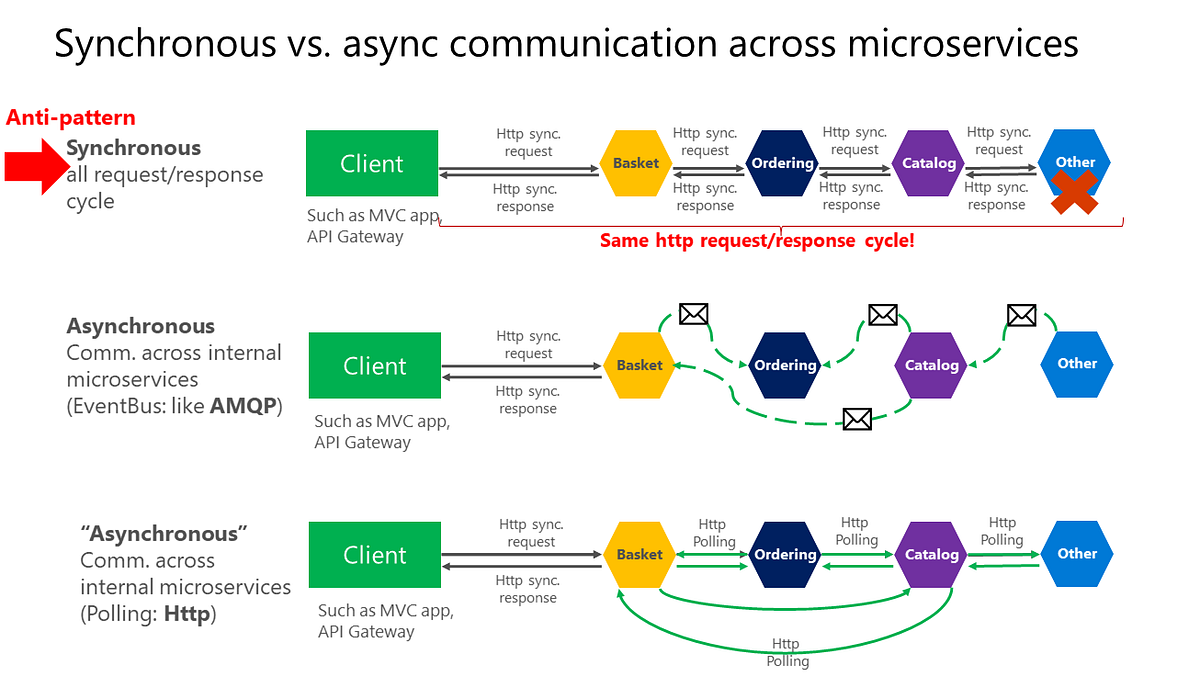
- Event-Driven: Inherently more resilient. If the
NotificationServicefails, events for it simply pile up in the message broker. TheOrderServiceandPaymentServiceare completely unaffected and continue to operate normally. This isolates failures and allows the system to degrade gracefully.
For a very deep analysis of these trade-offs, I recommend you skim through the following resource. It's a detailed paper, but the tables and summaries provide excellent talking points for an interview.
[PDF] What is the tradeoff when opting for asynchronous communication ...
The paper 'What is the tradeoff when opting for asynchronous communication...' provides a rigorous breakdown of the pros and cons across many dimensions, such as error handling, testability, and resilience.
You don't need to read the whole paper. Focus on these parts: Section 3.3 'Tradeoff ASYNC' (starts on page 9): Skim the headings (3.3.1 to 3.3.10). This gives you a fantastic vocabulary for discussing trade-offs: Error handling, Testability, Extensibility, Scalability, Responsiveness, Consistency, Resilience. Section 5.2 'Resilience-Tests' (starts on page 18): Read through the examples. For instance, 'Test: Order service fails' shows that with EDA, orders can still be accepted even if the order service is down. This is a powerful, concrete example of fault tolerance to use in an interview.
Making the Decision: A Practical Framework
In an interview, after explaining the trade-offs, you must apply them. The best answer is always, "It depends on the workflow."
-
Choose RESTful (Synchronous) when:
- The client needs an immediate response. (e.g., "Is this username taken?" or processing a credit card payment).
- The workflow is simple and involves querying or a simple command.
- You need strong consistency for the action being performed.
- The operation is read-heavy.
-
Choose Event-Driven (Asynchronous) when:
- The client doesn't need an immediate response. (e.g., "Your video is now being processed" or "Your order has been submitted").
- You need to decouple services for resilience and independent scaling.
- You have a fan-out scenario where one action needs to trigger multiple independent workflows (e.g., an
OrderPlacedevent triggersUpdateInventory,SendConfirmationEmail, andNotifyShipping). - The operation is write-heavy, and you want to absorb bursts of traffic.
An advanced pattern to mention is CQRS (Command Query Responsibility Segregation), where you can use EDA for writes (Commands) and a separate, optimized RESTful API for reads (Queries). This combines the best of both worlds but adds complexity.
Conclusion
You are now prepared to have a sophisticated conversation about these two core architectural patterns.
Key Takeaways:
- RESTful (Synchronous): Prioritizes simplicity and strong consistency. Its main trade-offs are tight coupling and lower fault tolerance.
- Event-Driven (Asynchronous): Prioritizes decoupling, scalability, and resilience. Its main trade-offs are higher complexity and eventual consistency.
- The best architecture is not one or the other, but often a hybrid, where you choose the right pattern for each specific business workflow. Demonstrating this nuanced understanding is the mark of a senior engineer.
Preview of the Next Lesson:
Whether you choose REST or events, your services need to agree on a contract or schema for the data they exchange. As your system evolves, these contracts will change. In our next lesson, we will evaluate API versioning strategies to manage these changes without breaking client applications.