Hello! Welcome back to our course on C++ internals.
In the last lesson, we built a crucial part of your testing arsenal: stress tests. You learned how to use tools like ThreadSanitizer to hunt for data races, GDB to dissect deadlocks, and benchmarking with perf to uncover performance bottlenecks. You now have the diagnostic tools to prove that your thread pool is not just correct, but also to find out where it's slow.
Today, we move from diagnosis to treatment. This lesson directly addresses the learning outcome: Analyze and optimize the thread pool's performance, focusing on reducing lock contention and task overhead. We'll dissect why your current thread pool design, with its single centralized queue, becomes a bottleneck under load and explore two powerful architectural patterns to solve it: work-stealing and lock-free queues.
1. The Bottleneck: A Single Point of Contention
Your current thread pool likely uses a single std::queue protected by a std::mutex. While this is simple and correct, it creates a major performance bottleneck under heavy use. Let's analyze why.
Multithreading Isn't Free: Performance Pitfalls Visualized
The article 'Multithreading Isn't Free' provides an excellent visualization of this exact problem. It shows how a simple thread pool with a global task queue spends most of its time waiting for locks rather than doing useful work.
Please read the sections titled 'Implementation time' and 'Can’t touch this (lock)'. The first section shows a naive WorkSharingPool with a global queue, similar to your current implementation. The second section provides a screenshot from the Tracy profiler showing massive amounts of time (the red bars) spent waiting on the lock. This is the problem we need to solve.
As the article demonstrates, when many threads are trying to push and pop tasks simultaneously, they all have to line up to acquire the same mutex. This is called high lock contention. A thread that should be executing a task is instead idle, waiting for the lock.
The "Under the Hood" Problem: Cache Coherence
The performance hit from lock contention is even worse than it appears. To understand why, we need to look at the memory hierarchy of a modern multi-core CPU.
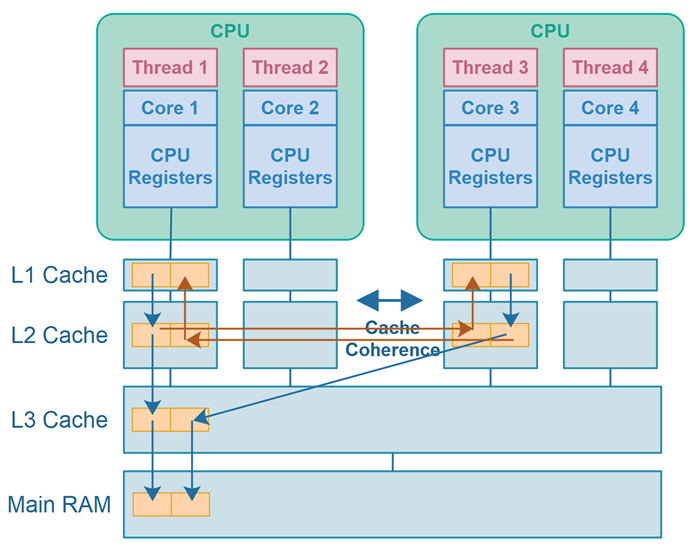
When a thread acquires a mutex and modifies the shared queue (e.g., by popping a task), it modifies data in its local cache. The cache coherence protocol must then invalidate the corresponding cache lines in all other cores. When another thread acquires the lock, it may have to fetch the updated queue data all the way from another core's cache or even main memory, which is orders of magnitude slower than accessing its own L1 cache.
This constant shuffling of the queue's memory between different cores' caches is often called cache line bouncing or "cache ping-ponging," and it severely degrades performance. The single mutex and its associated queue data structure become a "hot spot" of memory contention.
Worse yet, you can suffer from false sharing.
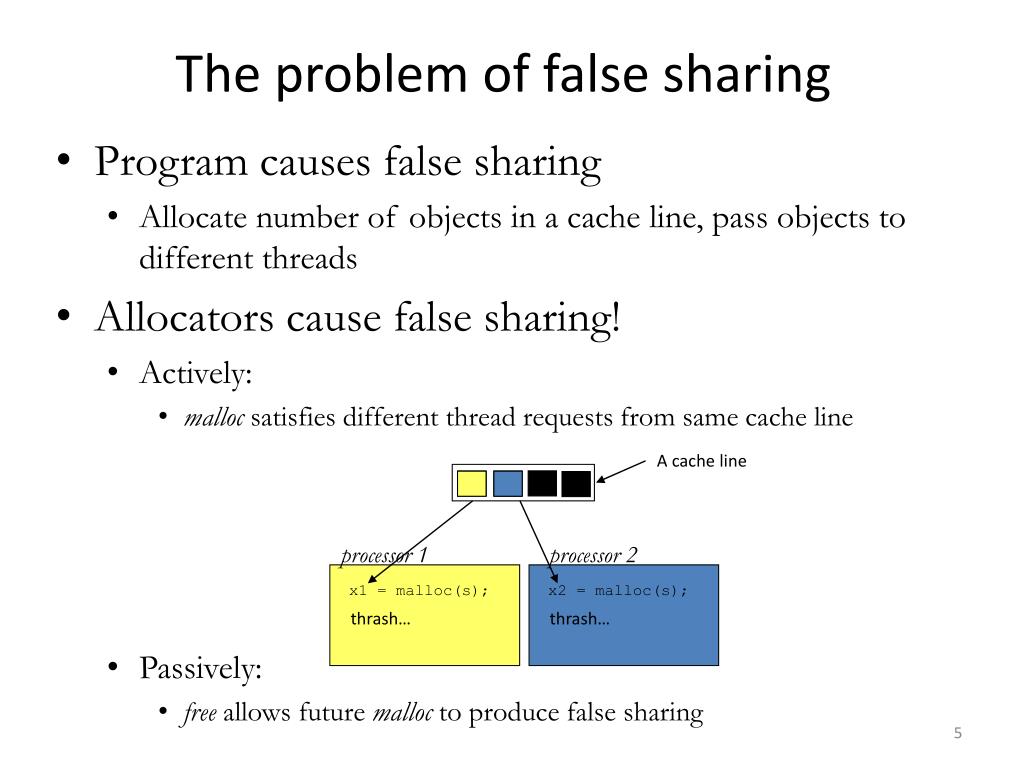
In the context of your task queue, even if you have separate variables for the head and tail pointers, a memory allocator might place them on the same cache line. If one thread is pushing (modifying the tail) and another is popping (modifying the head), they will cause cache line invalidations for each other, even though they are manipulating different ends of the queue.
2. Strategy 1: Work-Stealing
The most effective way to reduce contention on a single queue is to not have one. The work-stealing architecture gives each worker thread its own local queue of tasks.
Here's the core idea:
- Each worker thread has a deque (double-ended queue).
- When a worker needs to execute a task, it first looks at its own deque. It pushes and pops tasks from one end (e.g., the
back). This is the common case, and it requires no locking. - When a worker's deque is empty, it becomes a "thief" and attempts to "steal" a task from the other end (e.g., the
front) of another randomly chosen worker's deque. This is the only time synchronization is needed.
This design dramatically reduces contention because threads spend most of their time working on their own private queues. Stealing is the exceptional case, not the rule.
To get a great intuition for this, let's watch one of the most famous talks on the subject.
CppCon 2015: Pablo Halpern “Work Stealing"
Pablo Halpern's CppCon 2015 talk on 'Work Stealing' is a fantastic primer. He uses a postal delivery analogy that makes the concept incredibly clear.
Please watch from 24:55 to 37:24, and then from 46:00 to 55:11. The first segment introduces the postal analogy and contrasts a centralized queue with the distributed deques used in work-stealing. The second segment dives into the implementation details of 'child stealing' vs. 'continuation stealing,' which is the kind of deep dive you're looking for. It explains how a task and its continuation (the code after the task) are managed.
Why Work-Stealing is So Effective
- Locality: When a worker operates on its own deque, it usually follows a Last-In, First-Out (LIFO) order (pushing and popping from the
back). This is great for cache performance, as the most recently added task's data is likely still "hot" in the CPU cache. - Load Balancing: When a thief steals, it takes from the
frontof the victim's deque (First-In, First-Out or FIFO order). The oldest task is stolen. This is a brilliant heuristic: older tasks are more likely to be larger, more significant chunks of work that might spawn further tasks, thus efficiently distributing the load across the system. - Provably Efficient: As established in the seminal paper "Scheduling Multithreaded Computations by Work Stealing" by Blumofe and Leiserson, this randomized approach isn't just a good heuristic. It has been mathematically proven to be an efficient scheduling algorithm with strong guarantees on execution time, space, and communication overhead. You don't need to read the paper, but know that this approach is backed by rigorous computer science.
3. Strategy 2: Lock-Free Queues
Work-stealing reduces lock contention, but it doesn't eliminate it. The steal operation still requires synchronization. What if we could design a queue that multiple producers and consumers can use concurrently without any mutexes? This is the domain of lock-free programming.
Lock-free data structures are built using atomic operations, which are special hardware instructions that are guaranteed to execute as a single, indivisible step. The most important one is Compare-And-Swap (CAS). In C++, this is exposed via std::atomic::compare_exchange_weak/strong.
A CAS operation atomically does the following:bool compare_exchange(expected, desired)
- Read the current value at a memory location.
- Compare it to an
expectedvalue. - If they are the same, write the
desiredvalue to the location and returntrue. - If they are different, do nothing, update
expectedwith the value that was actually there, and returnfalse.
Building a queue push operation with CAS is complex because you need to update a pointer and potentially a size counter in a way that appears atomic. A simple lock makes this easy. Doing it without a lock is an expert-level task.
User API & C++ Implementation of a Multi Producer, Multi Consumer, Lock Free, Atomic Queue - CppCon
To understand why lock-free programming is so powerful and so difficult, let's look at its use in a high-performance trading system, where predictable low latency is everything. This CppCon talk explains the 'why' and 'how' behind a Multi-Producer, Multi-Consumer lock-free queue.
Watch the following three segments: (1:31 - 7:56): Focus on the concept of 'fat tails' in latency. This is a critical insight: the problem with locks isn't the average case, but the unpredictable worst case when the OS scheduler preempts a thread holding a lock. (15:26 - 18:42): This explains the core problem: a push operation (increment index, then write data) is not atomic. A lock-free solution needs to perform this in a single hardware step. (20:03 - 25:07): This explains how modern x86 hardware provides a special 16-byte CAS instruction (cmpxchg16b) that allows atomically updating a 16-byte structure, which is exactly what's needed to update a pointer and a counter/version number simultaneously. This is the 'magic' that makes high-performance lock-free queues possible.
Test your understanding!
Based on the video, why is a thread being preempted by the OS scheduler while holding a mutex so damaging to latency-sensitive applications?
Show answer
When a thread holding a mutex is descheduled, all other threads waiting for that mutex are blocked. The time the original thread remains descheduled is determined by the OS scheduler, which can be on the order of milliseconds. This introduces a large, unpredictable delay (a "fat tail" in the latency distribution), which is unacceptable in systems requiring consistent microsecond-level performance. A lock-free algorithm, by contrast, ensures that the system as a whole can always make progress, even if one thread is slow or descheduled.
4. How to Optimize Your Thread Pool
You now have two powerful strategies. How should you apply them to your project?
-
Adopt a Work-Stealing Architecture (Recommended):
This is the most practical and impactful optimization you can make. It doesn't require a fully lock-free queue.- Change your design from one central
std::queueto astd::vector<std::deque<Task>>, with one deque per worker thread. - Protect each deque with its own mutex.
- Implement the worker logic:
- Try to pop from its own deque (LIFO). This requires no lock.
- If its deque is empty, loop through other workers, pick one at random,
try_lockits mutex, and if successful, steal a task from the front (FIFO).
This hybrid approach dramatically reduces lock contention because locking only happens during steals. Most of the time, workers operate on their own deques lock-free.
- Change your design from one central
-
Use a Battle-Tested Lock-Free Queue (Advanced):
For the ultimate performance, you could replace the synchronized queues in your work-stealing design with a lock-free implementation. Writing one yourself is extremely difficult and prone to subtle bugs (e.g., the ABA problem, incorrect memory ordering).A better approach is to use a well-known, production-ready library, such as:
- moodycamel::ConcurrentQueue: A very popular and fast lock-free MPMC queue.
- The queue described in the video (
rigtorp::MPMCQueue), available on GitHub.
Integrating one of these would be a fantastic way to understand how to use and benchmark these advanced components.
Conclusion
You've now moved beyond the simple, correct-but-slow implementation and into the realm of high-performance concurrent design. You have the tools to measure performance and the knowledge to address the root causes of bottlenecks.
Key Takeaways:
- Centralized, locked queues are a major source of contention and cache inefficiency in multithreaded applications.
- Work-stealing is a powerful and provably efficient architectural pattern that solves this by giving each thread a local task deque, drastically reducing the need for synchronization.
- Lock-free data structures, built on hardware atomic operations like CAS, eliminate mutexes entirely, providing the best and most predictable performance at the cost of significant implementation complexity.
- The key to optimization is to keep threads doing useful work instead of waiting for locks or memory.
Next Lesson Preview:
With the core mechanics of our high-performance thread pool understood, we will shift our focus to software design and architecture. Our next module, Essential C++ Design Patterns, will begin by exploring fundamental patterns that help create flexible, maintainable, and robust object-oriented systems. We'll start with the Singleton pattern (and how to make it thread-safe) and the Factory Method pattern.