Hello! In our last lesson, we delved into the Thread-Specific Storage (TSS) pattern, a powerful technique for eliminating lock contention by giving each thread its own private copy of data. This is crucial for performance when data doesn't need to be shared.
Today, we move up another level in abstraction to examine an architectural pattern for structuring an entire concurrent server. We'll explore a highly efficient model for handling I/O events from multiple sources, such as numerous network clients. The goal for this lesson is to analyze the Leader/Followers pattern as an efficient model for handling concurrent events from multiple sources.
You've already learned about thread pools as a general concept. The Leader/Followers pattern is a specific, high-performance implementation of a thread pool designed to minimize the overhead commonly associated with concurrent event processing, such as context switching, data copying, and synchronization. As you'll see, optimizations like Thread-Specific Storage can play a key role in making this pattern even more effective.
1. The Core Problem: Efficient Event Handling
Imagine a high-performance network server that must handle thousands of concurrent client connections. A common approach is to use a thread pool and an event demultiplexer like select, poll, or epoll on Linux.
A typical (and somewhat naive) implementation might look like this:
- A single "acceptor" thread listens for new connections.
- When an event arrives (e.g., data to be read), the thread reads the data, packages it into a "task," and pushes it onto a shared, thread-safe queue.
- Worker threads in a pool are blocked, waiting to pull tasks from this queue.
- A worker thread wakes up, dequeues a task, and processes it.
This model, often called Half-Sync/Half-Async, works but introduces several performance overheads:
- Data Movement: The request data is read by one thread and handed off to another, potentially involving dynamic memory allocation and copying.
- Context Switching: At least two context switches are needed: one to wake the I/O thread and another to wake the worker thread.
- Synchronization: The shared queue requires locking, which can become a bottleneck under high load.
The Leader/Followers pattern offers a more streamlined alternative by eliminating the handoff between an I/O thread and a worker thread.
2. The Leader/Followers Solution: Roles and Dynamics
The pattern organizes a pool of threads into a collaborative team where threads dynamically take on one of three roles: Leader, Follower, or Processing.
To get a formal understanding of this concept, we'll consult the original paper that defined the pattern.
Leader/Followers: A Design Pattern for Efficient Multi-threaded Event Demultiplexing
This paper by Douglas C. Schmidt et al. is the definitive source for the Leader/Followers pattern. We'll start with the high-level intent and solution.
Please read Section 1 ('Intent') and Section 5 ('Solution'). Focus on understanding the core idea: how threads take turns to demultiplex events, and the distinction between the leader, followers, and processing roles.
At any given moment, the roles are assigned as follows:
- Leader (1 thread): This is the only thread that is actively waiting for an event to occur on the shared set of resources (e.g., calling
epoll_waiton a set of socket file descriptors). - Followers (N-1 threads): All other idle threads in the pool are followers. They wait passively on a synchronizer (like a condition variable) for their turn to become the leader.
- Processing (0 to M threads): Any thread that is actively handling a completed event is a processing thread. These threads run concurrently with the leader.
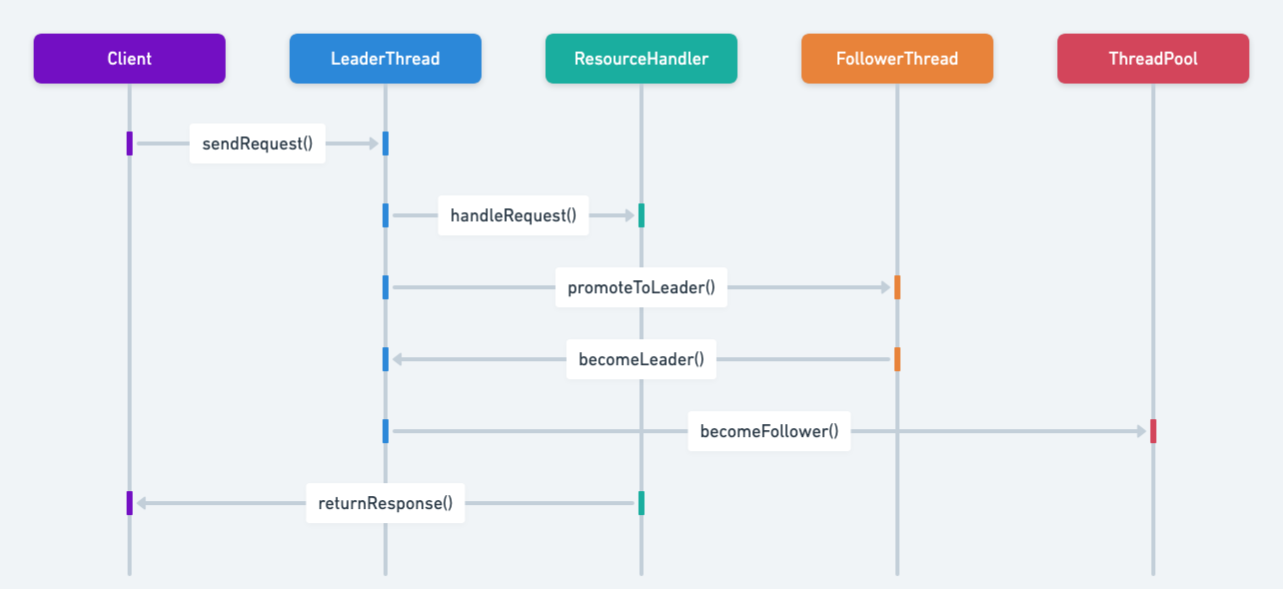
The key insight is the dynamic cycle of role changes:
- Event Detection: The leader thread detects a new event.
- Leader Promotion: The leader's first job is to promote one of the follower threads to become the new leader. This is typically done by signaling a condition variable the followers are waiting on. This ensures that another thread is immediately ready to handle the next incoming event.
- Event Processing: The original leader now transitions to the processing role. It handles the event it just detected from start to finish. There is no hand-off.
- Rejoining the Pool: Once the processing thread finishes its task, it transitions back to a follower, waiting for its next turn to become the leader.
This sequence is visualized well in the following diagram.
3. Deeper Dive: Structure and State Transitions
To implement this pattern, we need a few key components. The paper you're reading provides a detailed breakdown.
Leader/Followers: A Design Pattern for Efficient Multi-threaded Event Demultiplexing
Let's continue with the same paper to understand the components and the lifecycle of a thread within the pattern.
Read Section 6 ('Structure') and Section 7 ('Dynamics'). Pay close attention to the participants (Handle Set, Event Handler, Thread Pool) and the thread state transition diagram. This diagram is key to understanding the thread lifecycle.
Let's summarize the essential components and their interactions:
- Handle Set: An object that manages the collection of event sources (e.g., file descriptors). The leader thread waits on this set.
- Thread Pool: Manages the collection of threads and the synchronizer (e.g.,
std::mutexandstd::condition_variable) that orchestrates the promotion of a follower to a leader. - Event Handler: An interface that defines a hook method (e.g.,
handle_event()). When the processing thread gets an event, it calls this method on the appropriate concrete handler to perform the application-specific work.
The state transitions for any given thread are simple and elegant:
A thread's state transitions in the Leader/Followers pattern
This diagram from 'Evaluating and Optimizing Thread Pool Strategies' clearly shows the three states a thread can be in—Leading, Following, and Processing—and the events that trigger transitions between them.
Connecting to Previous Lessons
Notice that the thread in the Processing state handles the entire request. This is where the Thread-Specific Storage (TSS) pattern we discussed previously becomes a powerful optimization. The processing thread can allocate request buffers and other temporary data on its own stack or in its thread-local storage. This has two major benefits:
- It completely avoids the need for dynamic memory allocation from a shared heap, which would require locking.
- It improves CPU cache affinity, as all the data related to processing a request stays within the context of a single thread and likely a single CPU core.
4. Analysis: Performance and Trade-offs
The "analyze" part of our learning goal requires us to understand not just what the pattern is, but why and when to use it. Its benefits are best understood by comparing it to the alternative Half-Sync/Half-Async (queued) model.
Evaluating and Optimizing Thread Pool Strategies for Real-Time CORBA
This second paper provides a direct comparison of the Leader/Followers and Half-Sync/Half-Async strategies, including empirical performance data.
Please read Section 3.2.5 ('Consequences') and Section 4 ('Empirical results'). Focus on the table summarizing the evaluation criteria and the graph comparing performance. This will give you a concrete understanding of the pattern's trade-offs.
Benefits of Leader/Followers:
- Minimal Overhead: By eliminating the queue and the data handoff between an I/O thread and a worker thread, it significantly reduces overhead from synchronization, context switching, and memory management.
- Enhanced CPU Cache Affinity: As mentioned, because a single thread handles a request from I/O detection through to final processing, all the necessary data and instructions tend to stay hot in that CPU's cache.
- Reduced Priority Inversion: In real-time systems, the absence of an intermediate queue reduces opportunities for a high-priority task to be blocked by a low-priority task holding a lock on the queue.
Liabilities of Leader/Followers:
- Implementation Complexity: The logic for managing leader promotion, follower queuing, and thread role transitions is more complex than simply pushing to and popping from a thread-safe queue. The provided paper (LINK) shows just how involved the implementation can be.
- Lack of Flexibility: The Half-Sync/Half-Async model's queue is a natural place to implement features like request prioritization, reordering, or inspection for monitoring. This is much harder to do in the Leader/Followers model, as there is no explicit queue of pending work.
The performance graph in the paper you just reviewed tells a compelling story: the Leader/Followers pattern provides a massive performance boost when the work-per-request is small, because the fixed overhead of the queuing model dominates. As the application-level work increases, the advantage diminishes but remains present.
Test your understanding!
You are designing the core architecture for two different network servers:
- A high-frequency trading (HFT) server where every microsecond of latency counts. Requests are small and processing is very fast.
- A video processing server where tasks involve transcoding large files, taking several seconds each.
Which concurrency pattern—Leader/Followers or a queue-based Half-Sync/Half-Async—would you choose for each server, and why? Justify your choices based on latency, overhead, and workload characteristics.
Show answer
-
HFT Server: The Leader/Followers pattern is the ideal choice. The primary goal is minimizing latency. Leader/Followers excels here because it eliminates context switches between I/O and worker threads, avoids data copying, and removes synchronization overhead from a shared queue. Since the workload per request is small, these system-level overheads are the main performance bottleneck, and Leader/Followers is specifically designed to minimize them.
-
Video Processing Server: A queue-based Half-Sync/Half-Async model is more appropriate. The work per task (several seconds) is enormous compared to the microsecond-level overhead of a queue. The benefits of Leader/Followers would be negligible. More importantly, the queue provides flexibility that is valuable here. You could use it to prioritize certain jobs, limit the number of concurrent transcoding operations to manage system load, or re-route jobs to specialized hardware—features that are difficult to implement with Leader/Followers.
Conclusion
You have now analyzed the Leader/Followers pattern, a sophisticated and high-performance architectural model for concurrent event-driven servers. It stands in contrast to simpler queue-based thread pools by tightly integrating event demultiplexing with thread management to squeeze out performance.
Key Takeaways:
- Core Purpose: To efficiently handle events from multiple sources using a pool of threads by minimizing system overhead.
- Key Roles: Threads dynamically switch between being a Leader (waiting for events), a Follower (waiting to become leader), and Processing (handling an event).
- Central Dynamic: The leader detects an event, promotes a follower to be the new leader, and then processes the event itself. This avoids handoffs.
- Performance Profile: It offers significantly lower latency and higher throughput than queue-based models, especially when the work per request is low.
- Primary Trade-off: This performance comes at the cost of increased implementation complexity and reduced flexibility compared to queue-based designs.
Next Lesson Preview:
The Leader/Followers pattern, particularly its Event Handler component, relies on a callback-style mechanism (handle_event). This is just one way to structure asynchronous work. In our next lesson, we will broaden our view and compare different approaches to asynchronous task execution: callbacks, futures, and message passing. This will equip you to design and analyze a wider range of asynchronous APIs.