Hello! Welcome to a new module in our C++ journey.
In the previous module, we delved deep into the mechanics of runtime polymorphism, exploring vtables, vptrs, and abstract classes. You saw that to manage polymorphic objects, we frequently used manual new and delete. While this works, it places a heavy burden on the programmer to ensure every allocation is perfectly matched with a deallocation, a task that becomes incredibly difficult in the face of complex logic, early function returns, and especially exceptions.
This brings us to a cornerstone of modern C++: Resource Management. Your goal for this lesson is to explain the RAII (Resource Acquisition Is Initialization) principle as a core C++ idiom. This principle is arguably the most important concept for writing safe, robust, and maintainable C++ code. It's the language's elegant answer to the problems of resource leaks and is fundamental to the "zero-cost abstraction" philosophy that you're interested in.
The Problem: Manual Management is Fragile
First, let's hear from the creator of C++, Bjarne Stroustrup, on what he considers the most beautiful and fundamental feature of the language.
Bjarne Stroustrup: Constructors, Destructors, and Resource Acquisition Is Initialization (RAII)
In this short clip from an interview with Lex Fridman, Bjarne Stroustrup explains why constructor/destructor pairs are the key to C++ and how they enable the RAII principle.
Watch this clip from 00:51 to 03:10. Listen for his explanation of RAII and why he humorously regrets the name he chose for it.
As Stroustrup points out, the core idea is tying resource management to the lifetime of objects. Before we see how that works, let's formalize what we mean by a "resource" and why managing it manually is so hard.
Back to Basics: RAII and the Rule of Zero - Arthur O'Dwyer - CppCon 2019
Arthur O'Dwyer, in his CppCon talk "Back to Basics: RAII and the Rule of Zero", gives a clear definition of a resource and shows how easily manual management can fail.
Watch the segment from 01:07 to 03:17. Pay attention to the variety of things that count as a resource—it's not just heap memory. This includes file handles, mutex locks, and network sockets, all of which are critical in systems programming.
Coming from C, you are well-acquainted with the discipline required for manual management. For every malloc, there must be a free. For every fopen, an fclose. The problem, as this article explains, is that this discipline is fragile.
RAII: Compile-Time Memory Management in C++ and Rust
This article, "RAII: Compile-Time Memory Management in C++ and Rust", frames the problem perfectly. It contrasts error-prone manual management with the performance overhead of garbage collection, positioning RAII as C++'s zero-cost solution.
Read the section titled "The Problem: Manual Memory Management is Hard, GC is “Slow”". This will connect directly to your experience with C and your interest in performant, systems-level code.
Consider this simple C-style function:
#include <cstdio>
#include <stdexcept>

void process_file(const char* filename) {
    FILE* f = fopen(filename, "r");
    if (!f) {
        // Handle error and return
        return;
    }

    // ... perform some operations on the file ...
    if (/* some intermediate error occurs */) {
        // We must remember to close the file before returning!
        fclose(f);
        return;
    }

    // ... more operations ...

    // Finally, close the file at the end
    fclose(f);
}
Notice how you must remember to call fclose(f) on every single exit path. Forgetting just one fclose results in a resource leak. Now, imagine this function was much more complex, or worse, what if one of the operations threw an exception? The fclose call would be skipped entirely.
The Solution: Resource Acquisition Is Initialization (RAII)
C++ solves this by automating the cleanup. The RAII idiom dictates that you should tie the lifetime of a resource to the lifetime of an object.
- Acquire the resource in the object's constructor.
- Release the resource in the object's destructor.
Because the C++ language guarantees that a destructor will be called whenever an object's lifetime ends, the resource cleanup is also guaranteed. The object acts as a wrapper or a "handle" to the resource.
Let's see this in action by fixing a memory leak.
Back to Basics: RAII and the Rule of Zero - Arthur O'Dwyer - CppCon 2019
Let's return to Arthur O'Dwyer's talk. He demonstrates a naive vector-like class that leaks memory and then fixes it by adding a single, simple destructor, perfectly illustrating the RAII principle.
Watch from 03:17 to 06:26. Observe how the NaiveVector initially leaks its heap-allocated array, and how adding ~NaiveVector() ensures the delete[] call happens automatically when the vec object goes out of scope.
This is the beauty of RAII. You don't write cleanup code in the function body; you encapsulate it within a class's destructor. The C++ standard library is built on this principle. std::string, std::vector, and others manage their own memory. When a std::string object is destroyed, its destructor automatically frees any heap memory it was using.
This scales beautifully. If you have an object that contains other objects, the compiler ensures all destructors are called in the correct order, automatically managing complex, nested resources with no run-time overhead.
RAII: Compile-Time Memory Management in C++ and Rust
The article we read earlier provides excellent examples of how RAII works with standard library types like std::string and how the compiler automates cleanup for complex, nested data structures.
Read the sections "Raw RAII: How RAII Works on its Own" and "Ownership and its limitations". Focus on how std::unique_ptr and std::string abstract away the manual new/delete calls, and how the concept of "ownership" is central to this model.
The Mechanism: Stack Unwinding and Exception Safety
The most powerful guarantee of RAII is that it makes your code exception-safe. But how? When a throw statement is executed, the program doesn't just jump to the catch block. It performs a process called stack unwinding.
As you know from your C and OS background, when functions are called, they create stack frames that hold local variables and return addresses. Stack unwinding is the process of destroying these stack frames, in reverse order of creation, until a frame within a try block is found. The crucial part is that as each stack frame is destroyed, the destructors for all local objects within that frame are called.
Let's look at a detailed explanation.
C++ Tutorial: Exceptions - Stack Unwinding - 2020
This article from bogotobogo.com provides a fantastic, low-level explanation of the call stack and the process of stack unwinding.
Read the section starting with the first code example (the MyClass example). Compare the output of the program with and without the throw statement enabled. This will clearly show you that even when the functions terminate abruptly, the destructors are still called, preventing leaks. The text following the code clearly explains what is happening.
The image below, from the same article, provides a great visual summary of the process.
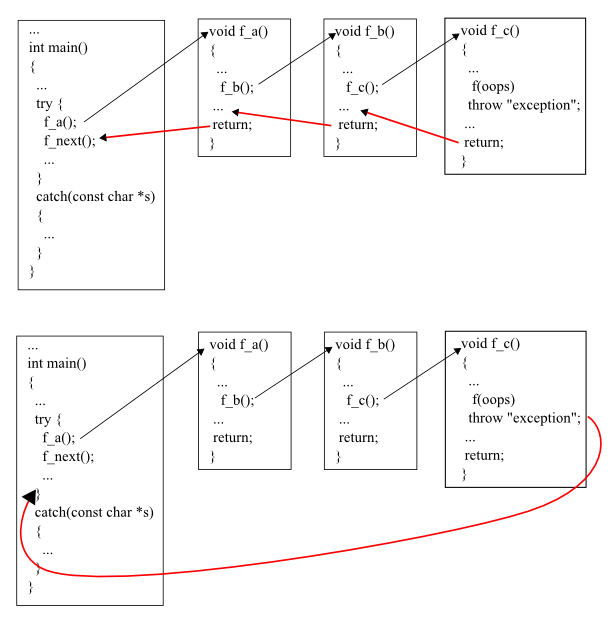
This guarantee from the C++ language is what makes RAII so robust. You can write cleanup logic once in a destructor and be confident it will execute, no matter how the function exits.
Test your understanding!
Imagine you are writing C++ code to control a robot arm. You have a C-style library with these functions:
// Returns a handle to the arm, or NULL on failure.
RobotArmHandle* grab_arm();

// Releases the arm. Must be called for every successful grab_arm().
void release_arm(RobotArmHandle* handle);

// Moves the arm. Can throw an exception if the move is invalid.
void move_arm(RobotArmHandle* handle, int x, int y);
How would you use the RAII idiom to write a C++ function that grabs the arm, moves it, and ensures it's always released, even if move_arm throws an exception? You don't need to write a full program, just sketch out the C++ class and the function that uses it.
Show answer
You would create a simple wrapper class that manages the RobotArmHandle*.
class RobotArm {
private:
    RobotArmHandle* handle;

public:
    // Constructor: Acquires the resource.
    RobotArm() {
        handle = grab_arm();
        if (!handle) {
            throw std::runtime_error("Failed to grab robot arm!");
        }
    }

    // Destructor: Releases the resource.
    ~RobotArm() {
        if (handle) {
            release_arm(handle);
        }
    }

    // A member function to use the resource.
    void move(int x, int y) {
        move_arm(handle, x, y);
    }

    // Disable copying to prevent double-free issues.
    RobotArm(const RobotArm&) = delete;
    RobotArm& operator=(const RobotArm&) = delete;
};
Then, the function using it becomes incredibly clean and safe:
void perform_task() {
    try {
        RobotArm arm; // Resource acquired here.
        arm.move(10, 20);
        // 'arm' goes out of scope here.
        // Its destructor is called automatically, releasing the handle.
    } catch (const std::exception& e) {
        // Even if move() throws, the 'arm' object is destroyed
        // during stack unwinding, and its destructor is called,
        // safely releasing the handle.
    }
}
This is the essence of RAII: encapsulating resource management within an object's lifetime to achieve automatic and exception-safe cleanup.
Conclusion
You have now learned the core principle of modern C++ resource management. This moves you away from the error-prone manual style of C and into a world where the compiler and language rules work for you to prevent entire classes of bugs.
Key Takeaways:
- RAII stands for Resource Acquisition Is Initialization. It's a C++ idiom where you bind the lifetime of a resource to the lifetime of an object.
- Resources are acquired in the constructor and released in the destructor.
- The C++ language guarantees that an object's destructor is called when it goes out of scope, either through normal function exit or during stack unwinding caused by an exception.
- This guarantee makes RAII the key to writing exception-safe code in C++, as it ensures resources are never leaked, even in the face of errors.
- This is a "zero-cost abstraction": the cleanup is deterministic and happens without the overhead of a garbage collector.
In the next lesson, we will solidify this concept by implementing a simple RAII wrapper for a file handle, building on the robot arm example. This practical exercise will prepare you to understand and use the standard library's smart pointers, which are powerful RAII wrappers for memory management.