Hello! Welcome back to our C++ thread pool project.
In our last lesson, we explored the inner workings of std::promise and std::future, creating a powerful mechanism to retrieve results from asynchronous tasks. Our thread pool is now highly functional, but it has a critical weakness: it doesn't shut down cleanly. If the ThreadPool object is destroyed, any tasks still waiting in the queue are simply lost, and the worker threads are abruptly terminated.
Today's lesson addresses this head-on. Our learning outcome is to implement a graceful shutdown mechanism that waits for pending tasks to complete. This is a non-negotiable feature for any production-quality thread pool. We will design a system that stops accepting new work, ensures all queued tasks are finished, and then cleanly terminates the worker threads. This process involves careful synchronization that touches on several core concurrency concepts you're keen to master.
The Challenge of Destruction
When a ThreadPool object's destructor is called, we need to orchestrate a careful sequence of events:
- Signal Termination: Inform all worker threads that no new tasks will be arriving.
- Process Remaining Work: Allow the workers to finish executing any tasks still in the queue.
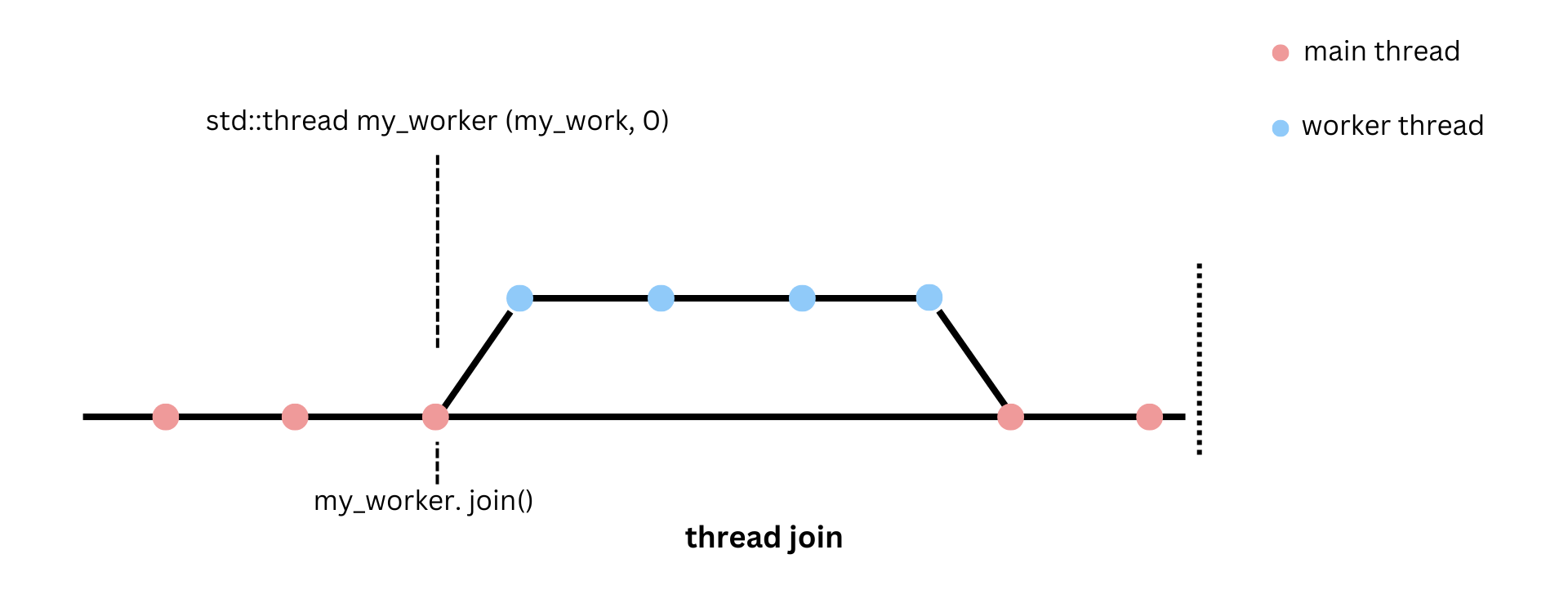
- Join Threads: The main thread must wait for every worker thread to finish its execution before the destructor can safely return and the pool's resources (like the task queue) can be deallocated.
Simply letting the destructor run would be catastrophic. The std::vector<std::thread> would be destroyed, and the C++ standard mandates that if a std::thread destructor is called for a thread that is still joinable (i.e., not joined or detached), std::terminate() is called, crashing the entire application.
Designing the Shutdown Mechanism
To implement a graceful shutdown, we need two key components:
- A stop flag (
std::atomic<bool>) to signal the intent to shut down. - A modification to the worker's main loop to check this flag and exit when appropriate.
Let's begin by studying a well-structured article that demonstrates a complete thread pool implementation, including the graceful shutdown logic we need.
From TCP Sockets to Thread Pools - Building a Production ...
The article 'From TCP Sockets to Thread Pools' provides a concise and effective implementation of a C++ thread pool. We will focus on its shutdown mechanism and the corresponding worker loop logic.
Please read two sections from this article: 'Worker Thread Event Loop' and 'Graceful Shutdown'. Pay close attention to how the stop atomic boolean is used in both the destructor and the worker's wait predicate.
Let's break down the logic presented in the article.
The Destructor: Orchestrating the Shutdown
The destructor is the trigger. Its job is to set the process in motion and wait for it to complete.
// Based on the [LINK](https://dev.to/rprakashdass/from-tcp-sockets-to-thread-pools-building-a-production-grade-c-web-framework-24db) resource
ThreadPool::~ThreadPool() {
    // 1. Set the stop flag. Lock is necessary for synchronization with the condition variable.
    {
        std::unique_lock<std::mutex> lock(taskQueueMtx);
        stop = true;
    }

    // 2. Notify all waiting threads to wake them up.
    condition.notify_all();

    // 3. Join all threads, waiting for them to finish.
    for(auto &worker : workerThreads) {
        if(worker.joinable()) {
            worker.join();
        }
    }
}
This sequence is crucial:
- Set
stop = true: This is our signal. We wrap it in a lock to ensure that when we notify the threads, they are guaranteed to see the updated value ofstop. condition.notify_all(): This is essential. If worker threads are sleeping incondition.wait(), they won't see the change tostopuntil they are woken up. We must wake up all of them so they can re-evaluate their wait condition and begin the shutdown process.join()loop: This blocks the main thread (the one running the destructor) until every single worker thread has finished itsworkerTaskfunction and exited.
The Worker: Responding to the Shutdown Signal
The worker's logic must be updated to recognize and act on the stop signal.
// Based on the [LINK](https://dev.to/rprakashdass/from-tcp-sockets-to-thread-pools-building-a-production-grade-c-web-framework-24db) resource
void ThreadPool::workerTask() {
    while(true) {
        std::function<void()> task;
        {
            std::unique_lock<std::mutex> lock(taskQueueMtx);

            // The magic happens here!
            condition.wait(lock, [this]() {
                return this->stop || !this->tasksQueue.empty();
            });

            // If woken up to stop and the queue is empty, exit.
            if(this->stop && this->tasksQueue.empty()) {
                return;
            }

            task = std::move(tasksQueue.front());
            tasksQueue.pop();
        } // Lock is released here

        task(); // Execute task outside the lock
    }
}
The condition.wait predicate is now return this->stop || !this->tasksQueue.empty();. This means a thread will stop waiting if:
- The pool is stopping, OR
- A new task has been added to the queue.
After waking, the if(this->stop && this->tasksQueue.empty()) check is the exit condition. It ensures that even after stop is set, the thread will continue to process the remaining items in the queue before finally returning from the function.
Test your understanding!
What would happen if we used condition.notify_one() instead of condition.notify_all() in the destructor?
Show answer
If we used notify_one(), only a single waiting thread would be woken up. That thread would see the stop flag, finish its work, and exit. The other threads would remain asleep, waiting on the condition variable. The join() loop in the destructor would then block forever when it tried to join these sleeping threads, resulting in a deadlock.
An Insidious Bug: Destruction Order
There is a subtle but deadly bug that can occur in this design, and it's a perfect example of the "under the hood" issues you're interested in. The order in which you declare member variables in your class header matters because it dictates the reverse order of their destruction.
Consider this class layout:
class ThreadPool {
private:
    std::vector<std::thread> workerThreads; // Declared FIRST
    std::mutex taskQueueMtx;                // Declared SECOND
    std::condition_variable condition;      // Declared THIRD
    // ...
};
When a ThreadPool object is destroyed, the members are destroyed in reverse order: condition, then taskQueueMtx, then workerThreads.
Now, imagine our join() loop in the destructor wakes up a worker thread. That worker thread's code in workerTask needs to use the condition variable and taskQueueMtx. But what if they've already been destroyed? The result is undefined behavior, most likely a crash.
The following video brilliantly captures a developer discovering and fixing this exact problem.
C++ Multithreading [Generic Task Pool]
The channel ChiliTomatoNoodle provides a great walkthrough of building a task pool. In this segment, he runs into a mysterious crash on shutdown and expertly debugs the cause, which turns out to be member destruction order. This is a fantastic real-world demonstration of the issue.
Watch from 35:11 to 37:25. The key insight comes when he realizes that the thread object is destroyed last, after the synchronization primitives it depends on are already gone.
The Fix: Always declare your std::vector<std::thread> (or std::vector<std::jthread>) as the last member variable in your class.
class ThreadPool {
private:
    // Primitives declared FIRST
    std::mutex taskQueueMtx;
    std::condition_variable condition;
    std::queue<std::function<void()>> tasksQueue;
    std::atomic<bool> stop;

    // Thread container declared LAST
    std::vector<std::thread> workerThreads;
public:
    // ...
};
This ensures the workerThreads vector is destroyed first. Our explicit join() loop in the ThreadPool destructor ensures the threads finish before their std::thread objects are destroyed. This guarantees that while the worker threads are running, all other class members (mutex, condition, queue) are still valid.
A Note on Performance and Correctness
In the workerTask loop, notice that the task is executed outside the locked critical section. This is vital for performance. If the lock were held during task(), only one thread could execute a task at a time, defeating the entire purpose of the thread pool.
This leads to a subtle behavior of condition variables.
condition_variable::notify_all() only wakes up one thread in ...
This Stack Overflow answer masterfully explains a common point of confusion with condition variables that's relevant to our shutdown logic. It explains what really happens when notify_all is called and multiple threads wake up.
Read the second answer (by Sam Varshavchik). Focus on the explanation of what wait() actually does: after being notified, a thread must re-lock the mutex before it can return from wait(). This explains why only one thread seems to make progress at a time if not handled correctly.
As the answer explains, when notify_all wakes up 8 threads, they don't all start running at once. They enter a race to re-acquire the mutex. One thread wins, gets the lock, returns from wait(), and enters the critical section. The other 7 threads are woken up but remain blocked, waiting for the lock.
This is why the pattern in LINK is so important:
- A thread wakes up and acquires the lock.
- It pops one task from the queue.
- It unlocks the mutex.
- It executes the task.
As soon as the first thread unlocks the mutex, one of the 7 waiting threads can acquire it, grab the next task, and so on, enabling true parallel execution.
Conclusion
You've now designed and understood the complete lifecycle of a thread pool, from creation to graceful termination. This is a significant milestone in building a robust, production-ready library for your portfolio.
Key Takeaways:
- Graceful shutdown is a three-step process: signal, notify, and join.
- A
std::atomic<bool>stop flag communicates the shutdown intent to worker threads. condition_variable::notify_all()is essential to wake up all sleeping threads so they can observe the stop flag.- The worker's
waitpredicate must be updated tostop || !queue.empty()to handle both shutdown and new tasks. - The worker loop must finish all queued tasks even after the stop flag is set.
- The order of member variable declaration is critical: the thread container must be declared last to ensure its dependencies (mutexes, CVs) outlive it during destruction.
- Executing tasks outside of the critical section lock is crucial for enabling concurrency.
Next Lesson Preview:
Our thread pool logic is now feature-complete. However, how can we be sure it's correct? Concurrency bugs are notoriously difficult to find. In the next lesson, we will begin the final module of the course: Project: Building a C++ Thread Pool. We'll start by setting up a testing framework (Google Test) and writing our first unit tests to validate the behavior of our thread-safe queue and task submission logic.