Introduction
Welcome to your next lesson. In our previous session, we established the "golden rule" of survival in Go: a group with two separate, real eyes is unconditionally alive. This rule provides a clear condition for safety, transforming a complex struggle into a solvable problem.
However, a common trap for improving players is misidentifying what constitutes an eye. Some shapes look like eyes but contain a fatal weakness. We call these false eyes. This lesson is dedicated to sharpening your analytical skills to distinguish between real and false eyes. Mastering this will prevent you from mistakenly believing a vulnerable group is safe and will also enable you to spot opportunities to kill your opponent's groups.
Defining the False Eye
Let's start with a formal distinction. In the last lesson, we saw that a real eye is an empty point that your opponent can't play on without committing suicide. A false eye is an empty point that looks like an eye, but your opponent can play on it because that move captures some of the stones forming the eye's border.
The vulnerability that creates a false eye lies not in the empty space itself, but in the insecurity of the stones surrounding it.
To see this in action, let's watch a short, clear explanation.
Eyes - How to Play Go (Episode 3)
This video from Brian's School of Go provides a concise definition of a fake (or false) eye and gives examples.
Watch from 01:53 to 03:57. Pay close attention to the core reason an eye is fake: one or more surrounding stones can be captured. The video will then test your understanding with several examples.
The key insight from the video is that an eye's integrity depends on the connections of the stones that form its wall. A diagonal break is the most common and important pattern to recognize.

A Simple Heuristic for Identifying False Eyes
Given your analytical background, you'll appreciate a clear, operational test. The question to ask yourself when evaluating a potential eye is:
Can my opponent play a legal move inside this "eye" that puts my group in atari?
If the answer is yes, it's not a real eye. This works because a legal move inside the eye implies that the move must capture something, revealing the eye's underlying weakness. Let's explore this idea through a forum discussion where a player grapples with this exact concept.
HELP : So damn confused in Eye! - Online Go Forum
This post from an online Go forum provides a very practical way to think about real vs. false eyes, framing it as a simple question.
Read the first two sections of this forum post. Start from the user's initial definition and read through to the clarifying rule: 'If the opponent can play enough legal moves inside one of your 'eyes' to put your group in atari, then it’s not a real eye.' This provides a robust mental model for checking an eye's validity.
This heuristic is powerful because it shifts the focus from passively recognizing a shape to actively probing for vulnerabilities.
The Consequences of a False Eye
Recognizing a false eye is critical because a group with one real eye and one false eye is dead. It functionally has only one eye. Forgetting this can lead to catastrophic losses where you believe a large group is safe, only to have your opponent destroy it with a single, well-placed stone.
Let's look at some life-and-death problems where the entire game hinges on correctly identifying and dealing with a false eye.
What Are False Eyes And How to Make Them Real Again?
The Go Magic channel offers excellent puzzles that illustrate the importance of spotting false eyes.
Watch from the beginning to 04:14. The first part (00:00 - 02:03) demonstrates how missing diagonal connections turn a real eye into a false one. The second part (02:03 - 04:14) presents several scenarios where you must decide if a group is alive or dead. Notice how in most cases, Black must play a defensive move to turn a false eye into a real one to survive.
The final example in that video clip (starting around 03:30) is particularly instructive. Black has one potential false eye, but already has two other real eyes. In this case, saving the false eye is a low-priority, one-point move. This highlights that you must assess the status of the entire group before deciding whether to fix a local defect.
Creating False Eyes: An Offensive Tool
Understanding false eyes isn't just for defense. You can use this knowledge to attack your opponent. By identifying weaknesses in their eye shape, you can play moves that create a false eye for them, turning a living group into a dead one. These clever, often surprising, tactical sequences are known as tesuji.
Many tesuji for creating false eyes involve a sacrifice, or a "throw-in" play. You place a stone where it can be immediately captured, but in doing so, you ruin the integrity of your opponent's eye shape.
What Are False Eyes And How to Make Them Real Again?
Let's return to the Go Magic video to see how you can go on the offensive by creating false eyes.
Watch from 04:14 to the end. Observe how a 'throw-in' sacrifice can put an opponent's stones into atari, forcing them to capture in a way that creates a fatal weakness in their eye.
This is a more advanced application, but it flows directly from the same core principle. You're engineering a situation where their own capture move creates the vulnerability you need to destroy their eye.
Final Examples for Analysis
To consolidate your understanding, let's look at a few more diagrams. The key is to examine the diagonal connections.
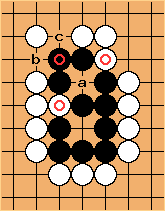
Now, let's review a few more cases.
This article provides clear diagrams of common false eye situations. Use them to test your recognition skills.
Read the section titled 'The imitation of eyes'. For each of the three examples (top-right, left, and bottom-right), trace the sequence of moves that allows White to destroy the false eyes.
Conclusion
You have now added a critical layer of sophistication to your understanding of life and death. The two-eyes rule is fundamental, but only when you can confidently distinguish real eyes from their deceptive counterparts.
Key Takeaways:
- A real eye is an unfillable empty point because any play inside would be suicide.
- A false eye is an eye-like shape where an opponent can play inside because that move captures part of the eye's wall.
- The primary vulnerability creating a false eye is a weakness in the surrounding stones, often a missing diagonal connection.
- A group with one real eye and one (or more) false eyes is considered dead.
- You can use this concept offensively by playing tesuji (like a throw-in) to create false eyes for your opponent.
In this lesson, we focused on the result—is the eye real or false? In our next lesson, we will shift focus to the process. We will explore how to form efficient shapes that are resilient and make it easy to create the two real eyes necessary for life.