Introduction
Welcome to your first lesson on the fundamentals of Go! Your goal is to develop an intuition for the game, moving beyond the basic rules to understand what makes a move good or bad. We'll start by building your tactical foundation.
In Go, short-range fights are often decided by who can capture whose stones. This lesson focuses on the two most fundamental capturing sequences: ladders and nets. Mastering them is your first step toward evaluating tactical situations. These sequences are deterministic; if the conditions are right, a capture is guaranteed. Your experience with algorithmic thinking will be helpful here, as executing these tactics is like running a simple, predictable program on the Go board.
By the end of this lesson, you will be able to recognize opportunities to use ladders and nets and execute them correctly to capture stones.
Ladders: The Zigzag Chase
A ladder (or shicho in Japanese) is a foundational capturing technique. It involves a zigzag sequence of moves, each one putting the opponent's stones into atari (one liberty remaining), relentlessly driving them across the board until they are trapped against the edge or another group of stones.
To see a ladder in action, let's watch a short video.
Beginner Go Series E4: Ladders and Nets
The following clip from the 'In Sente' YouTube channel introduces the basic ladder sequence. Pay attention to how each of Black's moves forces White's response, creating an inevitable chase.
Watch from the beginning of the 'Ladders' section until the start of the next problem. (Timestamp: 02:09 - 04:22)
As you saw, the ladder is a forced sequence. The defender has no choice but to extend, and the attacker simply follows, maintaining the atari.
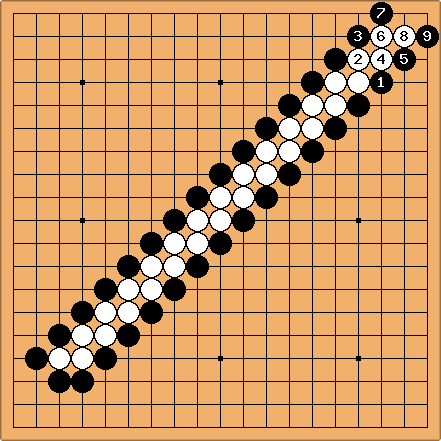
When Ladders Fail: The Ladder Breaker
A ladder does not work if the chased stones can run into a friendly stone (a "ladder breaker") before they hit the edge of the board. If this happens, the pursued group suddenly gains extra liberties, and the ladder is "broken". The attacker's stones, which formed the ladder, are now weak and can be captured themselves.
This is why you must always "read" a ladder to its conclusion before you start one. This process of mentally visualizing the sequence of moves is a core skill in Go.
Let's see what a broken ladder looks like.
Beginner Go Series E4: Ladders and Nets
This next segment from the same video demonstrates how a single 'ladder breaker' stone can completely turn the tables, making the ladder a disastrous move for the attacker.
Watch the section explaining broken ladders. Notice how the presence of other stones on the board determines whether the ladder succeeds or fails. (Timestamp: 04:22 - 08:51)
The key takeaway is that a ladder's success is not purely local; it depends on the state of the entire path it will travel. Before initiating a ladder, you must trace the zigzag path across the board and confirm there are no enemy stones waiting to break it.
Test your understanding!
Imagine you are playing as Black. You see an opportunity to start a ladder to capture a white stone. The ladder sequence will run diagonally towards the top-left corner of the board. Near that corner, but not directly on the ladder's path, is one of your own (Black's) stones. Does this friendly stone help your ladder succeed?
Show answer
No, it does not. A ladder is only affected by the chased player's stones (in this case, White's stones) in its path. Your own stones are irrelevant unless the opponent's stones run directly into them, which is not the case for a ladder chase. The ladder will succeed or fail based only on whether there are any white stones (ladder breakers) in its way.
Nets: A More Secure Capture
What if a ladder doesn't work? Often, the alternative is a net (or geta in Japanese). A net captures stones by surrounding them and blocking all their escape routes, without necessarily using a sequence of ataris. It's like throwing a net over the fish instead of chasing them into a corner.
When a ladder is broken, a net is frequently the correct way to capture.
Beginner Go Series E4: Ladders and Nets
Let's return to the 'In Sente' video to see how a net works. This part begins with the exact position where we just saw a ladder fail, and shows the net as the correct solution.
Watch the introduction to nets and the examples of netting one or two stones. (Timestamp: 08:51 - 12:26)
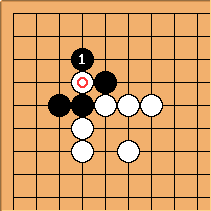
Nets are generally considered a more reliable capture than ladders because their success depends only on the local position. You don't need to read halfway across the board. However, like ladders, nets can sometimes fail if the surrounding stones are not positioned correctly, allowing the target to "slip through the mesh."
Beginner Go Series E4: Ladders and Nets
Finally, watch this brief segment showing a situation where a net can fail due to the clever resistance of the opponent.
Watch the 'Last Problem' example for nets. (Timestamp: 12:26 - 14:17)
If both a ladder and a net are possible to capture the same stones, the net is almost always the better choice. It is more efficient, achieving the capture with a single move and leaving no weaknesses. A ladder requires you to follow through with the capture, giving your opponent extra moves elsewhere on the board.
Application: From Tactics to Evaluation
Understanding ladders and nets isn't just for capturing stones. It's fundamental to evaluating the strength and safety of your own positions. Many standard moves and shapes in Go are considered "good" precisely because any attempt to cut them can be defeated by a ladder or a net.
Beginner Go Series E4: Ladders and Nets
This final clip connects the dots, explaining how the threat of a ladder or net makes certain common shapes (like the knight's move) strong and connected.
Watch the concluding section on how these concepts are applied in games. This is key to developing your intuition. (Timestamp: 14:17 - 17:57)
When you look at a move, you can start to ask: "If my opponent cuts here, can I capture the cutting stone in a ladder? Or a net?" If the answer is yes, your position is solid. If no, it might be weak. This is the beginning of moving from knowing the rules to playing with intent.
For Deeper Study (Optional)
If you'd like to solidify these concepts, I highly recommend the first chapter of Toshiro Kageyama's classic book, "Lessons in the Fundamentals of Go." Kageyama's writing is famous for its clarity and emphasis on the mental discipline required for Go, which you may appreciate. He treats the patient reading of ladders as a foundational exercise for strengthening your analytical abilities in the game.
Toshiro Kageyama Lessons In The Fundamentals Of Go
Read Chapter 1 of 'Lessons In The Fundamentals Of Go' by Toshiro Kageyama. This chapter is dedicated entirely to ladders and nets, providing numerous examples and stressing their importance.
The chapter begins on page 9. You can focus on the sections titled 'Ladders' and 'Nets'. The text is accompanied by many helpful diagrams.
Conclusion
In this lesson, we've covered the two most basic tactical sequences in Go.
Key Takeaways:
- Ladders are a forced, zigzag sequence of ataris used to capture stones.
- You must always read a ladder to its end to check for potential ladder breakers before playing one. A broken ladder is often a catastrophe for the attacker.
- Nets capture stones by surrounding them and blocking their escape routes. They are generally more secure and efficient than ladders.
- Understanding these capture sequences is crucial not just for fighting, but for evaluating the strength and stability of your own positions.
Now that you can execute a capture, the next logical question is: should you capture? In our next lesson, we will explore the decision-making process when your opponent puts one of your stones in atari, and you must choose whether to save your stone, capture theirs, or even sacrifice your stone to gain an advantage elsewhere.