Hello! Welcome back.
In our last lesson, we used a decision tree to map out the potential paths stemming from the US decision to implement a naval quarantine. We saw how it was a strategy to manage risk and control the pace of events. Today, we will shift from mapping potential futures to analyzing the actual sequence of events during the crisis.
Each action and reaction during those 13 days can be seen as a step up or down a ladder of conflict intensity. This lesson introduces the "escalation ladder," a powerful framework developed during the Cold War to understand and manage crises between nuclear powers. Our goal is to use this framework to analyze the moves and counter-moves made by Kennedy and Khrushchev, mapping both the deliberate and accidental steps that took the world to the brink of nuclear war and back.
By the end of this lesson, you will be able to analyze the 13 days of the crisis using the 'escalation ladder' framework to map potential and actual escalatory steps.
The Theory of Escalation
Before the nuclear age, a great power conflict could, in theory, escalate to "total war," where a nation's entire resources were mobilized for victory. The atomic bomb changed this calculus entirely. The top of the conflict ladder was no longer victory, but mutual annihilation. This created a new and terrifying strategic problem: how to pursue national interests against a nuclear-armed rival without triggering a catastrophe.
A key thinker who tackled this problem was the RAND Corporation strategist Herman Kahn. His work provides us with the central framework for today's lesson.
To begin, let's watch an introduction to the concepts of escalation management and Kahn's ladder. While this video uses the modern conflict in Ukraine as its case study, the theoretical principles it explains were forged during the Cold War and are directly applicable to our analysis of the Cuban Missile Crisis.
Escalation Strategy & Aid in Ukraine - How the West manages Russian nuclear threats and 'red lines'
This video from the channel Perun provides an excellent explanation of Herman Kahn's escalation ladder and the related concept of escalation dominance.
Please watch the segment from 11:22 to 15:47. Focus on understanding: The basic structure of Kahn's 44-rung ladder. The idea of 'thresholds' that separate different levels of conflict. The concept of 'escalation dominance'—having an advantage at a particular level of conflict.
As the video explains, Kahn's ladder provides a vocabulary for crisis management. It breaks down the path from a stable international situation to all-out nuclear war into discrete steps, suggesting that escalation is not necessarily an uncontrollable slide but a series of decisions.
For a more detailed look at the ladder and its origins, the following article is very insightful. Given your background in Cold War history, you will find the context around Kahn's thinking particularly interesting.
Imagining Armageddon: Herman Kahn's nuclear ladder
This article from Prospect Magazine delves into Herman Kahn's work and how the Cuban Missile Crisis itself shaped his thinking on escalation.
Please read the first half of the article, down to the end of the section that begins 'Kahn writes of ‘serious nuclear warfare’...'. Pay attention to how the article explicitly notes that rungs 10 to 20—including ultimatums and blockades—are 'reminiscent of what had lately played out between the superpowers over Cuba.'
Mapping the Crisis onto the Ladder
Now, let's apply this framework to the 13 days in October 1962. We can use Kahn's ladder to chart the crisis's trajectory, identifying the key actions that moved the superpowers up or down the rungs.
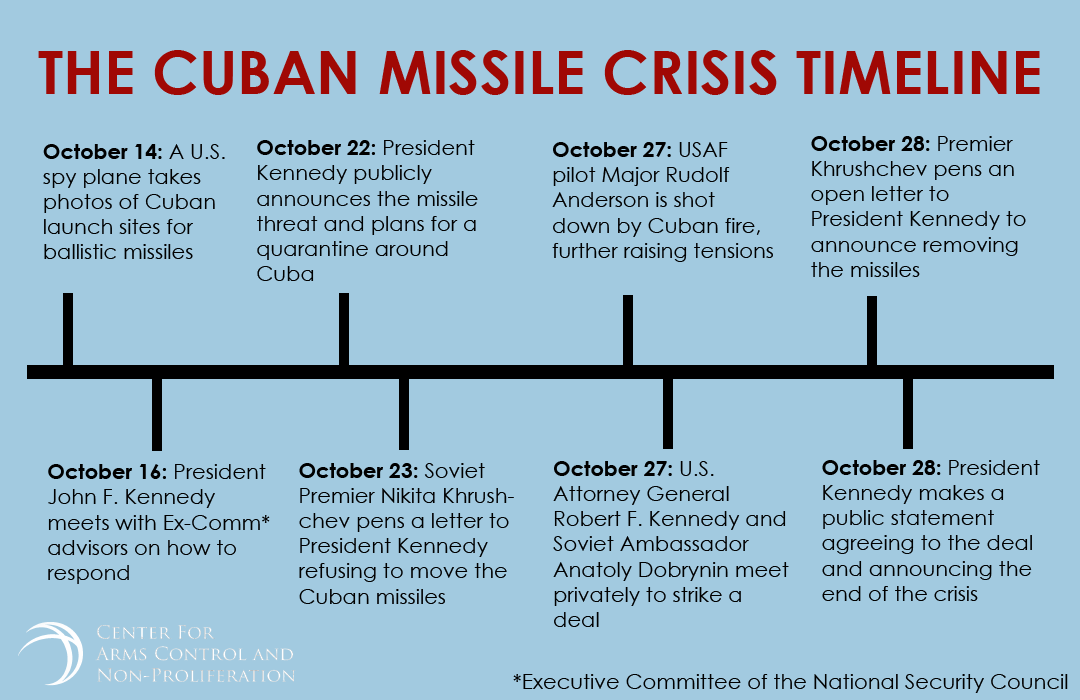
This timeline provides a useful reference for the sequence of events we will be analyzing.
Phase 1: Climbing the Lower Rungs (Subcrisis to Traditional Crisis)
The crisis began with a significant but covert move by the USSR.
- Rung 1-3 (Subcrisis Manoeuvring): The secret deployment of Soviet missiles to Cuba. This was a significant strategic action but was done below the threshold of open confrontation.
- Rung 4-9 (Traditional Crisis): The US discovery of the missiles on October 16th initiated the crisis proper. The ExComm debates represented a "Confrontation of Wills" (Kahn's Rung 4).
- Rung 10/11 (Dramatic Military Confrontations/Blockade): President Kennedy's televised address on October 22nd was a major escalatory step. He made the crisis public and announced the naval "quarantine." In Kahn's terms, this was a clear move across the "Don't Rock the Boat Threshold" into a direct, public military confrontation.
The world was now watching, and the next move belonged to Khrushchev.
Phase 2: The Brink (Approaching the "Nuclear War is Unthinkable" Threshold)
The period from October 24th to October 27th saw a rapid climb to the most dangerous rungs short of actual nuclear use.
-
DEFCON 2: On October 24th, the US Strategic Air Command (SAC) was ordered to DEFCON 2, the highest level of alert short of war. This placed the US nuclear bomber force on a literal war footing, with B-52s in the air 24/7. This was a clear, unambiguous signal of seriousness and a major step up the ladder.
-
"Black Saturday," October 27th: This day marked the peak of the crisis, where events began to spiral out of the leaders' direct control. Several incidents occurred, any one of which could have triggered a catastrophic, uncontrolled escalation.
To understand the precariousness of this moment, it's essential to look at the details of these events. The following resource provides a stark account of the "accidents" and near-disasters of Black Saturday.
One Step from Nuclear War | National Archives
The National Archives article, 'One Step from Nuclear War,' offers a gripping account of the events of October 27th and the chaos that threatened to overtake the decision-makers.
Please read the section titled 'While the ExComm Debated, Chaos Proved Troublesome.' Focus on the series of unplanned and unauthorized escalatory events: The shootdown of the U-2 spy plane over Cuba. The accidental overflight of Soviet territory by another U-2. General Powers unilaterally raising the DEFCON level and broadcasting it 'in the clear'. The confrontation with Soviet submarine B-59, which nearly resulted in the launch of a nuclear torpedo.
These events highlight a critical flaw in the idea of a neatly managed escalation ladder. Here we see:
- Unauthorized Escalation: The Soviet field commander's decision to shoot down Major Anderson's U-2.
- Accidental Escalation: The U-2 pilot accidentally straying into Soviet airspace.
- Command & Control Failure: The B-59 submarine captain, cut off from Moscow and believing war had begun, was only stopped from launching a nuclear weapon by a single dissenting officer, Vasily Arkhipov.
On Black Saturday, both sides were high up the ladder, approaching what Kahn called the "Nuclear War is Unthinkable Threshold." The combination of official military posturing and near-catastrophic accidents had brought them perilously close to the upper rungs, where "Barely Nuclear War" (Rung 15) could have begun.
Phase 3: Climbing Down the Ladder
The extreme danger of October 27th seems to have been the catalyst for de-escalation. Both Kennedy and Khrushchev stared into the abyss and realized they had to find a way down.
- Back-channel Agreement: Robert Kennedy's secret meeting with Ambassador Dobrynin was the crucial step down. The US offered a public pledge not to invade Cuba in exchange for missile withdrawal.
- The Secret Sweetener: The US also secretly agreed to remove its obsolete Jupiter missiles from Turkey at a later date. This allowed Khrushchev a way to save face and present the outcome as a mutual concession, not a capitulation.
- Public Resolution: On October 28th, Khrushchev announced over Radio Moscow that the missiles would be dismantled. The US publicly accepted, and the immediate crisis was over.
The resolution demonstrates a key feature of the escalation ladder concept: it is not a one-way street. A primary goal of crisis management is to find "off-ramps" or ways to climb back down once a point has been made.
A Critical Reflection: Ladder or Slippery Slope?
The escalation ladder is a powerful analytical tool, but the reality of the Cuban Missile Crisis exposed its limitations.
Many analysts, reflecting on the near-disasters of Black Saturday, concluded that a nuclear crisis is less like a ladder you can cautiously climb and more like a slippery slope.
One Step from Nuclear War | National Archives
The final section of the National Archives article reflects on this very point, discussing the legacy of the crisis for nuclear strategy.
Please read the section titled 'More Than a Crisis: A Global Event.' Focus on the paragraph that begins 'The literal fright that the crisis engendered...'.
The crisis showed that once you move up the ladder, factors like fear, miscalculation, technical failure, and the sheer complexity of military operations can wrest control from the leaders. While Kennedy and Khrushchev were trying to manage the crisis rung by rung, their subordinates and the circumstances on the ground were creating moments that could have caused them to fall off the ladder entirely.
Conclusion
In this lesson, we used Herman Kahn's escalation ladder to structure our analysis of the Cuban Missile Crisis. This framework helps us categorize the intensity of different actions and appreciate the thresholds that were crossed.
Key Takeaways:
- The escalation ladder is a model that breaks down the path from peace to nuclear war into distinct rungs, providing a framework for analyzing crisis actions.
- The Cuban Missile Crisis can be mapped onto this ladder, from the initial covert deployment, to Kennedy's public quarantine (a "dramatic military confrontation"), to the high alert of DEFCON 2.
- "Black Saturday" (October 27th) represented the peak of the crisis, where the world stood on the highest rungs short of actual war, pushed there by both deliberate actions and dangerous, uncontrolled accidents.
- The resolution involved finding a way to climb back down the ladder through a combination of public pledges and secret agreements, allowing both sides to de-escalate.
- The crisis itself served as a powerful critique of the ladder model, demonstrating that escalation can feel more like a "slippery slope" where control is easily lost.
We have now examined the crisis through several policy analysis frameworks: Cost-Benefit Analysis, decision trees, and the escalation ladder. These tools have helped us understand the what and how of the 13 days. In our next module, we will turn to game theory to explore the why—the underlying strategic logic that drove the decisions of Kennedy and Khrushchev.
Our next lesson will begin this new module by asking you to construct a simplified 2x2 game matrix representing the initial US-Soviet confrontation over Cuba, defining players, strategies, and payoffs.