Introduction
In our last lesson, we explored the Fogg Behavior Model (B=MAP) as a micro-level diagnostic tool, allowing us to dissect a single behavioral failure—like a learner not completing their environment setup—into its core components of Motivation, Ability, and Prompts. This provided a precise language for understanding why a specific action breaks down.
This lesson builds on that foundation by moving from the specific to the general. Instead of looking at a single point of failure, we will classify the common, recurring patterns of behavioral barriers that lead to early dropout in intense learning environments like bootcamps. Your learning outcome for this lesson is to be able to classify these common barriers, such as overwhelm, isolation, and unclear value. We'll use a framework from behavioral economics to structure our thinking and then ground it in empirical research on actual coding bootcamp students, giving you a pattern library of problems to spot in any learning experience.
A Framework for Behavioral Barriers
To create a robust classification system, it's helpful to start with a theoretical lens. Your background in economics will make this framework feel familiar. We can group the myriad reasons for dropout into a few core categories of behavioral failure. A landmark NBER paper on the behavioral economics of education provides an excellent structure for this.
[PDF] NBER WORKING PAPER SERIES BEHAVIORAL ECONOMICS OF ...
This paper by Lavecchia, Liu, and Oreopoulos offers a powerful framework for understanding why students don't always act in their own long-term best interests. It synthesizes insights from psychology and neuroscience into categories that are highly relevant to our dropout problem.
Please read the section titled "II. Barriers to Treating Education as Investment" (starting on page 6). Focus on the four key implications the authors highlight: Present Bias: Understand how the immediate, salient costs of studying can loom larger than distant, abstract benefits. Inertia and Information Gaps: Note how our reliance on automatic thinking can cause us to miss opportunities that require breaking from routine or seeking new information. Negative Identity: Grasp how concerns about social belonging and self-perception ("Am I the kind of person who succeeds here?") can powerfully influence educational decisions. Choice and Information Overload: See how having too many options or poorly presented information can lead to paralysis or poor decisions, a key component of what we call 'overwhelm'.
These four categories—Present Bias, Inertia/Information Gaps, Negative Identity, and Overload—provide a powerful lens. They help us see that when a student drops out, it's often not a single, rational decision, but the result of one or more of these cognitive and social pressures reaching a tipping point.
Now, let's see how these abstract barriers manifest in the specific, high-pressure context of a coding bootcamp.
From Theory to Reality: Barriers in Coding Bootcamps
A qualitative research study by Kyle Thayer and Amy J. Ko at the University of Washington provides a rich, ground-level view of the exact challenges your target learners face. By combining the economic framework above with these real-world findings, we can build a practical classification of the most common and potent barriers to persistence.
[PDF] Barriers Faced by Coding Bootcamp Students - Kyle Thayer
This paper is based on interviews with 26 bootcamp students and gives us direct insight into their struggles. It's a goldmine for understanding the "why" behind early dropout.
We will read a few key sections to see how the theoretical barriers play out in reality. First, to understand overwhelm, read the section on Personal Obstacles within bootcamps. Find the subsection that begins with a discussion of "intensity" (page 251). Notice the descriptions of the time commitment and resulting stress. Next, for isolation and identity, read the two sections on Informal Boundaries. Focus on the discussions of identity and belonging (pages 248-249) and the similar discussion of informal boundaries within the bootcamps (page 250). Pay close attention to mentions of impostor syndrome and cohort divides. Finally, for unclear value, read the first part of the section on Personal Obstacles in the software industry journey. Focus on the paragraphs describing the unexpected time commitment and financial strain after the bootcamp (pages 249-250). This highlights the gap between expected and actual time-to-value.
The reading provides visceral, first-hand accounts of the problems. Let's now formally classify them, linking them back to our B=MAP model and the behavioral economics framework.
1. Overwhelm & Burnout
This is perhaps the most common barrier in any intensive program. It's fundamentally an Ability problem in the B=MAP model, driven by excessive demands on Mental Effort and Time. In the NBER framework, it maps to Choice/Information Overload.
The Thayer paper paints a vivid picture:
- Extreme Time Commitment: Students report "Ten, twelve hours at least per day, and sometimes fourteen or sixteen hours" with no weekends.
- Cognitive Exhaustion: This leads to a state where students feel "so burnt out, I can’t even think. I can’t process." This is a state of depleted cognitive resources, making even simple tasks feel impossible.
- Neglect of Basic Needs: Students report neglecting everything not directly related to the bootcamp, from laundry to hygiene to relationships. This creates a cascading negative effect on well-being and motivation.
When a learner is in a state of overwhelm, their perceived ability to tackle any new task plummets, meaning even a small, unexpected bug or a slightly confusing concept can feel like an insurmountable wall.
2. Isolation & Negative Identity
This barrier is a potent mix of Motivation and Ability failures. A sense of belonging is a core human need, directly mapping to Fogg's motivational concept of "Social Acceptance/Rejection." When this need is unmet, motivation wanes. It also becomes an Ability problem under "Social Deviance"—if you feel you don't belong, asking for help feels risky, making it harder to complete tasks. This barrier is a direct manifestation of the Negative Identity category from the NBER paper.
The research highlights several facets:
- Impostor Syndrome: Students report feeling they are not "real" developers, even after months of study. This erodes confidence, a key personal obstacle.
- Cohort Divides: A particularly sharp finding was the divide between students with prior experience and those without. This creates a social dynamic where beginners feel "dumb and not smart enough," leading them to quit.
- Lack of Demographic Diversity: The paper notes the lack of women and racial minorities, making students from these groups feel like outsiders and question, "how do I do that?" when they are the only one on a team.
Isolation is insidious because it creates a negative feedback loop: feeling isolated reduces a learner's motivation to engage, which in turn leads to more isolation.
3. Unclear Value & Misaligned Expectations
This is a classic Motivation failure, specifically of Anticipation. If the connection between a current, painful task and a future, desired reward is weak or unclear, motivation evaporates. This is a direct consequence of Present Bias, where the immediate, certain cost of effort outweighs a distant, uncertain benefit.
Your product management background provides a perfect analogy here.
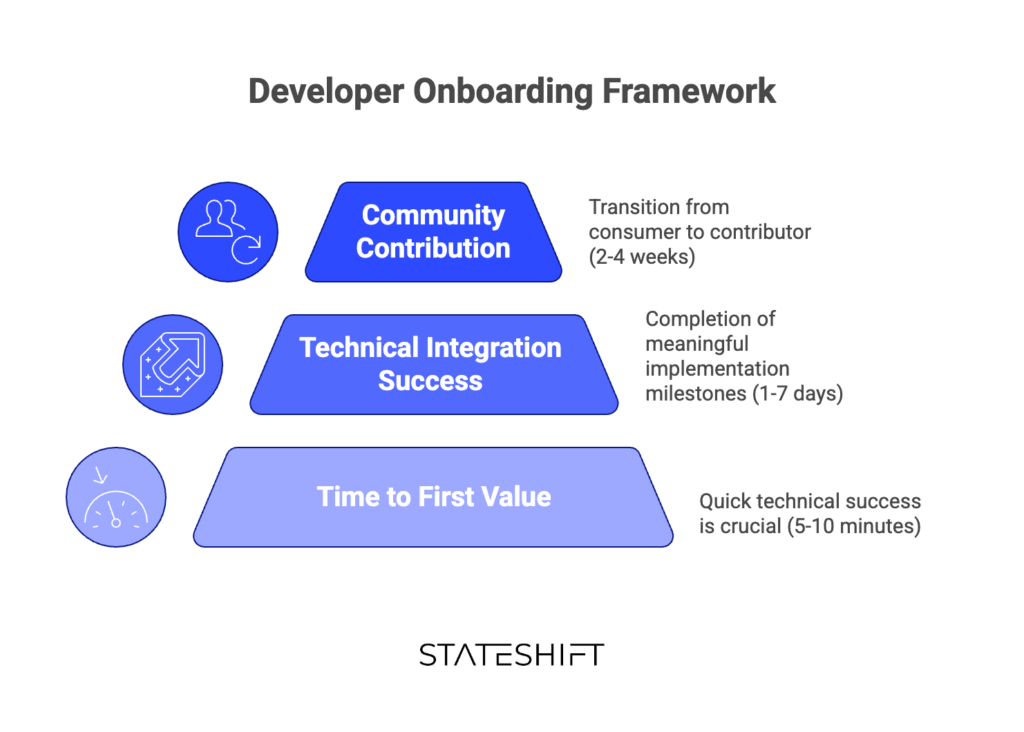
Just as a SaaS product must deliver a "quick win" to demonstrate its value and hook a new user (Time to First Value), a learning platform must make the benefits of early, often tedious, tasks feel immediate and tangible.
The bootcamp paper shows what happens when this fails:
- Delayed Payoff: Students were often surprised that the career transition could take "a year or more," far beyond the 3-6 month bootcamp duration. The "reward" was much further away than they anticipated.
- Sunk Cost Fallacy in Reverse: Some students felt that embarking on the bootcamp made their previous education and career "obsolete," creating a sense of loss that wasn't immediately replaced by a clear gain.
- Financial Strain: The prolonged job search post-graduation meant the financial costs were much higher than expected, making the entire value proposition seem shaky.
When a learner asks, "Why am I spending hours trying to configure this database when my goal is to build a cool app?", they are experiencing a failure of unclear value. The platform has failed to make the connection between the current effort and the desired outcome sufficiently salient.
Synthesis: The Ecosystem of Dropout
These barriers don't exist in a vacuum. They are interconnected and often reinforce one another. The diagram below, from a study on university dropout, provides a powerful visualization of this ecosystem of risk factors.

Notice how the factors we've classified are all present here. Overwhelm appears as "Mental health and academic stress." Isolation is "Weak social/family support network" and "Limited social satisfaction/integration." Unclear Value is captured by "Low motivation and vague goals" and "Vocational misalignment." The model shows how these psychosocial factors, combined with economic realities, create a powerful current pulling students toward dropping out.
Your Turn: Classifying Barriers
Let's put this classification system into practice. In the first lesson, you brainstormed friction points in a typical bootcamp journey. Let's take one of those and apply our new lens.
Scenario: A learner signs up for a bootcamp and the first task is to read a 30-page PDF on "The Philosophy of Agile Development" before writing any code. Analytics show a 25% drop-off at this step.
Your Task (5-10 minutes):
- Briefly diagnose this using the B=MAP model from the last lesson. What is the likely failure in Motivation, Ability, and Prompt?
- Now, using the classification from this lesson, categorize the primary behavioral barrier(s) at play. Is it mainly Overwhelm, Isolation, or Unclear Value? Justify your classification by referencing the concepts we've discussed.
Take a moment to formulate your answer. This will help you transition from simple diagnosis to pattern recognition.
Conclusion
In this lesson, we have built a practical classification of the most common behavioral barriers that cause early learner dropout. By layering a behavioral economics framework over real-world research from coding bootcamps, we can now confidently classify problems into three major categories:
Key Takeaways:
- Overwhelm & Burnout: An 'Ability' problem driven by excessive cognitive load and time pressure. It drains mental resources, making learners fragile.
- Isolation & Negative Identity: A 'Motivation' and 'Ability' problem rooted in a lack of belonging, impostor syndrome, and social friction. It saps the will to continue and makes seeking help difficult.
- Unclear Value & Misaligned Expectations: A 'Motivation' problem caused by 'Present Bias', where the immediate costs of learning feel disconnected from distant rewards. This is analogous to a poor "Time to First Value" in product onboarding.
These categories give you a powerful shorthand. When you see a problem on a learning platform, you can now quickly ask: "Is this an overwhelm problem? An isolation problem? A value-prop problem?" This moves you closer to designing effective solutions.
In our next lesson, we will synthesize the skills from this entire module. You will learn how to conduct a behavioral audit of an existing onboarding flow, using journey mapping, B=MAP diagnosis, and barrier classification to identify and prioritize specific dropout triggers for intervention.