Welcome to the next lesson in our journey through the mathematics of machine learning. In our previous sessions, you learned to visualize matrices as linear transformations that stretch, rotate, and shear space. We also saw how multiplying matrices is equivalent to composing these transformations.
Today, we'll introduce a way to capture a fundamental property of a transformation in a single number: the determinant. This lesson addresses the first learning outcome in this module: to compute the determinant of a 2x2 matrix and interpret it as the factor by which area is scaled. This concept is more than a computational tool; it's a deep geometric idea that will help us understand when a transformation is irreversible and what that implies for our data and models.
What is the Determinant?
At its core, the determinant tells you how much a linear transformation scales area. Imagine a 1x1 square on a grid. After applying a matrix transformation, this square might become a stretched and slanted parallelogram. The determinant is the area of that new parallelogram.
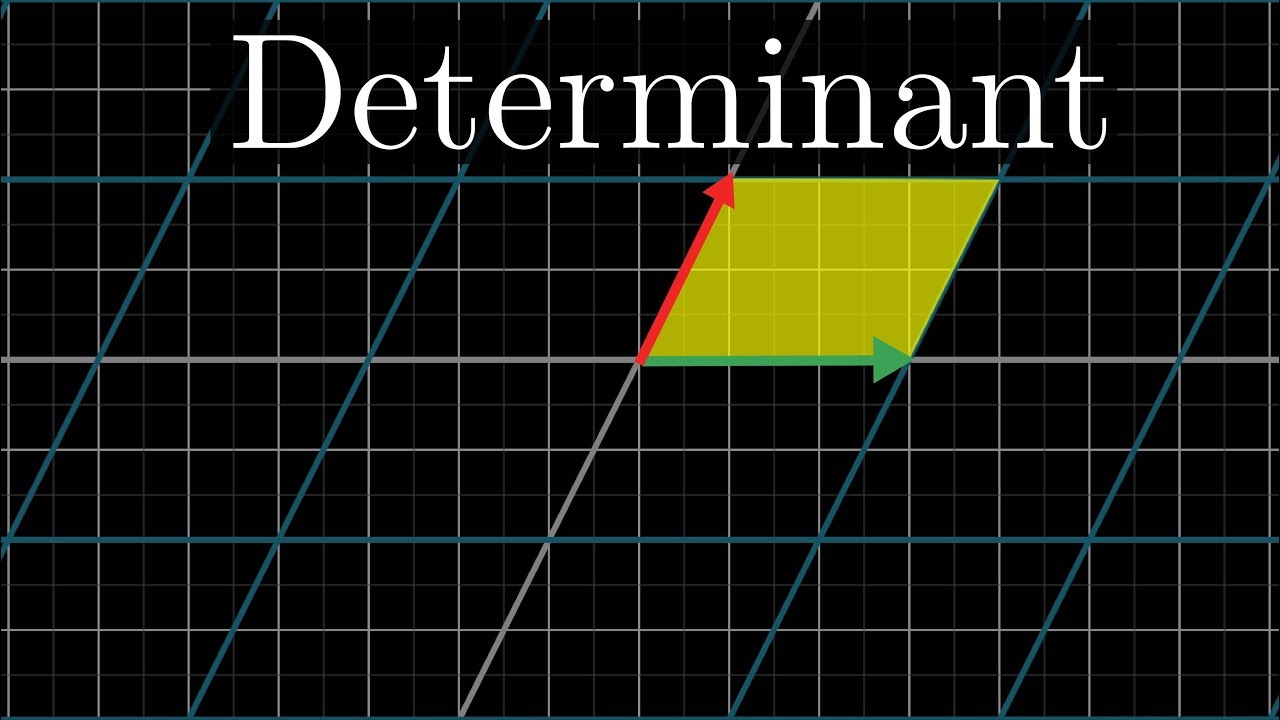
A linear transformation warps the grid lines. The determinant measures how the area of each grid square changes. Here, the unit square defined by the basis vectors transforms into the yellow parallelogram.
The fantastic 3Blue1Brown video series, which you've found helpful, provides the best visual intuition for this.
The determinant | Chapter 6, Essence of linear algebra
Please watch the beginning of the video "The determinant" from the 3Blue1Brown channel. It introduces the core concept of the determinant as an area scaling factor.
Watch from the start until the timestamp 2:59. Pay close attention to how the area of a single unit square changing tells you about the area change for any region in the plane.
As the video explains, this scaling factor is a universal property of the transformation. If the unit square's area is scaled by a factor of 6, the area of any shape you draw on the plane will also be scaled by 6. This single number, the determinant, quantifies the "stretching" or "squishing" effect of a matrix on the entire 2D space.
The Sign of the Determinant: What About Orientation?
You might notice that determinants can be negative. How can an area be negative? A negative determinant signifies that the transformation has "flipped" or inverted the orientation of space.
In 2D, you can think of orientation by looking at the basis vectors. Initially, (the basis vector ) is to the left of (the basis vector ). If a transformation results in the new being to the right of the new , the orientation has been flipped. It's like turning over a sheet of paper.
The determinant | Chapter 6, Essence of linear algebra
Let's continue with the same 3Blue1Brown video to understand what a negative determinant means.
Please watch the segment from 3:42 to 4:59. This part explains the concept of orientation and its connection to the sign of the determinant.
So, the determinant gives us two pieces of information:
- The absolute value, , is the factor by which the transformation scales area.
- The sign, , tells you if the orientation of space is preserved (positive) or inverted (negative).
Computing the 2x2 Determinant
Now that we have the geometric intuition, let's look at the formula for a 2x2 matrix. For a matrix :
The determinant is calculated as:
The columns of this matrix, and , are the vectors where the basis vectors and land after the transformation. The area of the parallelogram formed by these two vectors is precisely .
Let's explore the intuition behind this formula.
The determinant | Chapter 6, Essence of linear algebra
The 3Blue1Brown video provides a quick intuition for this formula.
Watch the short segment from 7:37 to 8:35. It explains why the ad term makes sense for simple scaling transformations.
The ad term represents the area of a rectangle if the matrix were diagonal (i.e., if b and c were zero). The -bc term is a correction factor that accounts for the "shearing" or "slanting" of this rectangle into a parallelogram.
For a deeper, complementary intuition on why we subtract bc, the following video offers a fantastic analogy.
3: Determinant Formula Intuition - Valuable Vector Calculus
This video from Mu Prime Math provides a different geometric breakdown of the ad - bc formula.
Watch from 6:19 to 11:24. The key idea here is the "book closing" effect, which gives a tangible reason for the subtraction in the formula. It shows how the b and c terms, which represent cross-directional mappings (how y affects x and vice-versa), work against the main ad scaling to reduce the area.
The image below provides yet another way to derive this formula, this time by carving up a large rectangle and subtracting the areas of the surrounding triangles and smaller rectangles. The area of the central parallelogram is what remains.
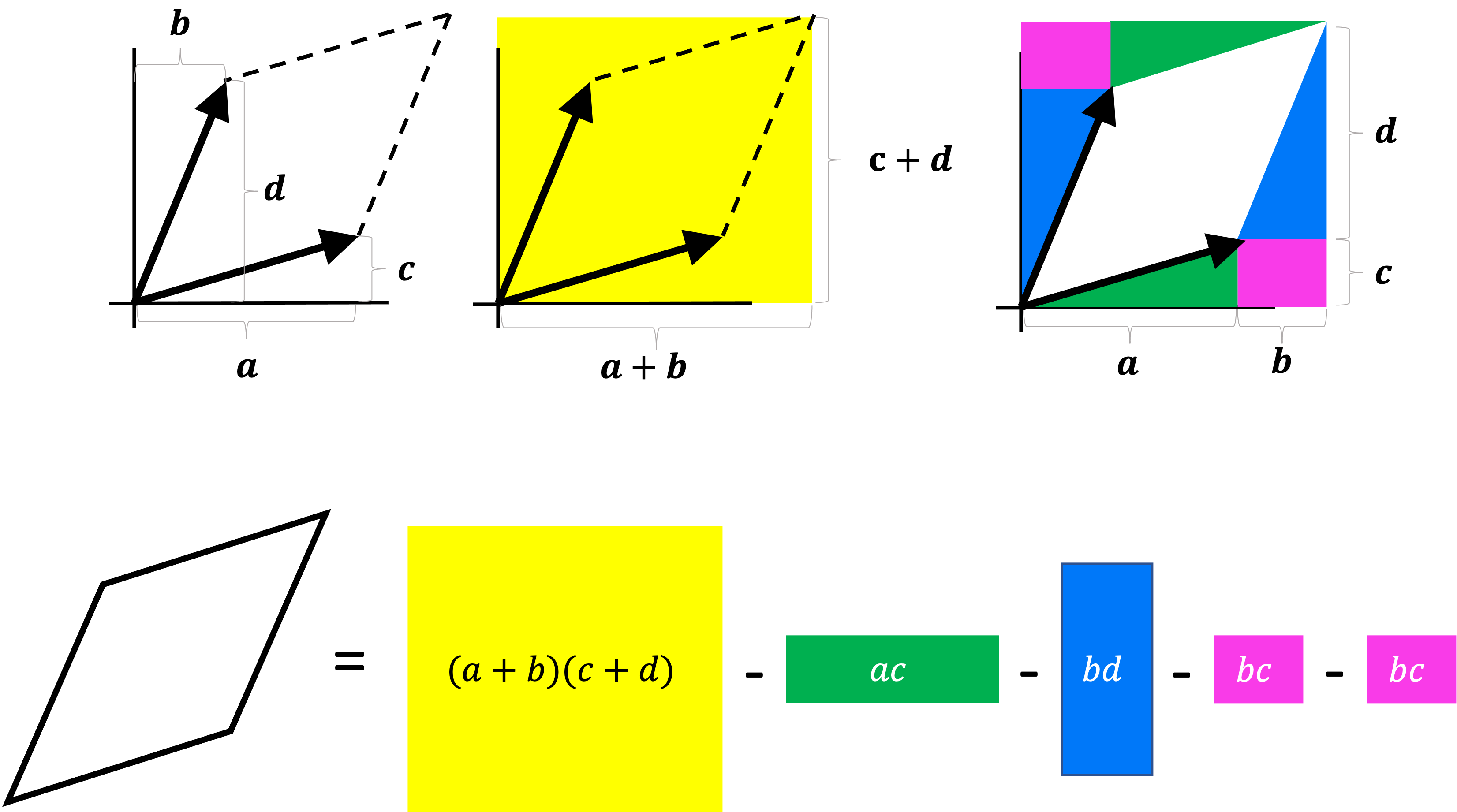
This image illustrates a geometric proof for the formula ad - bc. The area of the parallelogram is found by taking the area of the large outer rectangle (a+b)(c+d) and subtracting the areas of the surrounding pieces, ultimately simplifying to ad - bc.
Connection to Machine Learning and What's Next
The determinant is a fundamental concept that appears in various areas of machine learning:
-
Change of Variables in Probabilistic Models: When transforming probability distributions (a common task in generative modeling), the determinant of the Jacobian matrix (a matrix of partial derivatives, which we'll see later) is used to ensure the total probability remains 1. Models like Normalizing Flows rely heavily on this.
-
Diagnosing Data Transformations: If you apply a linear transformation to your features, the determinant tells you if you are expanding or compressing the feature space. A very small determinant suggests your data is being squeezed into a much smaller region, which might affect the performance of distance-based algorithms like k-Nearest Neighbors.
-
Invertibility and Model Solvability: This is the most immediate application for us. As we will see in the next lesson, a determinant of zero is a critical indicator. It means the transformation squishes space into a lower dimension (e.g., a plane into a line). Such a transformation is irreversible, or "singular." This has profound implications for solving systems of linear equations, which lies at the heart of models like linear regression.
To start thinking about this connection, let's look at a brief passage that frames the determinant's primary role.
Introduction to Linear Algebra for Applied Machine Learning ...
This reading reinforces the determinant's role as an indicator of a matrix's character, specifically its invertibility.
In the section "Determinant", read from the beginning paragraph down to the end of the first paragraph. Notice how it's described as "determining" if a matrix is singular or not.
Summary and Preview
In this lesson, we established the geometric meaning of the determinant.
- Key Takeaways:
- The determinant of a 2x2 matrix is calculated as .
- Geometrically, the absolute value of the determinant is the factor by which a linear transformation scales area.
- The sign of the determinant indicates whether the transformation preserves orientation (positive) or flips it (negative).
In our next lesson, we will explore the special and highly important case where the determinant is zero. You will learn why this makes a matrix "singular," what that means geometrically (a collapse in dimensionality), and why this concept is a cornerstone for understanding the stability and solvability of many machine learning models.