Introduction
In our previous lesson, we saw how the Moore-Penrose pseudoinverse provides a robust way to find the "best" solution to a linear system, even when multicollinearity creates infinite possibilities. This was about finding a specific vector that solves (or best approximates) .
Now, we will shift our perspective entirely. Instead of focusing on solving a system, we're going to analyze the geometry of the transformation matrix itself. We'll ask a fundamental question: when a matrix transforms an entire space of vectors, are there any vectors that have a special, simpler relationship with the transformation? Specifically, are there any directions that remain unchanged?
The answer to this question leads us to eigenvectors and eigenvalues, two of the most important concepts in linear algebra, particularly for machine learning. The term "eigen" is German for "characteristic" or "own," and these vectors and values reveal the deep, intrinsic structure of a linear transformation. For you, this concept is the mathematical key to understanding Principal Component Analysis (PCA) and the geometry of data variance. This lesson will focus on building a strong geometric intuition for what eigenvalues and eigenvectors are.
Stability Amid Transformation
A linear transformation, represented by a matrix , can stretch, squish, shear, and rotate space. Most vectors, when transformed, are knocked off the line they originally span. However, for almost every matrix, there exist special vectors that do not change their direction. The transformation only scales them—making them longer, shorter, or flipping them to point in the opposite direction.
These special vectors are the eigenvectors of the transformation. The factor by which they are scaled is their corresponding eigenvalue, denoted by the Greek letter lambda ().
The phenomenal 3Blue1Brown video below provides the best visual intuition for this idea.
Eigenvectors and eigenvalues | Chapter 14, Essence of linear algebra
This video masterfully illustrates how a linear transformation affects different vectors, leading to the discovery of special "eigenvectors" that stay on their own span.
Please watch the first four minutes, from the beginning to the main definition. As you watch, focus on the visual distinction between vectors that are "knocked off their span" and those that simply get stretched or squished along the same line.
To reinforce this, you can read through the first part of the companion article, which covers the same ground with text and static images.
Eigenvectors and eigenvalues - 3Blue1Brown
This text from 3Blue1Brown solidifies the concepts from the video.
Read the section titled An example. Pay attention to how it identifies two distinct sets of eigenvectors for the sample transformation, each with its own eigenvalue.
This central idea is beautifully summarized in the following infographic.
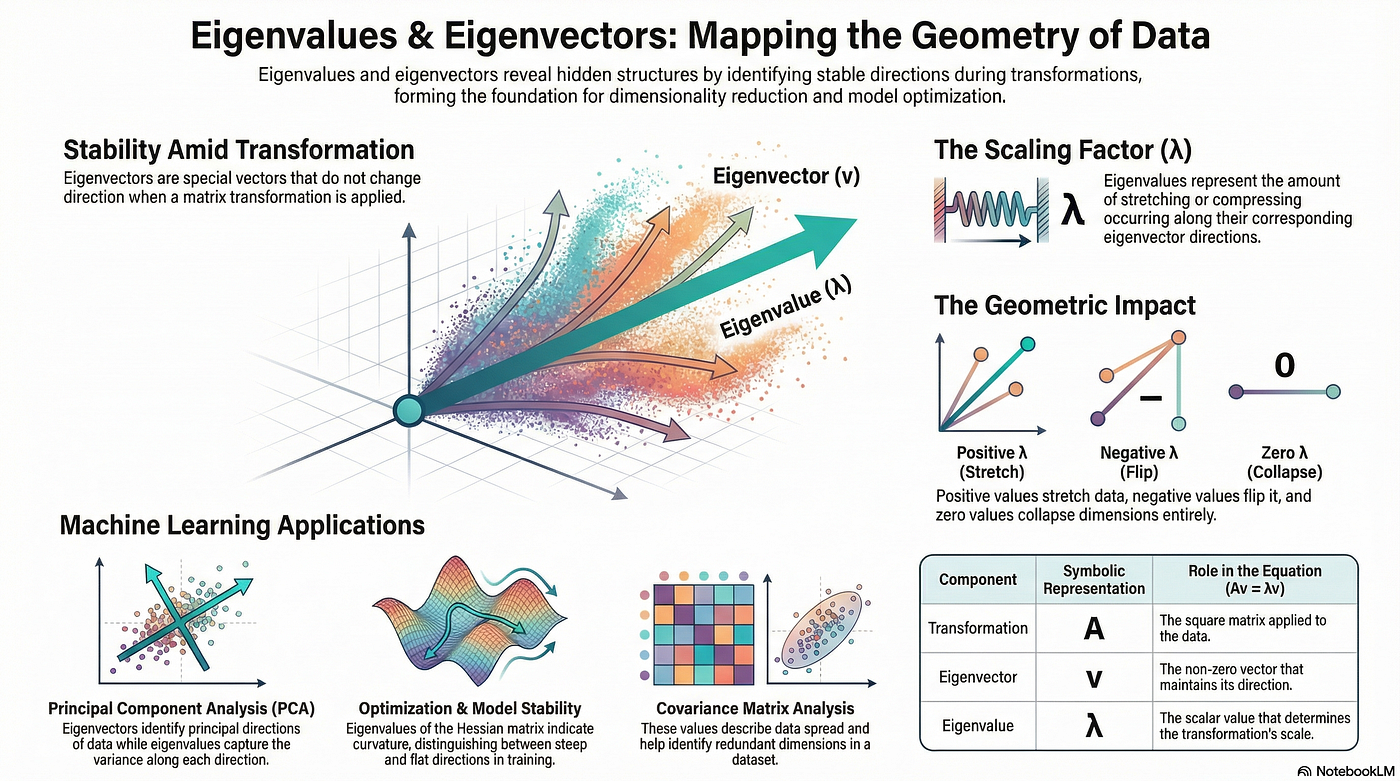
As you can see, the eigenvalue tells you how the eigenvector is scaled:
- If , the eigenvector is stretched.
- If , the eigenvector is squished.
- If , the eigenvector is flipped and then scaled.
- If , the eigenvector is unchanged.
- If , the eigenvector is collapsed to the zero vector. This means the transformation squishes a whole dimension out of the space.
The Defining Equation of Eigen-Things
This geometric concept can be expressed with a simple but powerful equation. If is an eigenvector of matrix , and is its corresponding eigenvalue, then:
Let's break this down:
- The left side, , represents the action of the transformation on the vector .
- The right side, , represents the simple action of scaling the vector by a scalar .
The equation states that these two actions are identical. The complex, multidimensional action of a matrix multiplication on an eigenvector simplifies to a straightforward scalar multiplication. This is the algebraic essence of the geometric intuition we just built.
Eigen Intuitions: Understanding Eigenvectors and ...
This article provides another clear visualization and neatly formalizes the intuition into the core equation.
Read from the beginning, through the section The mathematics. The GIF animation provides another helpful perspective on the concept, and the text then directly translates this observation into the equation A\mathbf{x} = \lambda\mathbf{x}.
Eigenvectors of Different Transformations
Thinking about the eigenvectors of different geometric transformations can deepen your understanding.
Reflection: Consider a matrix that reflects vectors across a line (e.g., the green line in the image below).
- Any vector lying on the line of reflection is an eigenvector. It is not changed by the reflection, so its eigenvalue is .
- Any vector lying perpendicular to the line of reflection is also an eigenvector. It gets flipped to point in the exact opposite direction, so its eigenvalue is .

Rotation: Now consider a 2D rotation (other than by 0 or 180 degrees), as shown on the right side of the image above. Every single vector in the plane is rotated and ends up pointing in a new direction. No vector stays on its own span. Therefore, a 2D rotation matrix has no real eigenvectors. This is a crucial insight: not all transformations have these special invariant directions in real space.
3D Rotation: As the 3Blue1Brown video briefly mentioned, this changes in 3D. Any 3D rotation must have an axis of rotation. Any vector lying on this axis is left unchanged by the rotation. Therefore, the axis of rotation is an eigenvector with an eigenvalue of . This is a beautiful example of an abstract mathematical concept having a direct, physical interpretation.
Connection to Machine Learning and Your Work
Why are we so focused on these "characteristic directions"? In machine learning, we often apply this analysis not to a transformation matrix, but to a covariance matrix, which describes the spread and orientation of a dataset.
The eigenvectors of a dataset's covariance matrix point in the directions of maximum variance—these are the "principal axes" of the data cloud. The corresponding eigenvalues tell you how much variance lies along each of those axes.
This is the exact mechanism behind Principal Component Analysis (PCA). By finding the eigenvectors of the covariance matrix, you identify the most important directions in your data. By projecting your data onto the few eigenvectors with the largest eigenvalues, you can reduce dimensionality while preserving the maximum possible amount of information (variance). This is directly applicable to analyzing high-dimensional biological data, like the genomic data in your cancer classification project, to find the most significant patterns of variation.
Conclusion
In this lesson, you have developed the core geometric intuition for one of linear algebra's most fundamental concepts.
Key Takeaways:
- Eigenvectors are the special, non-zero vectors that are not knocked off their span by a linear transformation; their direction is invariant.
- Eigenvalues are the scalar factors by which the eigenvectors are stretched, squished, or flipped.
- The relationship is elegantly captured by the equation .
- Different transformations have different eigenvector patterns. Reflections have eigenvectors, but 2D rotations do not (in real space).
- In machine learning, the eigenvectors of a covariance matrix define the principal components of a dataset, which are the directions of maximum variance.
So far, we have only defined these objects geometrically. We've relied on looking at a transformation and visually spotting the vectors that stay on their line. This is great for intuition, but not for computation. In the next lesson, we will bridge this gap. You will learn how to take the geometric definition and rearrange it into a concrete algebraic procedure for finding the eigenvalues of any square matrix.