Welcome to your first lesson in the Coffee Roasting course. As a professional barista, you've mastered the final stages of coffee's journey—brewing and extraction. Now, we'll go back to the very beginning to build the foundation for your new goal of becoming a professional roaster. This first module on Green Coffee Fundamentals is designed to give you a deep understanding of your raw material.
Today's lesson addresses the first learning outcome: describing the anatomy of a coffee cherry and the parts of the green coffee bean. We will dissect the coffee fruit layer by layer, from its outer skin to the core of the seed. Understanding this structure is fundamental. The composition and state of each layer, largely determined by processing methods, will directly influence how the bean behaves in the roaster and the final flavor in the cup.
From Fruit to Seed
The coffee we roast and brew is not a bean in the botanical sense, like a pinto or kidney bean. It is the seed of a fruit. Specifically, the coffee cherry is a type of fruit known as a drupe, similar to a peach, olive, or cherry. A key characteristic of a drupe is its structure: a fleshy outer part surrounding a hardened pit or stone, which contains the seed.
To begin, let's watch a short video that introduces this concept and provides a high-level overview of the coffee fruit's anatomy.
Lessons in Coffee Processing - Coffee Fruit Anatomy
This video from the Coffee Institute provides a clear introduction to the coffee cherry as a drupe and outlines its main components.
Watch the first two minutes of the video. Pay attention to the comparison with a peach and the initial breakdown into the main parts: the pericarp (fruit) and the seed. The segment from introduces the drupe concept, and the following part from shows a basic diagram of the cherry's structure.
As the video explained, the coffee cherry can be divided into two primary parts:
- The Pericarp: The "fruit" portion.
- The Seed: The "bean" that we ultimately roast.
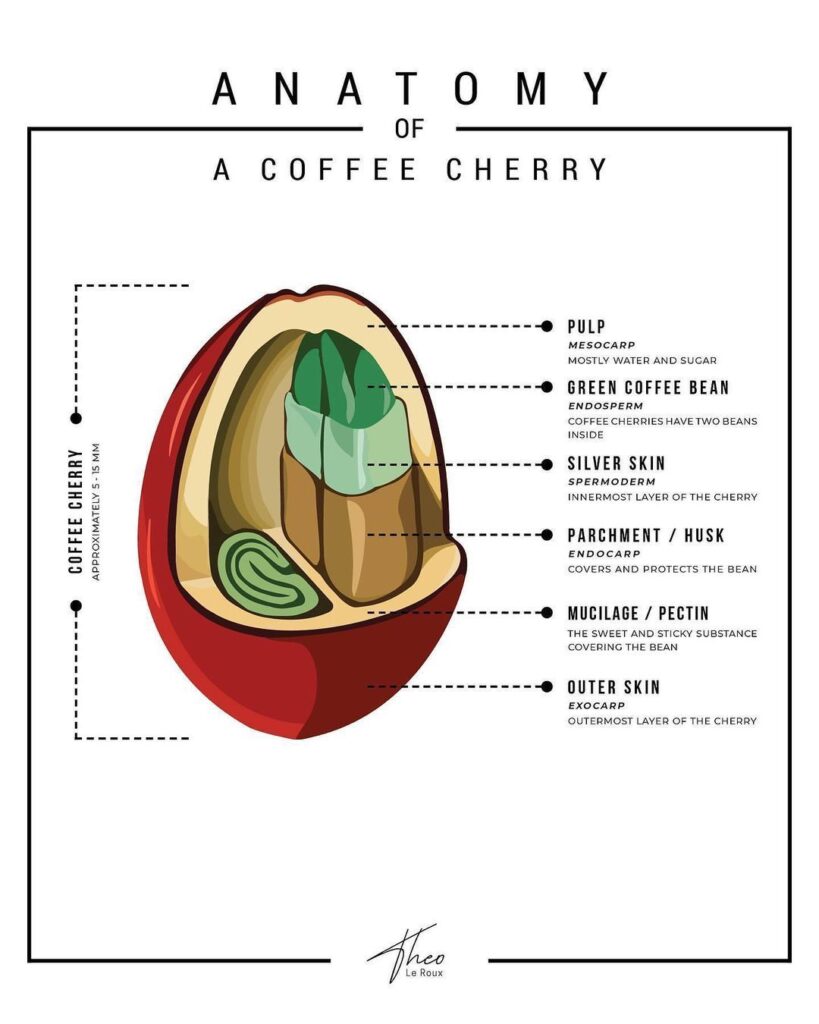
Now, let's examine the layers of each of these parts in detail, moving from the outside in. The two images below show this anatomy. The first is a real cross-section, and the second is a helpful diagram. You can refer back to these as we explore each layer.

The Pericarp: The Fruit Layers
The pericarp itself consists of three distinct layers. These layers protect the seed and their chemistry plays a huge role in the development of flavor, especially during the coffee processing stage after harvest.
-
Exocarp (Outer Skin): This is the outermost skin of the cherry. As a barista, you've likely seen images of vibrant red or yellow coffee cherries on bags of coffee. That color is the exocarp, and its change from green to red, yellow, or even purple signifies ripeness. The sugars within the fruit are at their peak at this stage, which is why harvesting ripe cherries is the first critical step in producing high-quality coffee.
-
Mesocarp (Pulp and Mucilage): Beneath the skin lies the fruit flesh. This is comprised of two parts:
- Pulp: The fibrous, fleshy part of the fruit.
- Mucilage: A sticky, honey-like layer rich in sugars (like sucrose and fructose) and pectins that coats the parchment. The presence of this sugar-rich layer is essential for the fermentation that occurs in many processing methods. The way this layer is handled—either removed with water (washed process) or left to dry on the bean (natural and honey processes)—is one of the most significant factors determining a coffee's final flavor profile.
-
Endocarp (Parchment): This is a hard, protective shell that surrounds the coffee seeds. It feels like brittle parchment paper when dried, hence the name. This layer protects the bean from physical damage and environmental contaminants. Coffee is often stored and transported in this "parchment" state to preserve its quality and is hulled just before being exported or sold to roasters.
To solidify your understanding of these outer layers, the following reading provides more detail on their composition and function.
This article from Kau Coffee Mill provides clear, detailed descriptions of each part of the coffee bean and cherry.
Please read the sections describing the three layers of the pericarp. Focus on understanding the function of each layer and its common name. Start with the Outer Skin or Exocarp. Then, read about the Mucilage or mesocarp. Finally, read the section on the Parchment or endocarp.
The Seed: The Green Coffee Bean
Inside the parchment layer, you will typically find two seeds, each with a flat side facing the other. This is the "green coffee" that you will purchase and roast. The seed itself also has several layers.
-
Spermoderm (Silver Skin): This is a very thin, delicate layer of tissue that adheres directly to the surface of the seed. It's called silver skin because of its silvery appearance. Some of it remains on the green bean after processing and flakes off during the roasting process. This material is known as chaff. As a roaster, you will become very familiar with chaff, as it is collected by your roasting machine and must be cleaned out regularly to prevent fire hazards.
-
Endosperm: This is the main body of the coffee seed and makes up the vast majority of its mass. The endosperm is the critical raw material for roasting. It is a dense structure of cells containing the chemical compounds—lipids, carbohydrates (sugars), proteins, and organic acids—that are the precursors to the thousands of aromatic compounds that create the flavor and aroma of roasted coffee. The cellular density and moisture content of the endosperm are two of the most important physical properties you will consider when developing a roast profile.
-
Embryo: Tucked inside the endosperm is the embryo, the tiny, living part of the seed from which a new coffee plant would sprout. While it makes up a negligible part of the bean's weight and isn't a direct concern for flavor, its presence reminds us that the green coffee bean is a living agricultural product. The viability of the embryo is an indicator of the freshness and quality of the green coffee.
The following video segment provides a great visual comparison between the botanical terms we've just discussed and the common technical terms used in the coffee industry.
Lessons in Coffee Processing - Coffee Fruit Anatomy
This part of the video from the Coffee Institute clearly lays out the different parts of the seed and provides definitions for each.
Watch from the diagram overview, which compares the technical and botanical terms for all layers of the fruit and seed. Then, continue watching from the definitions for a clear explanation of each part, particularly the spermoderm (chaff), endosperm, and embryo.
Finally, let's complement the video with a reading that goes into the chemical composition of the endosperm, which is the heart of what you'll be transforming with heat.
We'll return to the article from Kau Coffee Mill to get more detail on the components of the seed itself.
Read the following sections: First, the section on Silver Skin. Next, read the detailed description of the Endosperm. Pay close attention to the mention of soluble and insoluble compounds, as these are the building blocks of flavor and aroma. You can also read the brief section on the Embryo for completeness.
Conclusion
In this lesson, we have dissected the coffee cherry to understand its structure. You now know that coffee is the seed of a drupe, and you can identify its layers using both common and botanical names.
Here are the key takeaways:
- The coffee cherry consists of the pericarp (fruit) and the seed (bean).
- The pericarp is layered from the outside in: Exocarp (skin), Mesocarp (pulp/mucilage), and Endocarp (parchment). These layers are central to the coffee's processing after harvest.
- The seed itself consists of the Spermoderm (silver skin, which becomes chaff), the Endosperm (the main body of the bean containing flavor precursors), and the Embryo.
- As a roaster, your primary focus is on transforming the endosperm with heat, but understanding how the outer layers are handled during processing is crucial for predicting how a given coffee will behave in the roaster.
In our next lesson, we will build directly on this foundation by exploring the two most commercially important coffee species: Arabica and Robusta. We'll examine how their differences in genetics and cultivation lead to distinct physical characteristics and chemical compositions within the endosperm, requiring very different approaches to roasting.