Hello! In our previous lesson, we diagnosed the common ailments of agentic systems, identifying critical failure modes like hallucinated tool calls, infinite loops, and unsafe actions. We concluded that these are not random whims of an LLM but predictable engineering challenges.
Now, we shift from diagnosis to treatment. This lesson directly addresses the learning outcome of describing high-level mitigation strategies for these failures. We will explore architectural patterns and specific techniques to build agents that are more robust, secure, and reliable. Your goal of building production-grade agents for a business hinges on mastering these defensive design principles. Instead of just reacting to failures, we'll learn how to prevent them from the outset.
A Layered Defense: The Guardrail Pipeline
A powerful mental model for building reliable agents is the concept of a "guardrail pipeline," a multi-layered defense strategy. Rather than relying on a single check, we build a series of safeguards that validate the agent's inputs, reasoning process, and outputs. This approach is standard practice in secure and reliable software engineering.
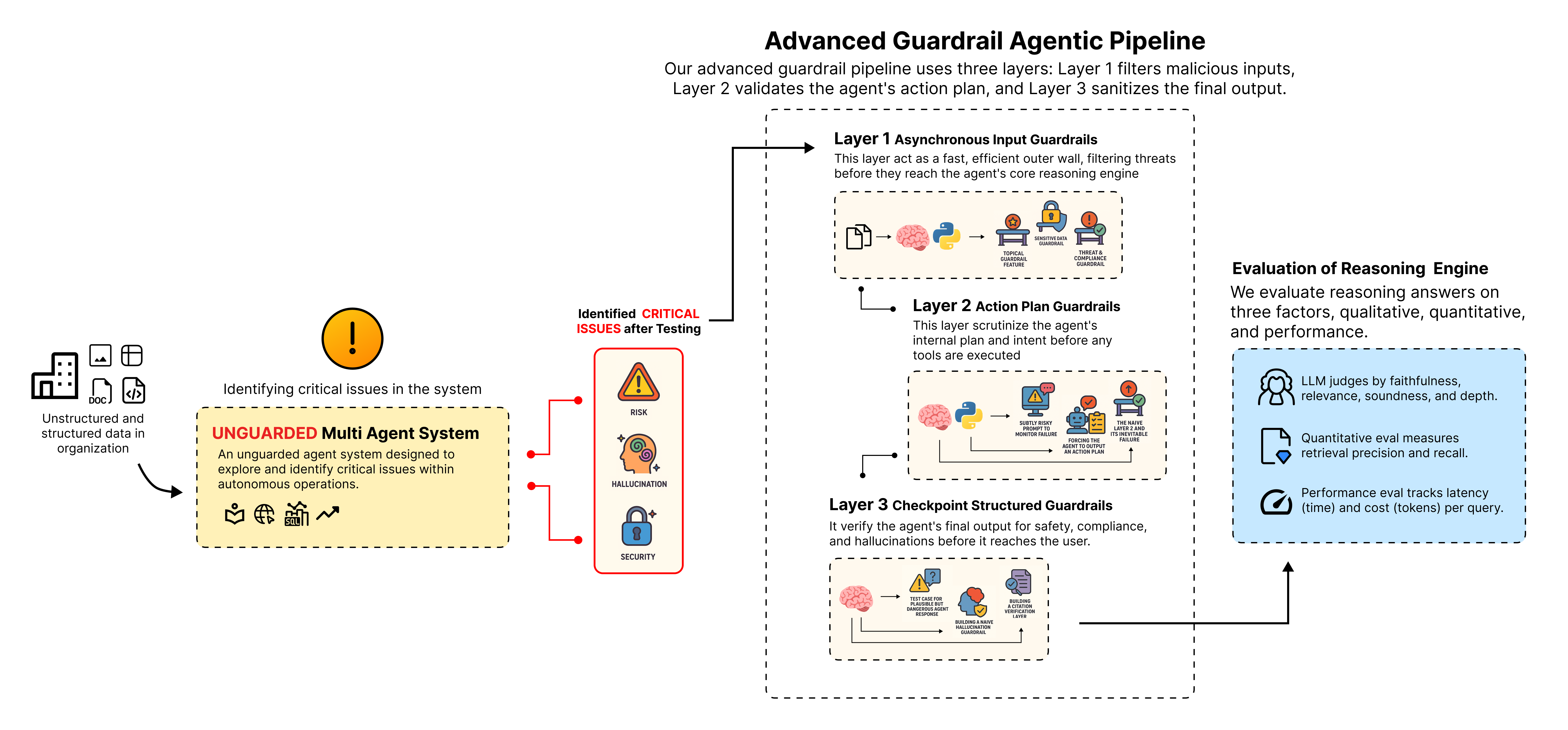
Layer 1: Input Guardrails — Securing the Front Door
The first opportunity to prevent failure is at the entry point: the user's request. Malicious or ambiguous inputs can derail an agent before it even begins its core reasoning loop.
Mitigating Prompt Injection and Adversarial Attacks
As we discussed, prompt injection is a major security vulnerability where an attacker manipulates the agent's instructions. The primary mitigation is a dedicated input-filtering layer.
7 AI Agent Failure Modes and How To Fix Them
This section from the Galileo blog provides a concise overview of prompt injection attacks and the layered defense required to counter them.
Please read the section titled Prompt Injection and Adversarial Exploits. Focus on the "layered defense" concept. Notice that it's not about one perfect solution, but a combination of techniques like input sanitation, signature detection, and isolation.
As you read, note that these defenses are not typically written into the main prompt. They are external security components that pre-process the input, acting as a firewall for your agent.
Mitigating Ambiguous Specifications
A more subtle input failure occurs when instructions are simply unclear. If you ask an agent to "clean up old files," its interpretation of "old" could have disastrous consequences. The fix here is to enforce clarity and constraints at the design stage. This involves:
- Constraint-based checks: Translating ambiguous business rules (like "outdated") into specific, testable code (e.g.,
last_modified_date < NOW - 90_DAYS). - Adversarial testing: Proactively testing the agent with ambiguous or edge-case prompts during development to uncover and fix these gaps before deployment.
Layer 2: Action Guardrails — Supervising the Agent's Work
This is the core of agent reliability, where we manage the agent's reasoning-and-acting loop. Here, we'll address the major failures of infinite loops, hallucinated plans, and unsafe tool use.
Breaking the Infinite Loop
As we saw, an agent can get stuck on a "hamster wheel," repeating actions without making progress. The solution is to impose external constraints on its autonomy. The IBM Technology video "Why Agentic AI Fails" offers clear, practical fixes.
Why Agentic AI Fails: Infinite Loops, Planning Errors, and More
This video segment explains the root causes of infinite loops and presents three straightforward mitigation strategies.
Watch the segment from the discussion of mitigation. Pay close attention to the three strategies: Termination Conditions: Setting a max_retries or max_steps is the simplest and most effective defense. Action Tracking: Comparing a new action to previous ones to ensure it's not just repeating itself. Progress Tracking: Evaluating if each retry is actually improving the outcome.
These are not concepts the LLM needs to understand; they are programmatic checks you, the engineer, build into the agent's execution loop.
Curbing Hallucinated Plans and Factual Errors
An agent might confidently generate a plan that relies on non-existent tools or hallucinated facts. We can mitigate this with validation and grounding.
1. Multi-Agent Validation: A powerful pattern is to use a second agent (or a simple, dedicated LLM call) to act as a "critic" or "validator." The primary agent proposes an action, and the validator checks it for correctness and safety before execution.

The video "Stop AI Hallucinations With These 5 Techniques" demonstrates this pattern effectively.
Stop AI Hallucinations With These 5 Techniques
This segment explains how a multi-agent "Swarm" of an executor, a validator, and a critic can catch fabricated success responses that a single agent might miss.
Watch the section on Multi-Agent Validation. The key insight is separating the "acting" from the "checking." The executor agent might fail and try to rationalize it, but the validator and critic provide an independent layer of review to catch the failure.
2. Human-in-the-Loop (HITL): For high-risk actions, the ultimate validator is a human. Instead of executing a tool call like delete_database() or send_mass_email(), the agent can pause and request approval. This is an essential safety net for production systems.
3. Grounding with RAG: To reduce factual hallucinations in the agent's reasoning, you can ground it in a trusted knowledge base using Retrieval-Augmented Generation (RAG). We will explore RAG in detail in Module 3, but the core idea is that the agent retrieves relevant, factual data first and is instructed to base its reasoning on that data.
Preventing Unsafe Tool Use
A technically correct action can still be catastrophic if performed in the wrong context. The mitigation here comes directly from classic cybersecurity principles.
Why Agentic AI Fails: Infinite Loops, Planning Errors, and More
This segment explains how to prevent an agent from performing technically valid but destructive or unintended actions.
Watch the final mitigation section on unsafe tool use. The core strategies are: Principle of Least Agency/Privilege: Grant tools the absolute minimum permissions they need to function. Approval Workflows: Implement HITL for high-risk actions. Tiered Tools: Separate tools based on access level (e.g., read_only_tools vs. write_access_tools).
Layer 3: Output Guardrails — Enforcing Rules in Code
The final layer of defense checks the agent's output just before it's sent to the user. This is our last chance to catch errors, enforce compliance, or prevent harmful content. The most robust way to do this is not with prompts, but with code.
Prompts are suggestions; code is a constraint. The AWS Developers video explains this distinction brilliantly.
Stop AI Hallucinations With These 5 Techniques
This video offers a powerful, code-centric approach to enforcing rules and steering agent behavior, which will align well with your Python expertise.
First, watch the segment on Neurosymbolic guardians. It contrasts a rule in a prompt (a suggestion the model can ignore) with a rule in code (a "hook" the model cannot skip). This is a critical concept for reliability. Next, watch the segment on runtime guardrails. This introduces an even more sophisticated idea: "steering" vs. "blocking." Instead of just stopping the agent when a rule is violated, a steering mechanism can guide it to self-correct and complete the task successfully.
This idea of rules-as-code is fundamental to building predictable systems. You can implement checks for data formats, PII, toxic language, or business-specific constraints as Python functions that validate the agent's final output.
Conclusion
Today, we've moved from identifying agent failures to architecting solutions. By adopting a layered defense strategy, you can build agents that are significantly more reliable and secure.
Here are the key mitigation strategies we covered:
- Layered Guardrails: A defense-in-depth approach with checks at the input, action, and output stages.
- Input Filtering: Using pre-processing checks to detect and block prompt injection and other malicious inputs.
- Termination Conditions: Programmatically stopping infinite loops with counters or timeouts (
max_steps). - Multi-Agent Validation: Using a "critic" agent to review and validate the primary agent's plans and actions.
- Human-in-the-Loop (HITL): Inserting a mandatory human approval step for high-risk operations.
- Principle of Least Privilege: Granting tools the minimum permissions necessary, a core tenet of security.
- Rules-as-Code: Enforcing critical constraints in Python code, not just in prompts, to ensure they are followed.
- Steering: Guiding an agent to self-correct when it violates a rule, rather than simply blocking it.
We have now completed the foundational module of this course, defining what agents are, how they work, where they fail, and how to fix them. In the next module, "Building with LangChain," we will leave the high-level theory behind and start writing code. You'll see how a framework like LangChain helps implement many of these concepts, such as defining tools, managing agent loops, and preparing for more advanced patterns like the ones we've discussed today.