Hello! Welcome to your next lesson on binary trees.
In our previous lesson, we mastered path-finding problems using Depth-First Search (DFS), including the crucial backtracking pattern for collecting all valid paths. We saw how DFS is a powerful tool for exploring a tree from top to bottom.
Today, we'll tackle a classic and important interview problem that directly builds on your knowledge of tree traversals: serializing a binary tree to a string and deserializing it back to a tree. This is a common question that tests your ability to translate a complex, non-linear data structure into a linear format suitable for storage or transmission, and then faithfully reconstruct it.
Why Serialize a Tree?
Serialization is the process of converting a data structure, like a tree object in memory, into a format that can be stored (e.g., in a file or database) or transmitted (e.g., over a network) and then reconstructed later. Think about saving your work in an application or sending a complex data object through an API—serialization is the underlying mechanism. For a tree, this means capturing both the node values and, critically, their structural relationships.
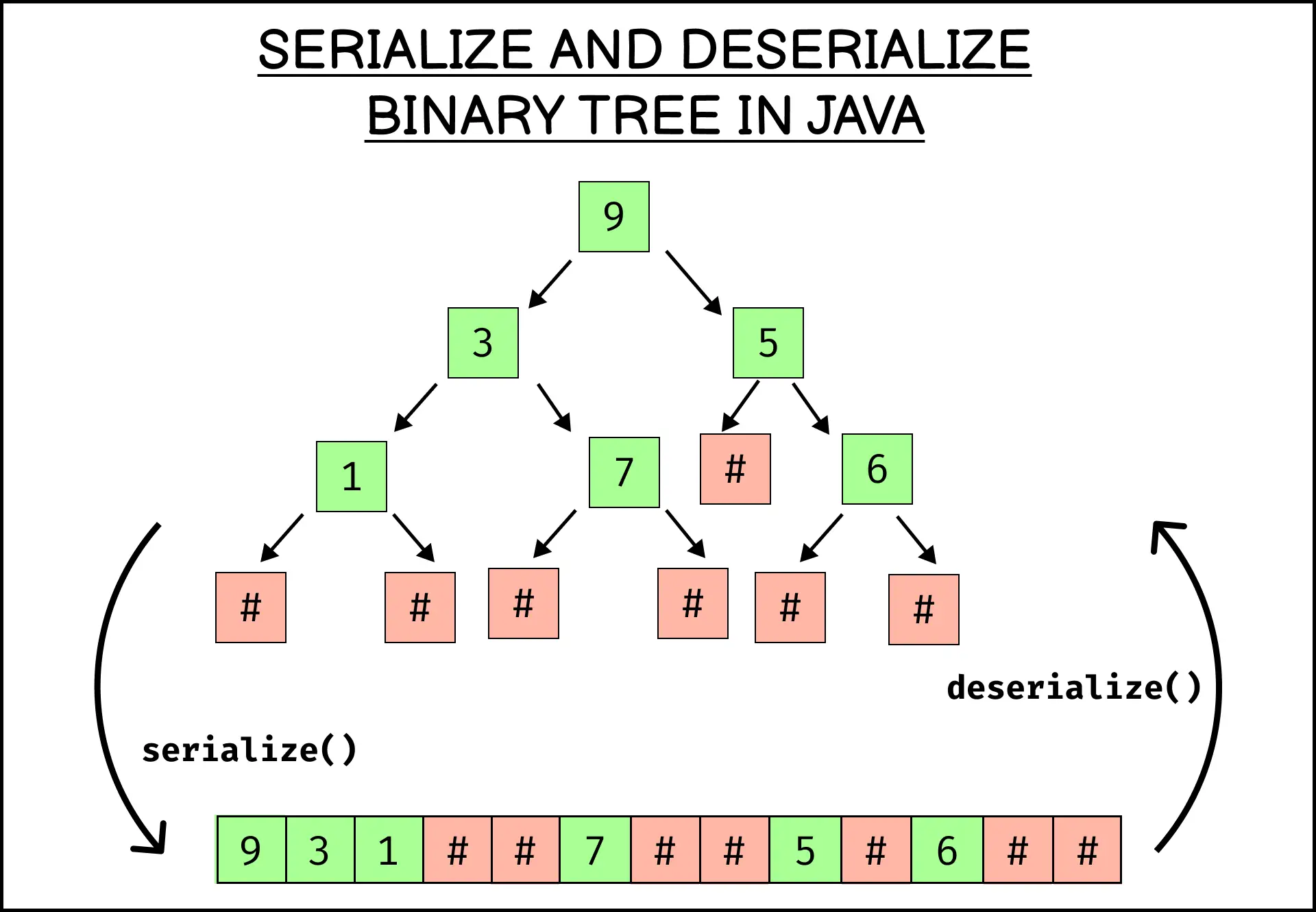
The key challenge is how to encode the tree's structure—especially the absence of children (null pointers)—in a way that is unambiguous. A simple in-order traversal, for instance, is not enough. The in-order traversal of two different trees can be identical. To solve this, we must also record the null nodes.
We will explore the two most common and effective strategies for this, both of which are high-ROI patterns for your interview preparation:
- Pre-order Traversal (DFS)
- Level-order Traversal (BFS)
1. Approach 1: Pre-order Traversal (DFS)
This method is a natural extension of the recursive DFS you're already familiar with. The elegance of pre-order traversal (Root -> Left -> Right) is that the root of any subtree always appears before its children, which makes reconstruction straightforward.
The Logic:
- Serialization: We'll perform a pre-order traversal. When we visit a node, we append its value to our result. If we encounter a null pointer (an empty child), we append a special marker (like '#' or 'N') to signify the absence of a node.
- Deserialization: We read the serialized data, which is now a sequence of values and null markers. We can build the tree recursively. The first value is the root. We then recursively call our function to build the left subtree using the subsequent values. Once the left subtree is fully constructed, the recursion naturally returns, and we proceed to build the right subtree from wherever the left subtree's construction left off.
Let's watch a video that walks through this entire process, from conceptualization to a clean Python implementation.
Serialize and Deserialize Binary Tree - Preorder Traversal - Leetcode 297 - Python
The video 'Serialize and Deserialize Binary Tree' by NeetCode provides an excellent explanation of the pre-order DFS approach.
Please watch the following segments: Serialization Logic (01:06 - 03:43): Focus on how the pre-order traversal builds the string with null markers ('N'). Deserialization Logic (03:43 - 08:01): Pay close attention to how the sequence of values is used to recursively reconstruct the tree. This is the core insight. Python Implementation (08:19 - 13:29): Watch the coding part for both serialize and deserialize. Note the use of a helper function and how the index/pointer is managed during deserialization.
Code Implementation (Pre-order DFS)
Here is a summary of the Python implementation, which aligns with the video's logic.
For serialization, we use a recursive helper function dfs(node) that appends values to a list.
# TreeNode class definition
class TreeNode:
    def __init__(self, val=0, left=None, right=None):
        self.val = val
        self.left = left
        self.right = right

# Inside the Codec class
def serialize(self, root):
    """Encodes a tree to a single string."""
    res = []

    def dfs(node):
        if not node:
            res.append("N") # Null marker
            return
        res.append(str(node.val))
        dfs(node.left)
        dfs(node.right)

    dfs(root)
    return ",".join(res)
For deserialization, we convert the string into a list and use a global index self.i to keep track of our position in the list.
# Inside the Codec class
def deserialize(self, data):
    """Decodes your encoded data to tree."""
    vals = data.split(',')
    self.i = 0 # Use a class member as a global pointer

    def dfs():
        if vals[self.i] == "N":
            self.i += 1
            return None

        node = TreeNode(int(vals[self.i]))
        self.i += 1
        node.left = dfs()
        node.right = dfs()
        return node

    return dfs()
Test your understanding!
Given the following binary tree:
    1
   / \
  2   3
     / \
    4   5
What would be the pre-order serialized string, using 'N' for nulls and ',' as a delimiter?
Show answer
The pre-order traversal sequence is:
- Visit root 1.
- Visit left child 2.
- Visit left child of 2 (null).
- Visit right child of 2 (null).
- Visit right child 3.
- Visit left child of 3, 4.
- Visit left child of 4 (null).
- Visit right child of 4 (null).
- Visit right child of 3, 5.
- Visit left child of 5 (null).
- Visit right child of 5 (null).
The resulting string would be: 1,2,N,N,3,4,N,N,5,N,N
2. Approach 2: Level-order Traversal (BFS)
Another popular and equally valid approach is using level-order traversal (BFS). This can feel more iterative and might be more intuitive if you think about building the tree layer by layer.
The Logic:
- Serialization: Use a queue and initialize it with the root. While the queue is not empty, dequeue a node. If it's not null, append its value to the result and enqueue its left and right children (even if they are null). If the dequeued node is null, append the null marker.
- Deserialization: This also uses a queue. First, create the root from the first value in the input and enqueue it. Then, iterate through the rest of the input values in pairs. For each node you dequeue, the next two values from the input correspond to its left and right children. Create nodes for them (if they aren't null markers), attach them to the parent, and enqueue the new non-null nodes.
Let's explore this approach through a combination of a video for the concept and an article for the implementation details.
L36. Serialize and De-serialize Binary Tree | C++ | Java
The video 'Serialize and De-serialize Binary Tree' from take U forward clearly explains the logic of the BFS approach.
Watch from 02:48 to 07:21. The video uses C++/Java, but focus on the logic. Observe how the queue is used to process nodes level-by-level for both serialization and deserialization. The visualization with the queue and the resulting string is very helpful.
Now, let's look at a detailed written explanation and Python code for this BFS strategy.
297. Serialize and Deserialize Binary Tree
The Algo.monster article on this problem provides an excellent breakdown of the BFS approach, common pitfalls, and complexity analysis.
Please read the following sections: Solution Approach: This section gives a high-level overview of the BFS method for both serialization and deserialization. Example Walkthrough: This is a crucial section. Follow the step-by-step example to solidify your understanding of how the queues and indexes work in tandem. Time and Space Complexity: Review the analysis. You should be able to derive this yourself. Common Pitfalls: This is extremely valuable for interviews. Understanding these mistakes will help you write more robust code.
Comparing the Approaches
Both DFS (pre-order) and BFS (level-order) are valid and efficient solutions with time and space complexity.
- DFS (Pre-order): The recursive implementation is often more compact and can be seen as more elegant. It relies on the call stack to manage the traversal state.
- BFS (Level-order): The iterative implementation using a queue can be more intuitive for some, as it builds the tree level by level. It might produce a slightly more compact string representation for complete or balanced trees.
For an interview, you should be comfortable with at least one approach and ideally be able to discuss the other as an alternative. Since you have a strong background in recursion and DFS from our previous lessons, the pre-order method is a great one to master.
Conclusion
Congratulations! You've just learned how to solve a challenging and practical problem that bridges data structures and system design thinking. Being able to convert a complex data structure into a linear, transmittable format is a fundamental skill.
Key Takeaways:
- The Problem: Serialization is about encoding a tree's values and structure into a string. Deserialization is the reverse process.
- The Key: The structure can be preserved by using a special marker for
nullchildren. - DFS/Pre-order Method: A recursive approach where
serializefollows aroot -> left -> rightorder anddeserializeuses the same order to reconstruct the tree. The call stack implicitly manages the state. - BFS/Level-order Method: An iterative approach using a queue to process the tree layer by layer. It's often very intuitive to trace.
- Complexity: Both primary methods have a time and space complexity of , where is the number of nodes in the tree.
In our next lesson, we will begin a new module on Binary Search Trees (BSTs). We'll start by defining the properties of a BST and implementing the fundamental operations: search, insertion, and deletion. This will introduce a new set of constraints and optimizations on the binary tree structure.