Hello! Welcome to the next lesson in our module on Heaps and Priority Queues.
In the previous lesson, we implemented a priority queue using a heap, understanding how the sift_up and sift_down operations enable efficient insertions and extractions. You learned how to use standard libraries like Python's heapq and Java's PriorityQueue to do this work for you.
Today, we'll leverage that knowledge to tackle one of the most common and high-value patterns in technical interviews: solving "Top K" element problems. By the end of this lesson, you will be able to identify and solve problems like finding the "Kth largest element" or "K most frequent items" using an optimal heap-based approach with time complexity.
1. Understanding the "Top K" Problem Pattern
Many interview questions boil down to finding a specific subset of elements from a larger collection: the top K scores, the K most frequent words, the K closest neighbors, and so on.
A simple, brute-force approach would be to sort the entire collection and then pick the first or last K elements. Given an array of size , sorting takes time. While correct, this is often suboptimal. If you have a million items and only need to find the top 10, sorting all one million seems wasteful. This is where heaps provide a more efficient solution.
To begin, let's get a formal overview of the pattern and the different heap-based strategies.
This article provides a concise explanation of the 'Top K Elements' pattern. It clearly outlines the problem, the suboptimal sorting approach, and the more efficient heap-based solutions.
Read the entire article. Pay close attention to the distinction between the max-heap and min-heap approaches. Focus on the Min-Heap section, as it details the optimal O(N log K) strategy for finding the top K largest elements, which we'll be focusing on first.
2. The Optimal Strategy: Finding the Top K Largest Elements
As the article explained, the most efficient way to find the K largest elements is to use a min-heap of size K. This might seem counterintuitive, so let's break down why it works.
The min-heap will act as a container for the K largest elements found so far.
- The root of this min-heap will always be the smallest of these K elements—our "weakest contender."
- When we process a new element from the input array, we compare it to this root.
- If the new element is smaller than or equal to the root, it cannot possibly be one of the top K largest, so we discard it.
- If the new element is larger than the root, it deserves a spot in our top K group. We remove the root (the current weakest contender) and insert the new, larger element. The heap then rearranges itself to find the new weakest contender and place it at the root.
After iterating through all elements, our min-heap contains exactly the K largest elements from the entire array.
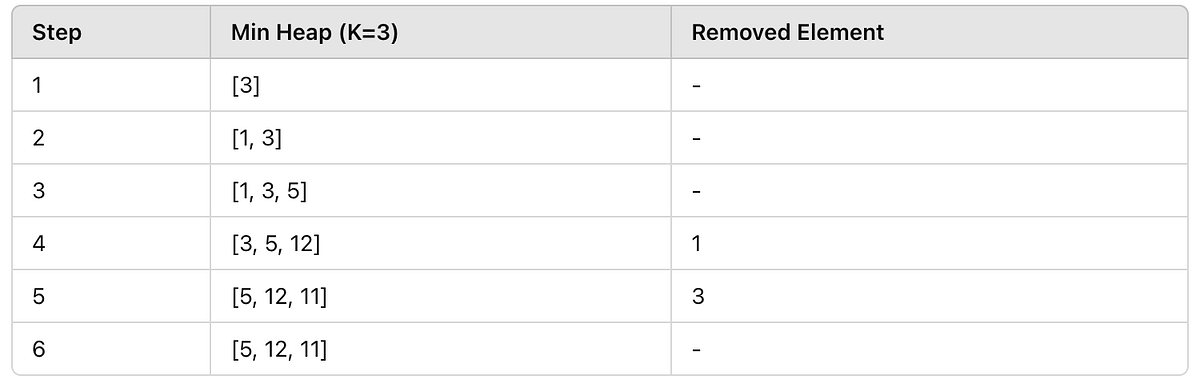
Complexity Analysis
- Time Complexity: We iterate through all elements. For each element, we perform a heap operation (a push and possibly a pop). Since the heap's size is capped at , each operation takes time. This gives a total time complexity of .
- Space Complexity: The heap stores at most elements, so the auxiliary space complexity is .
This approach is a significant improvement over the sorting solution, especially when is much smaller than .
3. Code Walkthrough: "Kth Largest Element in an Array"
Let's solidify this with a canonical interview problem: LeetCode 215, "Kth Largest Element in an Array." You're given an array nums and an integer k, and you need to return the kth largest element. For example, if nums = [3,2,1,5,6,4] and k = 2, the answer is 5.
The following video provides an excellent walkthrough of the optimal min-heap approach for this exact problem.
Kth Largest Element in an Array - Leetcode 215 - Heaps (Python)
This video by Greg Hogg provides a clear, step-by-step walkthrough for solving 'Kth Largest Element in an Array' using the min-heap strategy.
Watch the segment from 06:10 to 11:35. This part specifically details the more efficient min-heap approach that achieves O(N log K) time. Pay close attention to how he builds the heap and why the element at the top of the heap is the final answer.
Here is a Python implementation of the logic discussed in the video. We use the heapq module, which is a min-heap implementation.
import heapq

def findKthLargest(nums, k):
    # Create a min-heap. We'll maintain its size at K.
    min_heap = []

    for num in nums:
        # If the heap has less than K elements, just add the current number.
        if len(min_heap) < k:
            heapq.heappush(min_heap, num)
        # If the current number is larger than the smallest element in the heap (the root)
        elif num > min_heap[0]:
            # heappushpop is an efficient way to push a new item and then
            # pop and return the smallest item.
            # This is equivalent to a push followed by a pop.
            heapq.heappushpop(min_heap, num)

    # After iterating through all numbers, the root of the min-heap
    # is the Kth largest element.
    return min_heap[0]

# Example:
nums = [3, 2, 1, 5, 6, 4]
k = 2
print(f"The {k}nd largest element is: {findKthLargest(nums, k)}")  # Output: 5
4. Pattern Variations and The Symmetric Case
The "Top K" pattern is highly versatile. Understanding its core logic allows you to adapt it to various problem statements.
Finding the Top K Smallest Elements
What if you need to find the K smallest elements? The logic is perfectly symmetrical: you use a max-heap of size K.
- The max-heap stores the K smallest elements seen so far.
- The root is the "strongest" of these contenders (the largest of the K smallest).
- If you encounter a new element that is smaller than the root, you pop the root and push the new element.
- Since Python's
heapqis a min-heap, you can simulate a max-heap by pushing the negative of each number.
Test your understanding!
You are asked to find the 5 smallest numbers in a large stream of data. Which data structure and logic would you use to solve this efficiently?
Show answer
You would use a max-heap of size 5.
Logic:
- Iterate through the stream of numbers.
- For each number, push its negative value onto the heap (
-num) to simulate a max-heap. - If the heap's size exceeds 5, pop the root. The root will be the largest of the 5 smallest numbers seen so far (e.g., if the heap contains
[-1, -3, -5, -8, -10],heappopwill remove-1). - After processing the stream, the heap contains the negatives of the 5 smallest numbers. You can then retrieve them by negating them again.
This maintains an space complexity and an time complexity.
Top K Frequent Elements and K Closest Points
The pattern extends beyond simple numerical values. The "priority" can be a frequency, a distance, or any other computed metric.
Top K Elements in 6 minutes | LeetCode Pattern
This pattern is incredibly versatile. It's not just about finding the largest numbers. This video demonstrates how to apply the same core heap logic to more complex problems like finding the 'Top K Frequent Elements' and 'K Closest Points to Origin'.
Watch the segments covering 'Top K Frequent Elements' (03:29 - 04:45) and 'K Closest Points to Origin' (04:45 - 05:51). For each problem, focus on two things: (1) What is being used as the 'priority' in the heap? (frequency, distance) and (2) Why is a min-heap used for 'frequent' and a max-heap for 'closest'?
As the video shows:
- Top K Frequent Elements: This is a two-step process. First, use a hash map to count the frequencies of all elements ( time). Then, apply the "Top K Largest" pattern on the frequencies, using a min-heap of size K to find the K elements with the highest frequencies.
- K Closest Points to Origin: Here, you want the K elements with the smallest distance. This is a "Top K Smallest" problem. You use a max-heap of size K to keep track of the K points with the smallest distances seen so far. The priority is the distance from the origin. A common optimization is to use the squared distance to avoid floating-point calculations with
sqrt.
Conclusion
You have now mastered a fundamental and highly practical interview pattern. The ability to recognize a "Top K" problem and immediately jump to the optimal heap solution demonstrates a strong grasp of data structures and algorithmic trade-offs.
Key Takeaways:
- "Top K" problems are about finding a small subset of elements from a large collection based on some ordering.
- The optimal solution uses a heap of size K, achieving time and space complexity.
- To find the K largest elements, use a min-heap of size K.
- To find the K smallest elements, use a max-heap of size K.
- The pattern can be adapted to various "priorities," such as frequency or distance, by first computing that metric.
In our next lesson, we will explore another classic problem that is elegantly solved with heaps: Merging K Sorted Lists. This will further solidify your understanding of how heaps can manage and order elements from multiple sources efficiently.