Introduction
Welcome to the final lesson of our first module on limits and continuity. Having mastered the art of evaluating various limits, including complex indeterminate forms, we now turn to one of the most important applications of the limit concept: defining continuity. Intuitively, you know a continuous function is one whose graph can be drawn without lifting your pencil. Today, we will formalize this intuition using the rigorous language of limits.
Our goal is to define continuity at a point and over an interval, and then to systematically classify the different ways a function can fail to be continuous. This process of identifying and categorizing discontinuities is a critical skill for analyzing function behavior, a topic frequently tested in the JEE. This lesson serves as the bridge between the abstract concept of limits and the tangible properties of functions that we will study throughout calculus.
The Three Pillars of Continuity
The intuitive idea of an unbroken graph is a great starting point. In physics, for example, we naturally assume that the position of a particle changes continuously over time; it doesn't just vanish from one point and reappear at another. Calculus provides a precise way to express this idea. For a function to be continuous at a point , three specific conditions must be met.
Let's build these conditions from the ground up by examining why a function might not be continuous.
This reading from LibreTexts Calculus develops the formal definition of continuity by looking at graphical examples where our intuition of "connectedness" fails. This perfectly aligns with your preference for building a concept from the basics.
Please read the introductory paragraphs and the section "Continuity at a Point". As you read, focus on the three distinct ways a function's graph can have a "break" at a point a, and how each failure leads to one of the three necessary conditions for continuity.
As you've just read, the three conditions can be summarized as:
- is defined. (There must be a point on the graph at .)
- exists. (The graph must approach the same height from both the left and the right.)
- . (The height the graph is approaching must be the actual height of the point.)
When all three conditions hold, the function is continuous at . This entire set of conditions is elegantly captured in a single, powerful statement:
A function is continuous at a point if .
A function that fails to meet these conditions at a point is said to have a discontinuity at that point.
Classifying the Breaks: Types of Discontinuities
For the JEE, it's not enough to know if a function is discontinuous; you must also classify the type of discontinuity. The classification follows a clear, logical flowchart based on which of the continuity conditions fail.
The first and most important question to ask is: Does the limit exist at the point of discontinuity?
- If exists (and is a finite number), the discontinuity is Removable.
- If does not exist, the discontinuity is Non-Removable.
The following video from Unacademy's JEE channel provides a fantastic, exam-oriented overview of this classification system. It presents the logic as a clear decision tree, which should resonate with your coding experience.
JEE: Continuity L3 | Types of Discontinuity | Class 12 | Unacademy JEE | JEE Maths | Nishant Sir
This video breaks down the classification of discontinuities into a step-by-step process, exactly as you would apply it in a competitive exam setting.
First, watch the overview from this section to see the main branching structure: Removable vs. Non-Removable, decided by the existence of the limit. Next, focus on the explanation of Removable Discontinuities from this segment. Pay attention to the graphical difference between a "missing point" and an "isolated point" discontinuity. Finally, watch the breakdown of Non-Removable Discontinuities starting at this point. This part covers the three sub-types: Finite (Jump), Infinite, and Oscillatory.
Let's formalize and summarize the types of discontinuities you just saw.
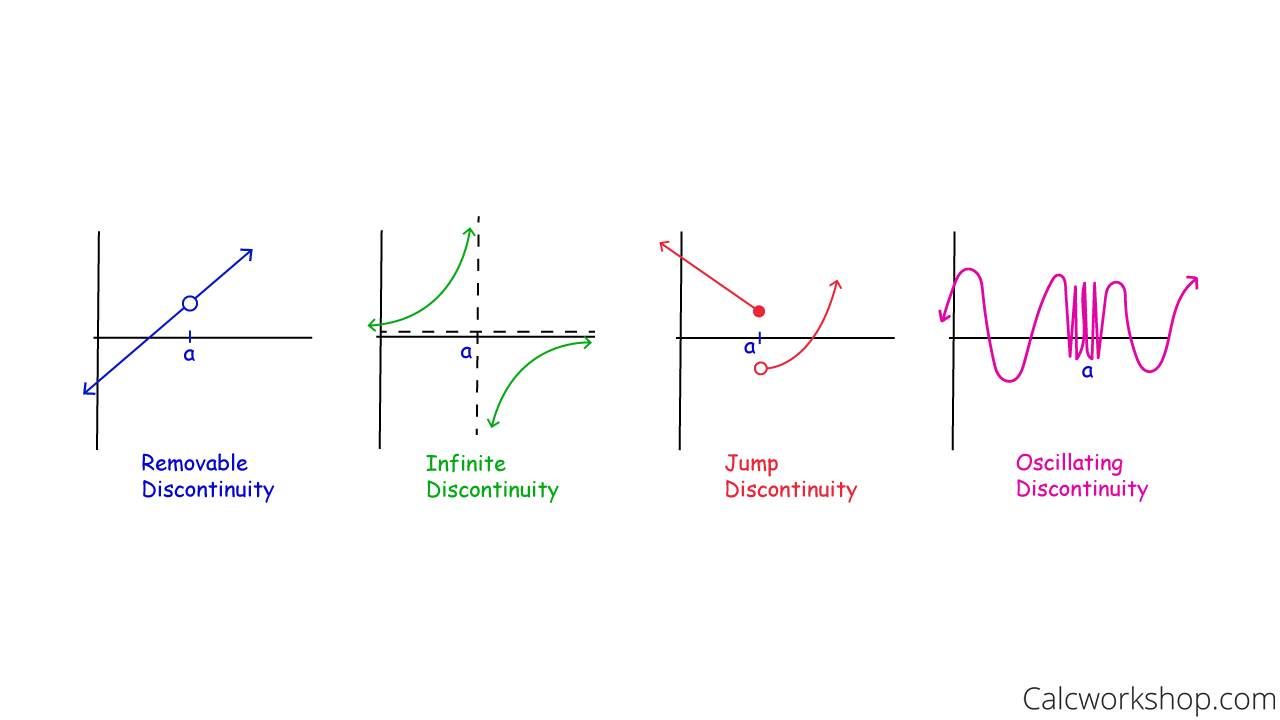
1. Removable Discontinuity
This occurs when exists, but is not equal to . This can happen in two ways:
- Missing Point: is undefined. There's a "hole" in the graph that could be "plugged."
- Example: at . The limit is 4, but is undefined.
- Isolated Point: is defined, but has a different value from the limit. The point exists but is "out of place."
- Example: at . The limit is 3, but .
2. Non-Removable Discontinuity
This occurs when does not exist. There are three primary reasons for this.
- Jump Discontinuity: The left-hand and right-hand limits both exist and are finite, but they are not equal (). The function "jumps" from one value to another. The magnitude of this jump, , is called the jump of the discontinuity.
- Example: The greatest integer function, , at any integer value.
- Infinite Discontinuity: At least one of the one-sided limits tends to or . This is visually represented by a vertical asymptote.
- Example: at .
- Oscillating Discontinuity: The function values oscillate so rapidly near the point that they don't approach any single number.
- Example: at .
The following resource provides clear, formal definitions and worked-out examples for each of these categories.
This text will solidify your understanding by providing formal definitions and examples that match the categories from the video.
Please read the section "Types of Discontinuities". Pay close attention to how the limit definition is used to classify the discontinuity in each example.
Continuity Over an Interval
We've focused on continuity at a single point, but we often need to discuss continuity over a whole range of values, or an interval.
Open Interval: A function is continuous on an open interval if it is continuous at every single point within that interval. This is a straightforward extension of our point-wise definition.
Closed Interval: Continuity on a closed interval is a bit more subtle because we can't take a two-sided limit at the endpoints and . Here, we use one-sided limits. A function is continuous on if:
- It is continuous on the open interval .
- It is continuous from the right at . This means .
- It is continuous from the left at . This means .
The following Khan Academy video gives an excellent intuitive and graphical explanation of this concept.
Continuity over an interval | Limits and continuity | AP Calculus AB | Khan Academy
Sal Khan's intuitive style is perfect for building a mental model of continuity on open and closed intervals.
Please watch from this segment to understand continuity over an open interval. Then, continue watching from the explanation of the more detailed definition for a closed interval. Notice how one-sided limits are used to handle the endpoints.
Conclusion
In this lesson, we have formally defined continuity and established a systematic way to analyze and classify discontinuities. This brings our foundational module on limits to a close. You are now equipped with a robust toolkit for analyzing the behavior of functions near a point.
Key Takeaways:
- A function is continuous at a point if the limit exists, the function is defined at the point, and the limit equals the function's value: .
- Discontinuities are classified by checking if the limit exists. If it does, the discontinuity is removable (missing or isolated point). If it doesn't, it is non-removable (jump, infinite, or oscillating).
- Continuity on a closed interval requires continuity on the interior plus continuity from the right at and from the left at .
In our next lesson, we will explore one of the most important consequences of continuity: the Intermediate Value Theorem. This theorem allows us to make powerful statements about the values a function must take on, and it provides a method for proving the existence of solutions to equations—a valuable tool in both mathematics and physics.