Introduction
In our last session, we mastered the Squeeze Theorem, a powerful tool for finding limits by "trapping" a function. Its most celebrated application was proving the fundamental trigonometric limit: . We saw how this result emerged not from simple algebra, but from a clever geometric argument involving areas within a unit circle.
This limit is not just a clever trick; it's the first of several standard limit forms that are foundational to calculus. For a competitive exam like the JEE, where speed and accuracy are paramount, memorizing these standard forms and knowing how to apply them instantly is non-negotiable. They are the essential shortcuts that allow you to bypass more laborious methods like the Squeeze Theorem or, later, L'Hôpital's Rule.
Today, we will build a full toolkit of these standard limits, covering not only trigonometric functions but also exponential and logarithmic ones. Our goal is to learn these forms by heart and, more importantly, to master the algebraic manipulations needed to transform complex limit problems into these recognizable patterns.
The Family of Trigonometric Standard Limits
We begin with the result you proved in the last lesson. This is the parent of all other trigonometric limits.
1. The Sine Limit (Recap)
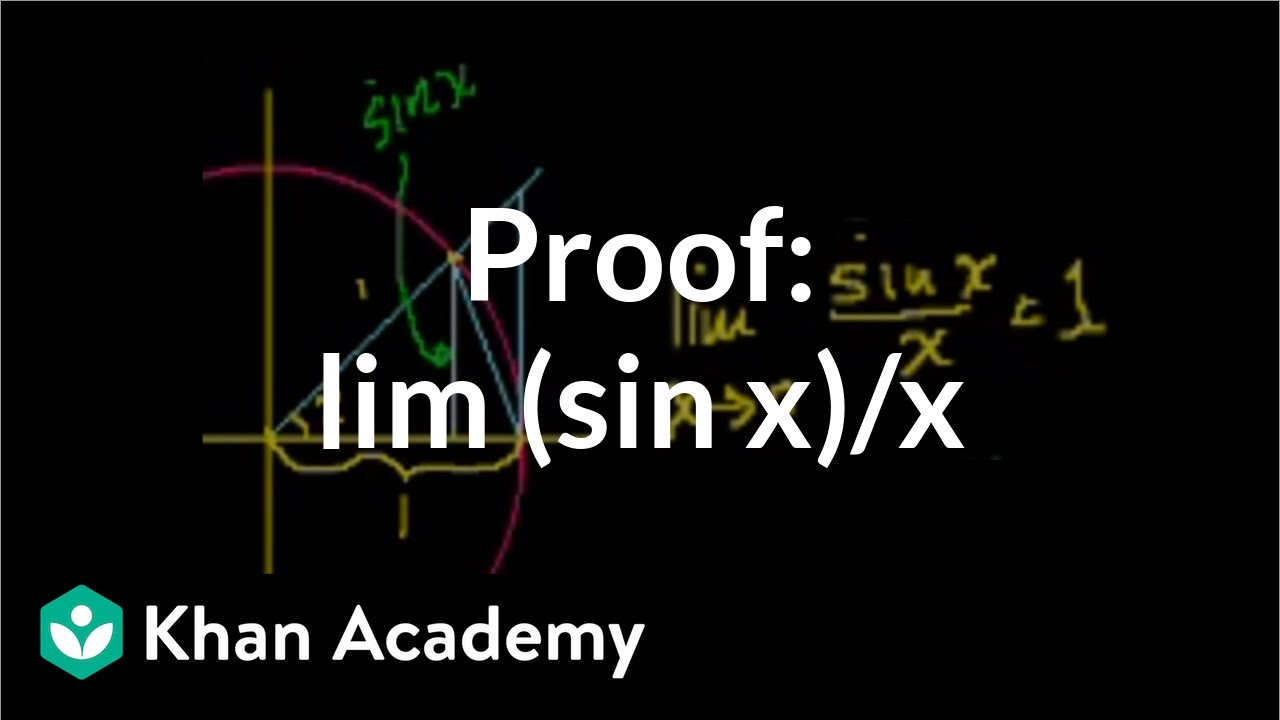
Recall the geometric proof where we sandwiched the area of a circular sector between the areas of two triangles.
2. The Tangent Limit
From the sine limit, we can easily derive the limit for the tangent function. Remember that .
Since the limit of a product is the product of the limits:
So, our second standard limit is:
The following resource provides a concise recap of this derivation.
How to prove that $\lim\limits_{x\to0}\frac{\sin x}x=1
This post on Math StackExchange gives a very clear and compact geometric proof for the sine limit and also shows the derivation for the tangent limit.
Focus on the first answer by user robjohn. Review the area comparison in the first paragraph which leads to the inequality. Then, follow the algebraic steps in equation (2) and (3) to see the Squeeze Theorem in action. Finally, notice how easily the tangent limit is derived in equations (4) and (5).
3. The Cosine Limit
The third crucial trigonometric limit involves cosine. It is . We can't evaluate this directly, but we can transform it using a trigonometric identity. The half-angle identity is perfect for this.
Now, we need to make the argument of the sine function match the denominator to use our standard sine limit. We want in the denominator.
As , also approaches 0. So, the term in the parenthesis approaches 1.
This gives us our third standard limit:
These three forms are the bedrock. For JEE problems, you'll almost always see them with scaled arguments (like instead of ). The strategy is always to make the denominator match the argument.
The following video is excellent for seeing this manipulation in action. It's a procedural skill, and watching it done step-by-step will solidify the method in your mind.
Limits of Trigonometric Functions
This video from The Organic Chemistry Tutor provides a very clear, methodical walkthrough of how to adapt the standard trigonometric limits for various problem formats common in exams.
Pay close attention to the technique, not just the answer. Limit of sin(ax)/x: Notice the key step of multiplying the top and bottom by 'a' to create the standard form. Limit of sin(ax)/bx: See how the constants are separated out. Limit of sin(ax)/sin(bx): This shows how to break the problem into two standard limits by multiplying and dividing by ax and bx. Limit of tan(x)/x: This confirms the derivation we did earlier. Limit of tan(ax)/bx: This extends the tangent rule to scaled arguments, just like with sine.
Standard Exponential and Logarithmic Limits
Next, we move to limits involving the number and the natural logarithm. These functions describe phenomena of continuous growth and decay, which you've likely encountered in physics (e.g., radioactive decay, RC circuits). Their limits are just as fundamental as the trigonometric ones.
The following resource, designed for JEE aspirants, provides a concise list of these standard forms.
IIT JEE Main Maths -Unit 7- Limits of a Function- Study Notes
This set of study notes contains a fantastic summary of the standard limits you must know for the JEE.
Navigate to the section "Limits Involving Trigonometric and Exponential Functions". First, review the table under "Standard Trigonometric Limits". It summarizes what we've just covered and includes the generalized forms with constants a and b. Then, carefully study the table under "Standard Exponential and Logarithmic Limits". These are the key forms we will focus on now. Pay special attention to the "Important Combined Forms" that follow, as they are direct applications you'll see in problems.
Let's break down the most important of these new forms.
1. The Definition of : The form
These limits are often used as the definition of the number . They represent the result of compounding interest infinitely often. Notice that they both result in the indeterminate form .
2. The Exponential Limit
This is arguably the most useful exponential limit. You can get an intuition for it by making a substitution. Let . As , . Also, , which means . Substituting this into the limit gives:
This looks like the reciprocal of our next standard limit.
3. The Logarithmic Limit
As we saw above, this limit and the exponential limit are two sides of the same coin. If one is true, the other must be as well.
Generalizations:
Just as with trig functions, these forms can be generalized:
- (This is the most general form; setting gives ).
Problem-Solving Strategy
With this vocabulary of standard limits, the approach to solving complex limit problems becomes a pattern-matching exercise.
- Check for Indeterminate Form: First, always try direct substitution. If you get or another indeterminate form, proceed.
- Identify Standard Forms: Scan the expression for pieces that resemble the standard limits we've discussed.
- Isolate and Manipulate: Use algebra—multiplying and dividing by appropriate terms—to break the complex expression into a product or quotient of standard forms.
- Evaluate: Substitute the known values for the standard limits and calculate the final result.
Let's try an example that mixes trigonometric and exponential forms:
Evaluate .
This looks intimidating, but let's break it down into familiar pieces. We can rewrite the expression as:
The first part is a standard form: .
The second part can be broken down further by introducing and to match the arguments:
Now we take the limit of each piece:
Putting it all back together:
By recognizing the patterns, we dismantled a complex problem into simple, known parts. This is the core skill this lesson is about.
Conclusion
Today, we've moved from deriving a single, fundamental limit to mastering a whole vocabulary of them. These standard forms are your primary weapons for attacking a huge variety of limit problems you will face on the JEE.
Key Takeaways:
- There are a set of fundamental or standard limits for trigonometric, exponential, and logarithmic functions that evaluate to constants like 1, 1/2, or .
- Trigonometric Forms:
- Exponential & Logarithmic Forms:
- The primary problem-solving technique is to algebraically manipulate a complex limit to express it as a product or quotient of these standard forms.
In our next lesson, we will focus specifically on the indeterminate forms , , and . We've already had a preview with the limit definition of , which is a form. We will explore a general technique using logarithms to transform these exponential indeterminate forms into the more familiar or forms, further expanding your problem-solving arsenal.