Welcome to your first lesson. This course is designed to be a direct application of various eponymous laws and mental models to your specific areas of interest: lingerie design and polyamorous relationships. As you requested, we will bypass formal definitions and dive straight into practical analysis.
Today, we begin the "Foundations of Critical Thinking" module by exploring two fundamental "razors"—mental heuristics that help cut away unnecessary complexity. We will apply Occam's Razor and the closely related Alder's Razor to diagnose a bra fit issue and to interpret a partner's behavior in a Vee relationship. The goal is to practice selecting the simplest explanation that adequately fits the facts.
The Principle of Parsimony: Occam's and Alder's Razors
At its core, Occam's Razor states that among competing hypotheses, the one with the fewest assumptions should be selected. It's often paraphrased as "the simplest explanation is usually the right one." Alder's Razor is a modern articulation of the same idea, suggesting the simplest solution is often the most likely to be effective. We'll treat them as two sides of the same coin: a powerful preference for simplicity and parsimony.
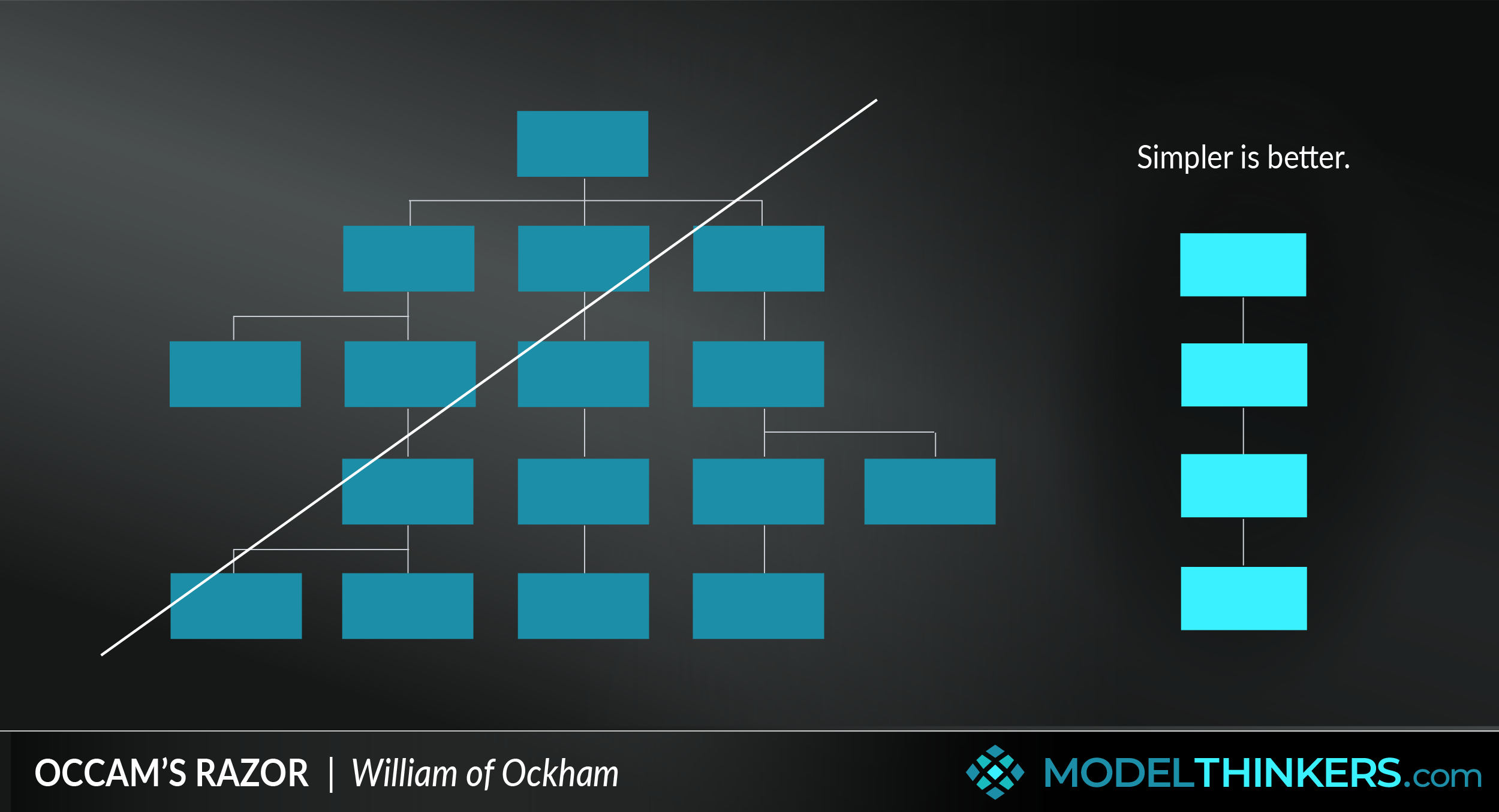
This principle doesn't guarantee the simplest explanation is always true, but it provides the most rational starting point. In statistical terms, this is analogous to preferring a more parsimonious model that explains the data sufficiently, rather than a complex model that may be overfitting to noise. Let's apply this.
Application 1: Diagnosing a Bra Fit Issue
A client comes to you for a fitting. She's wearing a 36B bra and complains of several issues: the straps keep slipping off her shoulders, there is visible gaping at the top of the cups, and the band feels uncomfortable by the end of the day. Her self-diagnosis is, "My breasts must be too small for the cup, and I probably need a 36A. Maybe my shoulders are just too sloped for bras."
Her explanation involves multiple assumptions:
- Gaping is caused by cups being too large.
- Slipping straps are due to her shoulder shape.
- The best solution is to decrease the cup size while keeping the band size the same.
Occam's Razor encourages us to question this and look for a simpler, single explanation that could account for all the symptoms. A very common one in lingerie fitting is that the bra's band is too loose.
A loose band fails to anchor the bra, causing it to ride up the back. This slackens the straps, making them fall. To compensate, women often overtighten the straps, which can pull the cups away from the body, creating the illusion of a cup that is too large. All three of her complaints can stem from this single, fundamental issue.
The following video from the TODAY show provides excellent real-world examples of this principle in action. A professional fitter repeatedly identifies an incorrect band size as the simple root cause of what wearers perceived to be more complex fit problems.
Struggling to find the right bra? How to get the perfect fit
Please watch the following segments from the video "Struggling to find the right bra? How to get the perfect fit."
Focus on the first two case studies. Notice how the fitter's solution in each case is a counterintuitive but simple correction of the band and cup size. Watch the diagnosis for Delina, who believed her cup size was too big. Pay attention to how the fitter immediately identifies the loose band as the core problem from the back, leading to a radical but correct size change. Then, watch the case of Karen, who struggled with a large chest and a band riding up. The solution again involves a significant change to the band and cup size, providing a simple, effective fix for what felt like a lifelong struggle.
As the video demonstrates, the more parsimonious explanation—that the foundational measurement (the band) is wrong—is often correct. The solution, per Alder's Razor, is to fix that single issue rather than attempting to patch multiple symptoms individually.
A Note on Necessary Complexity
Of course, the goal is the simplest adequate explanation. Sometimes, a problem is genuinely complex. Your experience in lingerie design tells you that breast shape, root width, and tissue density are real variables.

Consider the system shown in this image. It uses seven distinct measurements. Does this violate Occam's Razor?
Not necessarily. If these seven variables consistently produce a better fit prediction than a simpler model (e.g., one using only underbust and bust circumference), then this complexity is justified. The principle of parsimony is a guide, not a law of nature. It directs us to test the simplest hypothesis first. If it fails, we add complexity incrementally.
Application 2: Interpreting Behavior in a Vee Relationship
Now let's apply the same razor to your second scenario: a Vee relationship where a husband (let's call him Alex) supports his wife (Bella) in her relationship with her lover (Charles).
Scenario: For the past week, Alex has noticed that Bella seems distant. She is quieter than usual, initiates less physical affection, and seems preoccupied.
A mind prone to complexity might immediately generate high-stakes, dramatic hypotheses:
- Hypothesis A: Bella's feelings for Charles are intensifying, causing her to pull away from Alex. The Vee is becoming unstable.
- Hypothesis B: Bella is hiding a serious problem in her relationship with Charles, and the stress is spilling over into her relationship with Alex.
- Hypothesis C: Bella is re-evaluating her commitment to polyamory or to Alex specifically and is emotionally withdrawing before initiating a difficult conversation.
- Hypothesis D: Alex has done something wrong that he is unaware of, and Bella is passively expressing her anger.
These explanations are heavy with assumptions about Bella's internal state, the dynamics of her other relationship, and the future of their marriage. Occam's Razor prompts us to ask: what are the simplest explanations? What hypotheses require the fewest assumptions?
- Hypothesis 1: Bella is tired from a demanding week at work.
- Hypothesis 2: Bella is mildly unwell or feeling run down.
- Hypothesis 3: Bella is stressed about a non-relationship issue (e.g., finances, a family matter, a personal project).
- Hypothesis 4: Bella simply needs some quiet time for herself, a normal fluctuation in a long-term relationship.
These mundane explanations are statistically more common in daily life than major relationship crises. Applying the razor doesn't mean ignoring the possibility of a deeper issue. Instead, it provides a diagnostic framework: start with the simplest, most probable cause.
Instead of Alex initiating a conversation with, "Is our marriage in trouble?" (which assumes a complex problem), the razor guides him toward a simpler, less accusatory opening: "You've seemed a little quiet this week. Is everything okay?" This approach directly addresses the observed behavior without layering on complex, potentially incorrect assumptions. It invites an open response and starts the diagnostic process at the most logical point.
Conclusion
In this lesson, we introduced Occam's and Alder's Razors as practical tools for critical thinking. You've seen how this principle of parsimony can be applied to diverse and personal domains.
Key Takeaways:
- Occam's and Alder's Razors urge us to prefer simpler explanations and solutions over more complex ones, as long as they are adequate.
- In lingerie fitting, this means first investigating fundamental fit issues (like band size) that can explain multiple symptoms, before concluding there is a more complex or unique problem.
- In relationship dynamics, this means starting with simple, common, and mundane explanations for a partner's behavior before jumping to complex, high-drama conclusions. This allows for a more rational and less anxious approach to communication.
This practice of choosing the most plausible starting hypothesis is a cornerstone of clear thinking. In our next lesson, we will build directly on this by exploring Hanlon's Razor, which provides a powerful guide for interpreting the intent behind people's actions, suggesting we shouldn't attribute to malice what can be adequately explained by incompetence or carelessness.