In our previous lesson, we explored Walson's Law, which champions the idea that true success—be it financial or relational—stems from a deep and focused investment in your expertise and intelligence. It’s a principle of building on your strengths. Today, we'll examine its cynical and humorous counterpart, a law that observes our perplexing tendency to do the exact opposite.
This lesson focuses on Rothbard's Law, which wryly suggests that "people tend to specialise in what they're worst at." Instead of leveraging our natural talents, we sometimes gravitate toward challenges for which we are uniquely ill-suited, often because we undervalue what comes easily to us. Our goal is to apply this law to humorously identify these tendencies, both in the world of lingerie design and within the complex dynamics of relationship management.
The Allure of Incompetence
Why would anyone choose to specialize in something they are bad at? The journalist Oliver Burkeman explores this very question in a piece on the economist Murray Rothbard and his eponymous law. It’s less about a lack of self-awareness and more about the psychology of achievement and what we value.
This column will change your life: why do we undervalue what we're ...
This article from The Guardian introduces Rothbard's Law and unpacks the reasons behind this counter-intuitive behavior.
As you read, please focus on these key ideas: First, absorb the core definition and the academic example Rothbard himself used, found in the opening paragraphs. Next, examine the distinction Burkeman draws between Rothbard's Law and the Peter Principle. The key insight is that Rothbard's Law is about undervaluing natural abilities and seeking a feeling of accomplishment in areas of difficulty. Finally, consider the conclusion that the trick is to learn to recognize and value your strengths, which may be more significant than you assume.
The core takeaway is that we often fail to recognize our innate talents as "special" precisely because they feel effortless. The struggle to achieve something difficult, even if we do it badly, provides a more tangible sense of accomplishment. This sets the stage for some truly baffling, and often comical, professional and personal choices.
Application 1: The "Expert" Fitter Who Can't Fit
The world of lingerie is replete with examples of Rothbard's Law. You've likely encountered this yourself: the "professional" who seems to have specialized in the very skill they lack. A classic case is the bra fitter who, despite their job title, demonstrates a profound incompetence in fitting bras.
The internet is filled with humorous and frustrating anecdotes that perfectly capture this phenomenon. These aren't just isolated mistakes; they represent a pattern where individuals remain in a role they are fundamentally bad at, perhaps because they undervalue the true, nuanced skill required for the job.
What's your Funniest, most wrongest, WRONG bra fitting ... - Reddit
This Reddit thread provides a series of real-world examples of Rothbard's Law in a retail setting.
Please read the original post from the user. Note the almost comical series of errors: misrepresenting stock, ignoring sizing systems, and culminating in the suggestion of a 44C for a 38G/GG customer. This is a person specializing in what they are worst at.
The story of the fitter suggesting a 44C for a 38G bust is a perfect, if painful, illustration. The fitter is so far from competence that she has abandoned all rational methodology, resorting to "thinking outside the box" in a way that is utterly detached from the principles of her profession. She has, in effect, specialized in being a terrible fitter.
We can also see this in the design process. Imagine a lingerie designer who has a genuine, natural talent for engineering and construction. She can draft a pattern for a full-cup bra that provides incredible support and comfort, almost instinctively. To her, this is "easy" and therefore, not impressive.
Seeking a challenge and the admiration of the high-fashion world, she decides to specialize in delicate, minimalist bralettes made from non-stretch silk and esoteric materials.
- Her natural talent is in structural integrity.
- She chooses to specialize in aesthetic fragility, an area where she has no intuitive skill.
The result is a collection of visually striking but functionally useless garments. The cups gape, the bands offer no support, and the straps dig in. She is celebrated in some avant-garde circles for her "deconstructed" look, but for the average person, her work is unwearable. She has successfully specialized in her weakest area, creating bras that fail at their primary function.

Application 2: The Supportive Partner as Amateur Therapist
Now let's apply this to the vee relationship, consisting of a husband, a wife, and the wife's male partner (the metamour). The husband's natural strength lies in his steadiness. He is an anchor—calm, dependable, and excellent at managing practical matters like schedules, finances, and household stability. This provides a secure base from which his wife can explore her other relationship.
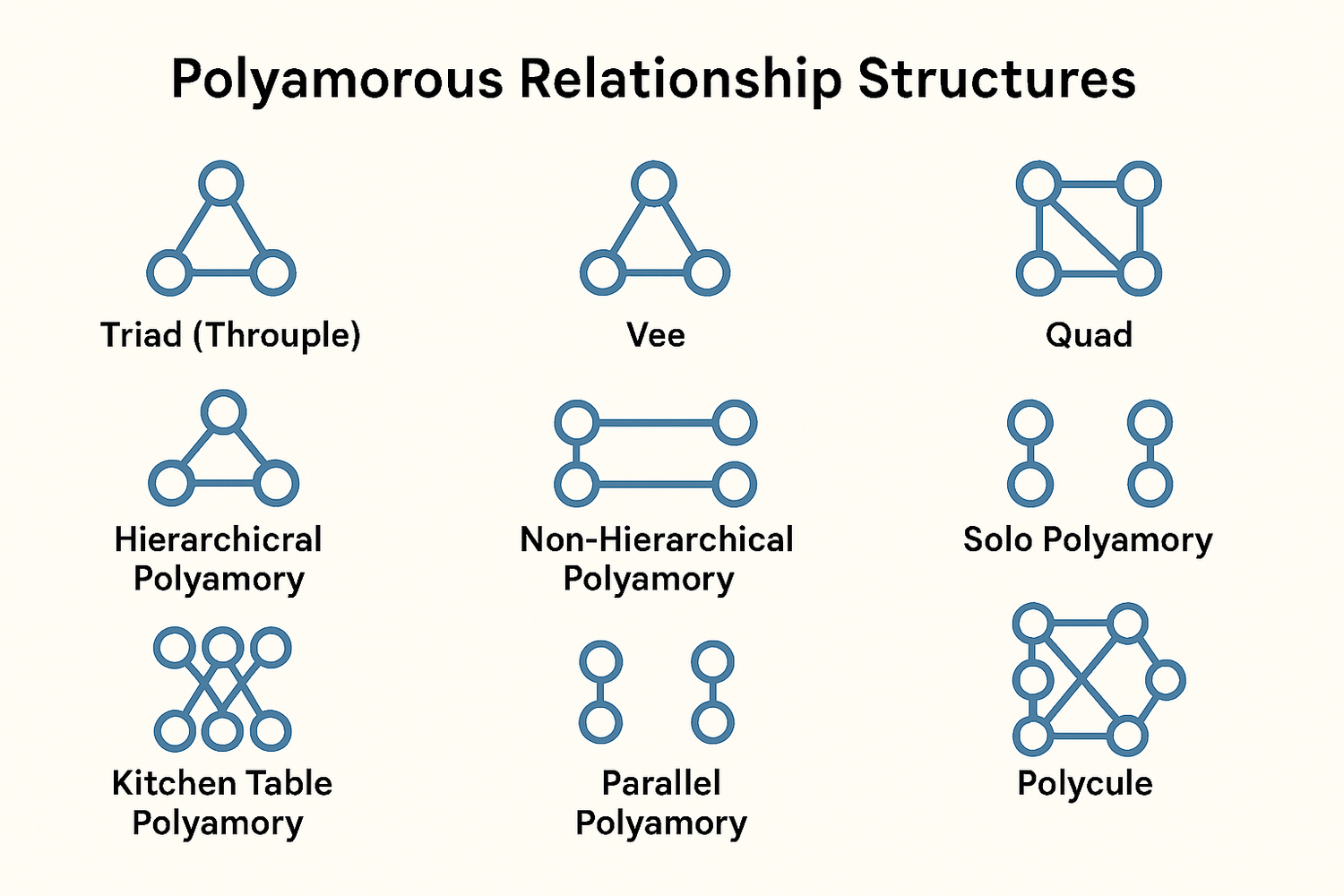
However, in the spirit of Rothbard's Law, the husband undervalues his contribution. To him, being "the stable one" feels passive and unglamorous. He looks at the intense emotional processing, communication, and negotiation that can occur and decides that is the impressive skill to master. He decides to specialize in being the relationship's emotional facilitator, a role for which he has little natural talent.
- His natural talent: Providing practical support and a calm, stable presence.
- He chooses to specialize in: Mediating and analyzing the complex emotional dynamics between his wife and her partner.
This leads to a series of well-intentioned but clumsy interventions:
- He starts offering unsolicited "psychological" interpretations of his wife's feelings for her metamour, often missing the mark entirely.
- He tries to "coach" his wife on how to handle disagreements with her partner, using jargon he's picked up from articles but doesn't fully understand.
- During a check-in, instead of just listening, he might say, "It sounds like you're experiencing some limerence, which is causing a projection of idealized traits onto your partner. We should deconstruct that."
His attempts to manage what he doesn't understand create awkwardness and tension. His wife and metamour, who were navigating their dynamic effectively, now have to manage the husband's misguided attempts to "help." He has taken his greatest strength—being a source of uncomplicated stability—and abandoned it to specialize in being a bad relationship therapist. He has fallen into the trap of believing the most valuable work is the work he finds most difficult, rather than the work he does best.
Conclusion
Rothbard's Law serves as a humorous but insightful cautionary tale. It reveals a psychological quirk where the satisfaction of tackling a difficult challenge can blind us to the greater value of our innate talents. By undervaluing what comes naturally, we risk specializing in our own incompetence.
Key Takeaways:
- Rothbard's Law: People have a humorous tendency to specialize in what they are worst at, often because they undervalue their natural, "easy" talents and seek a sense of accomplishment from difficult tasks.
- In Lingerie Design: This manifests as designers or fitters who ignore their core competencies (e.g., structural drafting) to pursue areas where they are weak (e.g., avant-garde aesthetics), resulting in functionally poor products. It also explains the "expert" who is profoundly bad at their job.
- In a Vee Relationship: It can appear as a partner who abandons their natural, stabilizing role to become an amateur (and ineffective) emotional mediator, creating more complexity instead of providing support.
- The Underlying Lesson: Recognizing and valuing your own strengths is a critical, and often overlooked, skill. True effectiveness comes from leveraging what you do best, not from struggling in areas of weakness for the sake of a challenge.
In our next lesson, we will shift our focus to the subjective nature of experience by examining Vierordt's Law, which explores the fascinating and often predictable ways our perception of time can stretch and shrink.