Welcome to the next lesson in our exploration of systems and models. In our previous session, we examined Parrondo's Paradox and saw how two losing strategies could be combined in a state-dependent sequence to create a winning outcome. Today, we move from the domain of game theory to evolutionary biology, not for a scientific principle, but for a powerful cautionary tale.
We will explore Lamarck's Theory of Evolution. While discredited as a mechanism for biological evolution, it serves as an excellent metaphor for a common and costly error in professional and personal life: the flawed assumption that skills or knowledge we acquire through effort can be automatically understood or "inherited" by those around us. This lesson will show you how to identify this fallacy in your work and relationships, linking it to a cognitive bias known as the "Curse of Knowledge," and develop strategies to overcome it.
Lamarck's Theory: A Metaphor for Flawed Assumptions
Jean-Baptiste Lamarck proposed that an organism could pass on characteristics it had acquired during its lifetime to its offspring. The most famous example is the giraffe.

The core idea is the inheritance of acquired characteristics. We now know that biological inheritance works through genes, not through the efforts of a parent. A blacksmith who develops strong arms through years of hammering does not pass that muscle mass directly to his children. They inherit the genetic potential for it, but they must still do the work themselves.
However, in our social and professional lives, we often behave as if Lamarckism were true. An expert who has spent years "stretching" to gain a deep, intuitive understanding of a subject often implicitly expects their students, colleagues, or partners to possess that same understanding without having gone through the same rigorous process.
The Curse of Knowledge: The Psychological Root of the Lamarckian Fallacy
This tendency to project our own knowledge onto others is a well-documented cognitive bias called the curse of knowledge. Once you know something, it becomes difficult, if not impossible, to remember what it was like not to know it. Your expertise "curses" you, making it hard to put yourself in the shoes of a novice.
To see this bias in action, watch this short video from an MIT Sloan professor. It uses a fascinating visual illusion to demonstrate how quickly our brains acquire a pattern and then cannot "unsee" it.
The Curse of Knowledge: Why Experts Struggle to Explain Their Work
This video, "The Curse of Knowledge: Why Experts Struggle to Explain Their Work," provides a clear and concise explanation of the bias.
Please watch these segments: First, the introduction frames the core problem of why experts can be poor communicators. Then, watch the section from the dolphin illusion through the explanation of how this "curses" experts. This is the key part of the video. The speaker's point is that, like the dolphin, once you see the pattern, you forget what it was like before you knew.
As the video explains, the more expertise you develop, the stronger the curse becomes. You hear the full "melody" of your knowledge in your head, while your audience may only hear disconnected "tapping." This is the Lamarckian fallacy in action: assuming your internal melody is being inherited by the listener.
The following article delves deeper into this phenomenon and provides a framework for overcoming it.
Curse of knowledge at work: why experts can no longer explain ...
This article from SUE Behavioural Design breaks down the curse of knowledge in a work context and offers concrete solutions.
Please focus on these parts: Read the introduction, from the definition up to the end of the tapper-listener experiment description. This solidifies the concept. Next, review the section "Three situations where it does the most damage," which provides relatable examples in presentations, product design, and onboarding. Notice how in each case, the expert assumes their acquired context is shared. Finally, read the section "Five interventions that change the environment." These are the practical antidotes to the Lamarckian assumption.
Application 1: The Curse of Knowledge in Lingerie Design
Let's apply this to your work in lingerie design and fitting. As an experienced designer, you possess a vast amount of acquired knowledge: the subtle differences in fabric tension, the way a dart's angle changes breast shape, the intuitive sense of proportion. This expertise is your "long neck."
The Lamarckian Fallacy in Action:
- Training an Apprentice: You show a trainee how you adjusted a pattern to create more lift. You see the logic instantly because you've done it a thousand times. When the trainee struggles to apply the same principle to a different size or style, you might feel frustrated. "Why don't they get it?" This is the curse of knowledge. You are expecting them to have inherited your decade of practice, forgetting the thousands of small failures and discoveries that built your intuition.
- Communicating with a Client: During a fitting, you explain, "The band is riding up because the cup volume is too small, forcing the band to compensate for the lack of projection." To you, this is a clear causal chain. To the client, who lacks your understanding of structural engineering for the body, it might be meaningless jargon. You assume she understands the physics because you do. You are tapping out the song of perfect fit, but she only hears technical noise.
- Collaborating with a Manufacturer: You send a technical drawing to a factory. You might leave out certain minor details about seam finishing because, for you, "it's obvious" that a luxury garment would be finished that way. The factory, operating on explicit instructions, produces a garment that is technically correct but lacks the refined feel you intended. You implicitly expected them to inherit your aesthetic standards.
The Antidote: Explicit Teaching and System Design
To counter this, you must consciously shift from assuming knowledge is inherited to designing systems that actively transfer it. The goal is not to simplify your expertise, but to translate it.
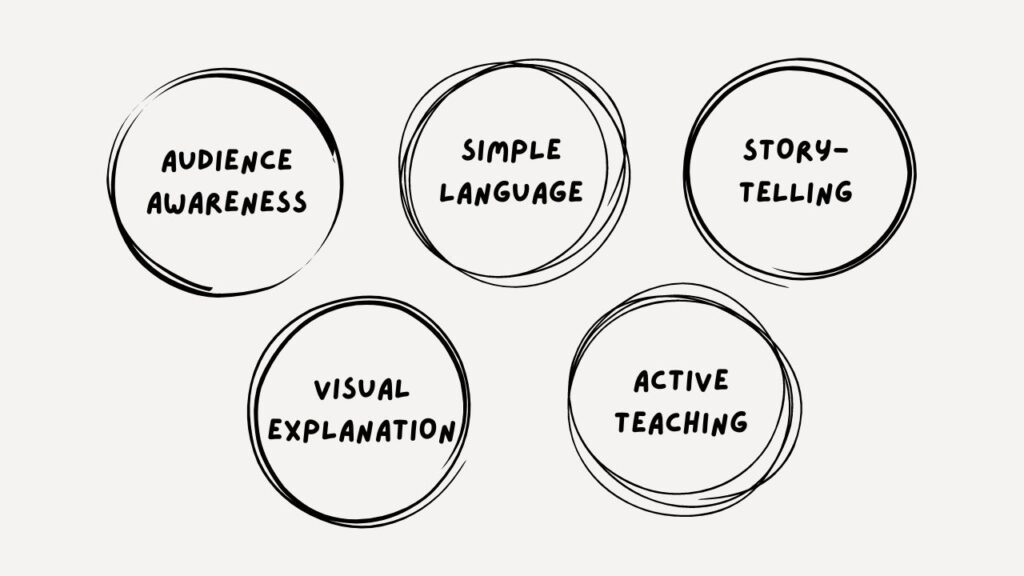
Drawing on these ideas and the article's recommendations, you could:
- For the Trainee: Don't just show; actively teach. Create structured exercises. Give them a simple pattern and have them perform one specific modification (e.g., "increase side support"). Have them explain the "why" back to you. This forces them to go through the "stretching" process themselves.
- For the Client: Use storytelling and concrete examples. Instead of technical explanations, translate the benefit. "See how this seam lifts you from the side? It's like a little architectural support beam, giving you this amazing shape here." Use "before and after" photos (visual explanation) to make the impact tangible.
- For the Manufacturer: Implement an "outsider review." Before sending a tech pack, have someone less familiar with the design review it for ambiguities. Provide physical samples (a form of "visual explanation") that embody the desired quality, rather than assuming it will be understood from a drawing.
Application 2: The Lamarckian Fallacy in a Vee Relationship
Now let's turn to relationship analysis. Consider a vee relationship where the wife, as the hinge, has invested significant time in learning about polyamory. She has read books, listened to podcasts, and engaged in deep self-reflection. She has "stretched her neck" to acquire advanced skills in communication, emotional regulation, and managing compersion.
The Lamarckian Fallacy in Action:
- The wife feels a surge of compersion seeing her husband and her lover get along. Later, her husband expresses insecurity. She is hurt and confused, thinking, "But we're polyamorous, you're supposed to feel compersion!" She has forgotten that her compersion is an acquired skill, developed through practice and reframing. She is assuming her husband should have "inherited" this complex emotional state simply by being in the relationship.
- She tries to initiate a "RADAR" (Review, Analyze, Discuss, Action, Repeat) check-in, a specific communication tool she learned about. Her partners seem resistant or confused. She feels they are "not doing the work," forgetting that for her, the tool is familiar and intuitive, while for them, it's a new and abstract process. She is tapping out the rhythm of a structured communication protocol, but they haven't learned the song yet.
The Antidote: Co-creation of Knowledge
The solution is to abandon the "expert/teacher" model and adopt a "co-learner" model. The goal is not for her to transfer her knowledge to them, but for all three to build a shared pool of knowledge together. This directly counters the idea of passive inheritance.
- Shared Learning, Not Reported Learning: Instead of her reading a book and reporting the "conclusions" to her partners, they could read a chapter together or listen to a podcast episode and then discuss it. This ensures they all go through the "stretching" process in parallel.
- Translate Principles into Concrete Behaviors: An abstract principle like "We should communicate with more transparency" is vulnerable to the curse of knowledge. A better approach is to collaboratively define it. "What is one specific thing we could do this week that would feel more transparent to you?" This moves from abstract principle to concrete example.
- Use a "Translator": As discussed in the business context, sometimes an outside party is invaluable. A polyamory-aware relationship coach can act as a neutral translator, helping each person articulate their perspective in a way the others can understand, bridging the gap created by differing levels of acquired knowledge. The coach ensures no one is just "tapping."
Conclusion
Lamarck's discredited theory provides a powerful framework for understanding a common failure in communication and teaching. We often act as if the knowledge and skills we've worked hard to acquire are automatically inheritable, a fallacy rooted in the curse of knowledge.
Key Takeaways:
- Lamarck's Theory as a Metaphor: The belief that acquired traits are inheritable serves as a cautionary tale for assuming our learned skills and insights are automatically understood by others.
- The Curse of Knowledge: This cognitive bias is the engine of the Lamarckian fallacy. Experts forget what it was like to be a novice, leading them to overestimate shared context and understanding.
- The Antidote is Explicit Transfer: Overcoming this requires moving from implicit expectation to explicit teaching, translation, and co-creation of knowledge. This involves using concrete examples, visual aids, storytelling, and structured feedback systems.
In our next lesson, we will apply Tobler's First Law of Geography. We will shift our focus from the internal psychology of knowledge transfer to the external dynamics of space and proximity, exploring how "near things are more related than distant things" in both lingerie markets and polyamorous networks.