Welcome to our new lesson on systems and complexity. In our previous session, we examined Stein's Law, which provides a framework for identifying unsustainable systems by forcing us to acknowledge that "if something cannot go on forever, it will stop." It teaches us to spot the signs of an impending breakdown. Today, we turn to a complementary principle: Tesler's Law of the Conservation of Complexity.
This law helps explain why systems are the way they are, particularly the intricate ones. It states that every system—be it a product, a process, or a relationship structure—has an irreducible amount of complexity. This complexity doesn't vanish; it is merely shifted. The crucial decision is determining who shoulders the burden of this complexity: the designer or the user. This lesson will focus on applying this law to identify and manage the inherent complexity in both bra pattern engineering and the logistics of a vee relationship.
Tesler's Law: Complexity Cannot Be Destroyed, Only Moved
Larry Tesler, a pioneering computer scientist, formulated this law in the context of user interface design. He argued that when you simplify an application for the user, the complexity doesn't disappear; it gets transferred to the software's developers. The designer's job is to absorb as much of the system's inherent complexity as possible, providing the user with a simple, elegant experience. When this is done poorly, the user is forced to manage the complexity themselves, often resulting in frustration and failure.
This principle extends far beyond software. We will now explore its application in two highly specialized domains you are familiar with: lingerie design and relationship analysis.
Application 1: The Irreducible Complexity of a Well-Fitted Bra
From the user's perspective, a bra should be simple: you put it on, it fits, it provides support, and it's comfortable. However, achieving this "simple" outcome requires the designer and manufacturer to manage an immense amount of underlying complexity. Your experience designing lingerie will confirm that a bra is one of the most technically demanding garments to create.
The following article provides an excellent overview of the many factors contributing to this inherent complexity.
Why Lingerie Is One of the Hardest Garments to Make - Deepwear
This piece from Deepwear, an apparel production consultancy, breaks down the specific engineering and manufacturing challenges that make lingerie so complex. It perfectly illustrates Tesler's Law in action.
As you read, focus on how each point represents a form of irreducible complexity that the designer must solve so the wearer doesn't have to: Begin with the introduction to understand the core premise of why lingerie is so complex. Pay close attention to the section on unforgiving fit. Note the description of the band, cup, and straps as three interacting systems, creating a non-linear sizing matrix. This is a classic example of irreducible complexity. Read about the challenges of materials and multi-layer construction. The complexity lies in making dissimilar components act as a cohesive whole. Finally, review the points on skilled labor and how technology doesn't replace expertise. This shows that some complexity must be handled by human skill, not just automation.
The article confirms that a bra is not a simple garment; it's an engineered system. The complexity arises from the need to map a highly variable, soft-tissue 3D form (the human torso) onto a 2D pattern that is then constructed into a functional 3D object.
To visualize this, consider the following image:
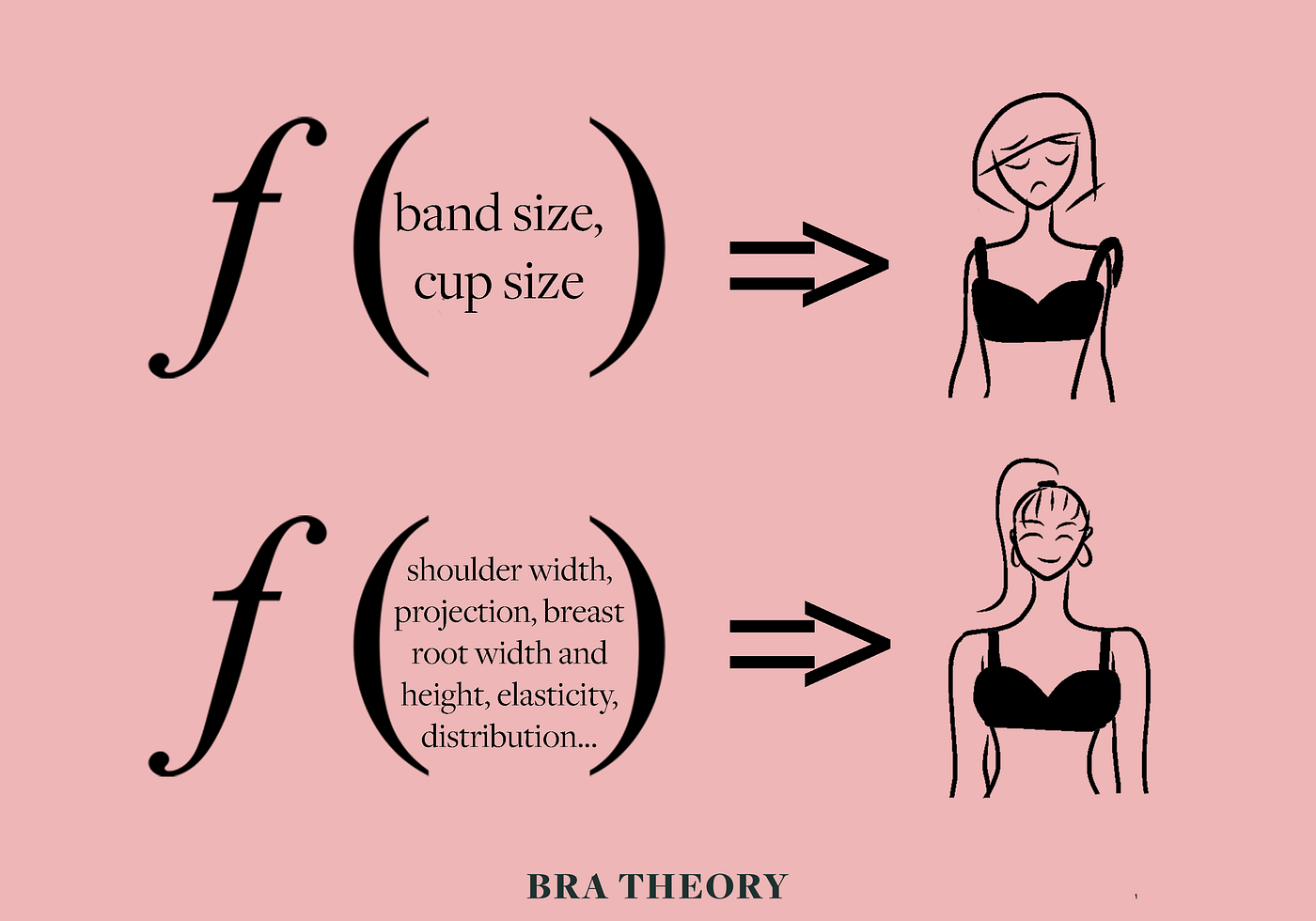
As the image shows, simplifying the input variables (band size, cup size) doesn't eliminate the body's actual complexity; it ignores it, leading to a poor result for the user. A proper fit requires the designer or fitter to manage a much larger set of variables, effectively absorbing the complexity on behalf of the customer.
The process of pattern drafting makes this tangible. Watch the following video to see the number of steps, measurements, and geometric adjustments required to create just the basic pattern for a bra.
This "Tayary Designs" tutorial demonstrates the hands-on process of drafting a custom bra pattern. It provides a clear visual of the complexity involved in translating body measurements into a functional design.
Focus on these key stages where complexity is managed by the pattern maker: Drafting the lower cup: Notice the specific calculations for the bust dart and the adjustments made to avoid pointiness. Drafting the frame: Observe how the cradle is drafted and then measured against the cup pieces to ensure they will fit together. Shaping the frame: This section is crucial. The designer makes specific adjustments based on body shape (e.g., tapering the waist, raising the center gore) to prevent gaping. This is a perfect example of the designer anticipating and solving problems for the user.
Every measurement, every curve adjustment, and every seam allowance is a decision that manages a piece of the system's total complexity. From your background in the Design of Experiments, you can frame this as a multi-variable problem where factors like fabric stretch, underwire gauge, strap placement, and dozens of pattern dimensions interact. A successful design is one that finds an optimal solution within this complex space, delivering a "simple" and effective product to the end-user. The complexity has been conserved, neatly contained within the pattern and the garment's construction.
Application 2: The Conservation of Complexity in a Vee Relationship
Just as a bra is a system of interacting components, so is a polyamorous relationship. A common misconception is that non-monogamous relationships can be "casual" or "simple." In reality, maintaining healthy, ethical, and sustainable multi-partner relationships involves a significant degree of inherent complexity that must be managed. If it's not managed explicitly through systems and agreements, it is offloaded onto the partners as emotional turmoil, misunderstandings, and logistical chaos.
Let's examine this through the lens of a vee relationship (e.g., a husband, his wife, and her lover). The core complexity here involves managing time, emotional resources, privacy, and communication among three people with interconnected lives.
The following resource, an interview with the creator of a scheduling app for polyamorous people, directly addresses this.
Polyamory's Biggest Struggle Isn't Jealousy
This podcast transcript from Nope! We're Not Monogamous discusses the logistical challenges of polyamory, framing it as the central, irreducible complexity of this relationship style.
Please read the following excerpts: First, read the section where the interviewee, Richie, discusses an academic study on polyamorous scheduling. Find the paragraph starting with "I am, If you can't tell quite a nerd." The finding that poly scheduling is considered a mathematically unsolved problem is a perfect articulation of irreducible complexity. Next, consider why generic tools fail. In the section starting "Well, and, and like the, what's out there right now," notice the description of people juggling multiple calendars and phones. This is a classic symptom of users being forced to manage complexity that the tool (e.g., Google Calendar) does not handle for them. Finally, read about the proposed solution. Starting with "One big foundational piece of my app," the creator explains how a dedicated tool can absorb complexity by integrating intentional scheduling, boundary setting, and privacy controls into the system itself.
The key insight is that the complexity of managing schedules, needs, and boundaries in a polyamorous network is real and unavoidable.

Your expertise in Operations Research, particularly in scheduling and queueing theory, provides a formal language for this. A vee relationship can be modeled as a dynamic scheduling problem with multiple, often conflicting, constraints:
- Time constraints: There are only 24 hours in a day.
- Resource constraints: Each individual has finite emotional energy and personal time.
- Precedence constraints: Some events must happen before others (e.g., a conversation about boundaries before a first overnight date).
- Stochasticity: Plans change unexpectedly due to illness, work, or mood.
Applying Tesler's Law to the vee scenario:
- Offloading Complexity to Users: The "simple" approach is to have no system. The wife communicates her plans with her lover, and separately with her husband. This forces the husband and lover to constantly react, adapt, and piece together the full picture. The logistical and emotional burden of de-conflicting schedules, managing expectations, and dealing with last-minute changes is placed squarely on the individuals. This often leads to feelings of being overlooked or overburdened, a direct path to the unsustainable states we discussed in the last lesson on Stein's Law.
- Absorbing Complexity into a System: A more robust approach acknowledges the inherent complexity and builds a system to manage it. This system is itself complex to set up but simplifies the daily experience. Examples include:
- A shared, color-coded calendar visible to all three partners.
- A weekly check-in meeting to align on plans and emotional needs.
- Explicit agreements ("house rules") about overnights, use of shared spaces, and expectations for communication.
In this model, the system does the heavy lifting. The complexity is conserved—it now exists within the rules and tools the triad uses—but it is no longer a constant source of stress and confusion for the partners. They have shifted the burden of complexity from their moment-to-moment interactions into a shared, intentional structure.
Conclusion
Today we explored Tesler's Law, which posits that complexity is a constant in any system; it can be moved but not eliminated. A successful design, whether of a product or a social structure, is one that deliberately absorbs this complexity to create a simpler, more functional experience for the user.
Key Takeaways:
- Tesler's Law: Every system possesses an irreducible core of complexity. The designer's fundamental choice is where to locate it.
- In Lingerie Design: The complexity of the human form and material science is irreducible. A skilled designer manages this through intricate pattern-making and construction, shielding the wearer from the burden of a poor fit.
- In Relationship Dynamics: The logistical and emotional complexity of a multi-partner relationship is also irreducible. A healthy relationship structure manages this complexity with explicit systems (calendars, agreements), shielding the partners from the daily chaos of unmanaged assumptions.
In our next lesson, we will delve into Parrondo's Paradox. This counterintuitive principle explores how two individually losing strategies can be combined to produce a winning outcome, offering another fascinating perspective on navigating complex systems.