Welcome to the first lesson in our module on measurement, data, and quality assessment. In our previous session, we explored the subjective elasticity of time with Vierordt's Law, seeing how our internal state can warp our perception of objective reality. Today, we shift our focus from subjective perception to the pitfalls of objective measurement itself. As a statistician, you are intimately familiar with the challenge of selecting a proxy variable to stand in for a complex, unobservable construct. This lesson examines the dramatic behavioral consequences that unfold when that proxy is not merely observed, but turned into a high-stakes target.
We will delve into two closely related principles: Goodhart's Law and Campbell's Law. Goodhart's Law famously states, "When a measure becomes a target, it ceases to be a good measure." Campbell's Law offers a parallel warning: the more a quantitative social indicator is used for decision-making, the more it will be subject to corruption and distort the very social processes it is intended to monitor. Our goal is to apply these laws to understand how a seemingly rational focus on metrics can perversely undermine goals in both a lingerie business and a polyamorous relationship.
The Tyranny of the Target
At its heart, Goodhart's Law describes a predictable pattern of human adaptation. When a simple number is elevated to a position of great importance—determining bonuses, status, or a sense of security—people will naturally optimize their behavior to influence that number. The problem is that they often optimize the number itself, not the underlying reality it was supposed to represent.
This leads to a phenomenon called surrogation, where the metric (the proxy) cognitively replaces the actual goal (the construct). Success is no longer defined by achieving the complex, real-world outcome, but by making the number on a dashboard go up.
These two images provide a powerful visual intuition for this concept.
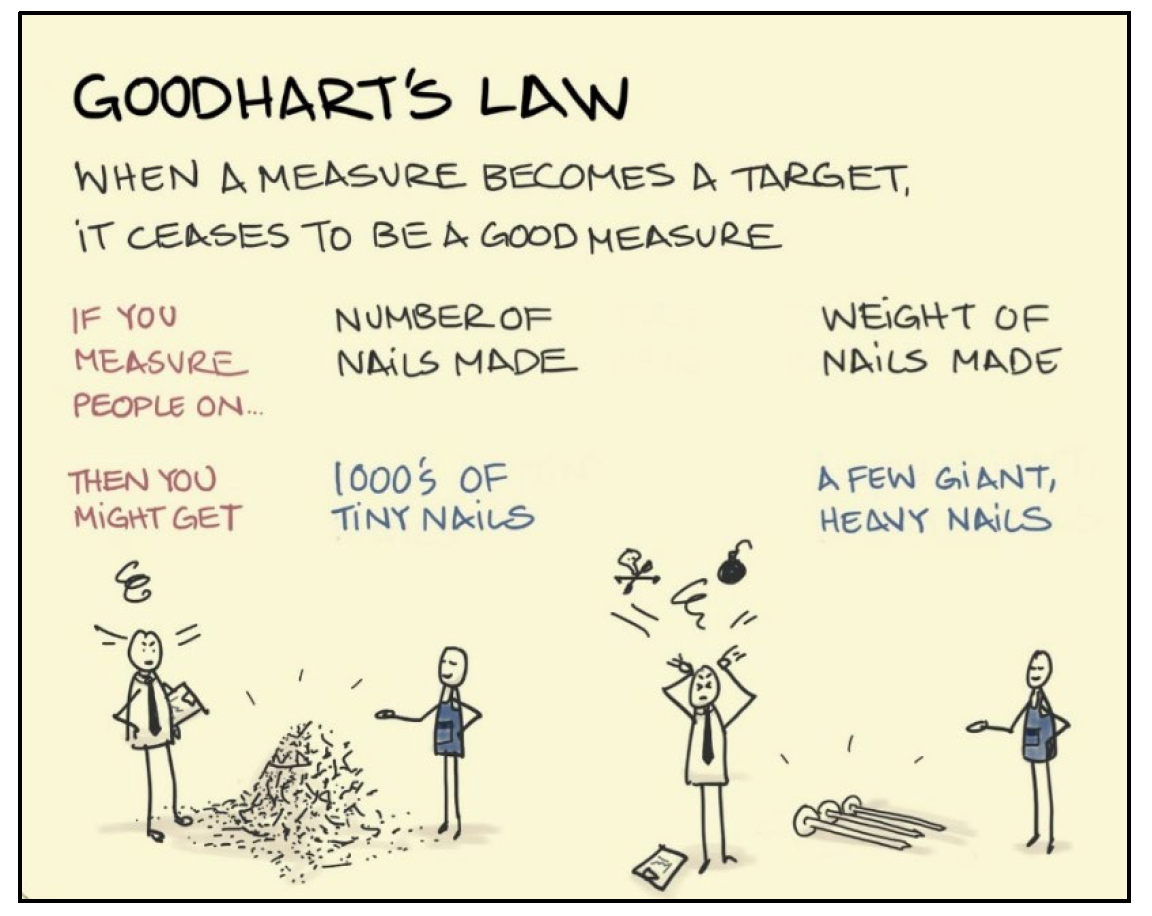

To formalize this and connect it directly to Campbell's Law, let's turn to a short article that distinguishes the two.
Campbell's Law: The Dark Side of Metric Fixation - NN/G
This article from the Nielsen Norman Group provides clear, concise definitions and highlights the crucial link between Goodhart's and Campbell's Laws.
Please read the introduction, from the beginning down to the start of the section "Campbell’s Law in Everyday Life." Pay close attention to the distinction it draws and the formal definitions provided for both Campbell's Law and Goodhart's Law.
The Anatomy of Metric Corruption
The failure described by Goodhart's Law isn't a single phenomenon. It's a family of related failure modes. Understanding these different "rot" mechanisms allows for a more precise diagnosis of how a metric is failing. An excellent essay on the topic proposes a practical taxonomy for these failures.
Goodhart's Law and the Death of Honest Metrics - Medium
This Medium article provides a sophisticated analysis of why metrics fail. It introduces the key concept of "surrogation" and breaks down Goodhart's Law into four distinct mechanisms.
Please read the introduction and the first two main sections. In the introduction, focus on the core idea that a metric is not a passive thermometer but an active part of the system that changes behavior. In section 1, absorb the definition of surrogation — when the measure replaces the construct. In section 2, carefully study the four mechanisms of metric rot: the full taxonomy. These are Regressional, Extremal, Causal, and Adversarial Goodhart.
With this framework in mind—surrogation and the four mechanisms of failure—let's apply it to our scenarios.
Application 1: The Lingerie Business Metric Trap
Imagine a boutique lingerie business. The owner wants to increase profitability and customer loyalty. After some analysis, she decides that Average Transaction Value (ATV) is a good proxy for success, as higher ATV could indicate customers are buying more, presumably because they are happy. She makes "Increase ATV by 15%" the primary target for her sales staff, with bonuses attached.
Here's how this seemingly rational target can become corrosive:
- The Goal vs. The Target: The true goal is a thriving business built on customer trust and satisfaction. The target is simply a higher average receipt total.
- Surrogation in Action: The staff, driven by the bonus, begins to see their job not as "fitting clients perfectly" but as "maximizing the value of each sale." The ATV number replaces the customer satisfaction construct in their daily decision-making.
- Adversarial Goodhart (Gaming): A fitter might pressure a client to buy a more expensive bra that doesn't fit as well, simply because it will boost the transaction value. Or, they might aggressively upsell matching underwear or accessories, even if the client is hesitant, turning a supportive consultation into a high-pressure sales pitch. The metric is gamed by prioritizing high-margin items over the client's actual needs.
- Extremal Goodhart (Leaving the Regime): The focus on ATV might lead staff to neglect customers who only want a single, basic, but well-fitting item. They might receive rushed, dismissive service because they are perceived as "low value" transactions. The staff is optimizing within a new regime—focusing only on big spenders—where ATV no longer correlates with overall business health, as it alienates a core customer base.
The Campbell's Law Corruption: The social process of a bra fitting—a nuanced, expert-led service intended to build confidence and solve a personal problem—is corrupted into a crude, transactional process focused on upselling. The metric, intended to monitor business health, has actively distorted the core value proposition of the business.
Application 2: Quantifying Love in a Vee Relationship
Consider the Vee relationship: a husband, wife, and the wife's male lover. The husband, feeling insecure, wants reassurance that his primary relationship with his wife is secure and prioritized. He decides that a good metric for this is the amount of dedicated time they spend together.
He and his wife agree on a target: "We must have at least three 'date nights' per week, just the two of us."
- The Goal vs. The Target: The true goal is emotional security and deep, mutual connection. The target is a numerical quota of shared evenings.
- Surrogation in Action: The husband starts looking at the weekly calendar as the primary indicator of relationship health. "Did we hit our three nights?" becomes the key question, replacing "How connected do we feel?" The number on the calendar supplants the feeling of intimacy.
- Causal Goodhart (Changing Causality): The act of measuring and targeting date nights changes their very nature. What were once spontaneous acts of affection now become obligations. The wife, feeling the pressure of the quota, may show up for the date night physically but be emotionally exhausted or disengaged. The date night is no longer a result of their connection; it is a forced input intended to manufacture a feeling of connection, which rarely works. The metric has causally altered the behavior it was meant to measure.
- The Perverse Outcome: The couple successfully hits their target of three date nights per week. The metric looks great. However, the quality of that time has plummeted. The husband may feel even less secure, sensing his wife's detached presence. The wife feels burdened and resentful. The focus on the metric has actively damaged the underlying goal of emotional connection.
The Campbell's Law Corruption: The complex, organic social process of negotiating intimacy, connection, and reassurance is distorted by a rigid, quantitative rule. The indicator (number of nights) has corrupted the process it was supposed to monitor (nurturing the relationship).
Escaping the Trap: Towards Honest Metrics
If single metrics are so dangerous, is the answer to stop measuring? No. The answer is to build a more robust and intelligent governance system around your metrics. The "Honest Metrics" article provides an excellent set of principles.
Goodhart's Law and the Death of Honest Metrics - Medium
This final reading from the same article outlines a practical architecture for creating metrics that are more resistant to corruption.
Please read section 6, "What 'honest metrics' look like in practice," and section 8, "A concrete standard: The Honest Metrics Charter." Focus on the actionable principles provided, such as using a portfolio of metrics and pairing every target with a counter-metric.
Let's apply this thinking:
-
For the Lingerie Business: Instead of a single ATV target, the owner should use a portfolio of proxies that balance each other.
- Control KPI: ATV (to monitor sales).
- Counter-Metric 1: Product return rate. If ATV goes up but so do returns, it's a red flag for pressure-selling ill-fitting items.
- Counter-Metric 2: Customer satisfaction score (e.g., a 1-5 scale on a follow-up email). If ATV goes up but satisfaction drops, you're alienating customers.
- Qualitative Judgment: Regular, informal conversations with staff about their recent client interactions.
-
For the Vee Relationship: The couple should abandon the rigid quota and treat measurement as a sensor, not a commandment.
- Shift from a target to a qualitative check-in: Instead of "Did we have three date nights?" ask, "On a scale of 1-10, how connected have you felt to me this week?" This moves from a flawed proxy to a more direct measure of the construct.
- Introduce a "shadow metric": Discuss the quality of the time spent together. "Let's make sure we have at least one 'deep conversation' this week, whenever it happens" values quality over quantity.
- Use metrics for learning, not judgment: Track the calendar not to enforce a rule, but to notice patterns. "I see we haven't had a proper evening together in ten days. I'm feeling a bit distant. Can we schedule something nice?" This uses the data as a conversation starter, not a weapon.
Conclusion
Goodhart's and Campbell's Laws are essential warnings for anyone who works with data and people. They teach us that measurement is not a neutral act; it is an intervention that reshapes the system being observed. As a statistician, you know that all models are wrong, but some are useful. These laws highlight the point at which a useful model becomes actively harmful: the moment its output is treated as an infallible target.
Key Takeaways:
- Goodhart's & Campbell's Laws: Targeting a metric incentivizes people to optimize the metric itself, often at the expense of the true goal. This corrupts both the metric's meaning and the system it measures.
- Surrogation: This is the cognitive trap of allowing a proxy measure (like "sales figures" or "date nights") to replace the actual construct you care about (like "customer loyalty" or "relationship security").
- Mechanisms of Failure: Metrics can fail by optimizing for noise (Regressional), pushing behavior into strange edge cases (Extremal), changing the system itself (Causal), or inviting deliberate cheating (Adversarial).
- The Antidote is Governance: The solution isn't to abandon metrics, but to use them wisely: in portfolios, paired with counter-metrics, and balanced with qualitative judgment. Use them as sensors for conversation, not as rigid commandments.
In our next lesson, we will explore a concept that flows directly from this discussion: the McNamara Fallacy, which describes the error of prioritizing what is easily measured over what is truly important, a foundational mistake that enables the failures of Goodhart's Law.