Welcome back. In our previous lesson, we explored the Hegelian Dialectic as a method for resolving internal contradictions, synthesizing a thesis and its antithesis into a stronger, more complex whole. We saw how this can lead to innovative bra designs and more resilient relationship agreements.
Today, we shift our focus from resolving internal conflicts to navigating the confusion caused by conflicting external information. This brings us to Segal's Law, which wryly states: "A man with a watch knows what time it is. A man with two watches is never sure."
This lesson will deconstruct Segal's Law, applying it to explain the uncertainty that arises when a lingerie client consults contradictory sizing charts, and when a partner in a vee relationship receives conflicting advice. For someone with your background in statistics, this law speaks directly to the nature of measurement, error, and certainty. A single data point provides a confident—but potentially inaccurate—estimate. Two conflicting data points destroy that confidence but introduce a crucial awareness of the underlying uncertainty, forcing a more critical approach to finding the truth.
The Double-Edged Sword of Information
At first glance, Segal's Law seems to lament the introduction of a second data point. The man with one watch enjoys a state of blissful, if potentially misplaced, certainty. The moment a second, differing watch appears, that certainty shatters. However, the law's deeper wisdom lies in this very disruption.
Let's explore this nuance through a discussion on the Hacker News forum.
This online discussion provides several interpretations of Segal's Law, moving from the simple adage to more sophisticated statistical and philosophical takes.
As you read through the comments, focus on the different ways the users interpret the law: First, locate the simple statement of the law itself, posted by user getToTheChopin: "A man with a watch...". Next, read the insightful comment by user Phiwise_ at the top of the thread. Pay close attention to the italicized portion: "However, the underlying message...". This reframes the law not as an endorsement of ignorance, but as a critique of false certainty. Finally, scan the subsequent comments to see how the idea evolves. Note the mention of paralysis of choice, the suggestion to use Bayes' theorem to weigh evidence, and the corrected version offered by cs702: "A person with a watch thinks...".
The key takeaway is that the man with two watches is, in fact, in a better position. He has moved from a state of unfounded certainty to a state of informed uncertainty. He is now aware that "what time it is" is not a simple fact but a measurement with potential for error. This awareness is the first step toward a more robust understanding.
Application 1: The Lingerie Sizing Dilemma
Your experience designing lingerie has likely shown you that bra sizing is far from a standardized science. This lack of standardization is a perfect real-world illustration of Segal's Law.
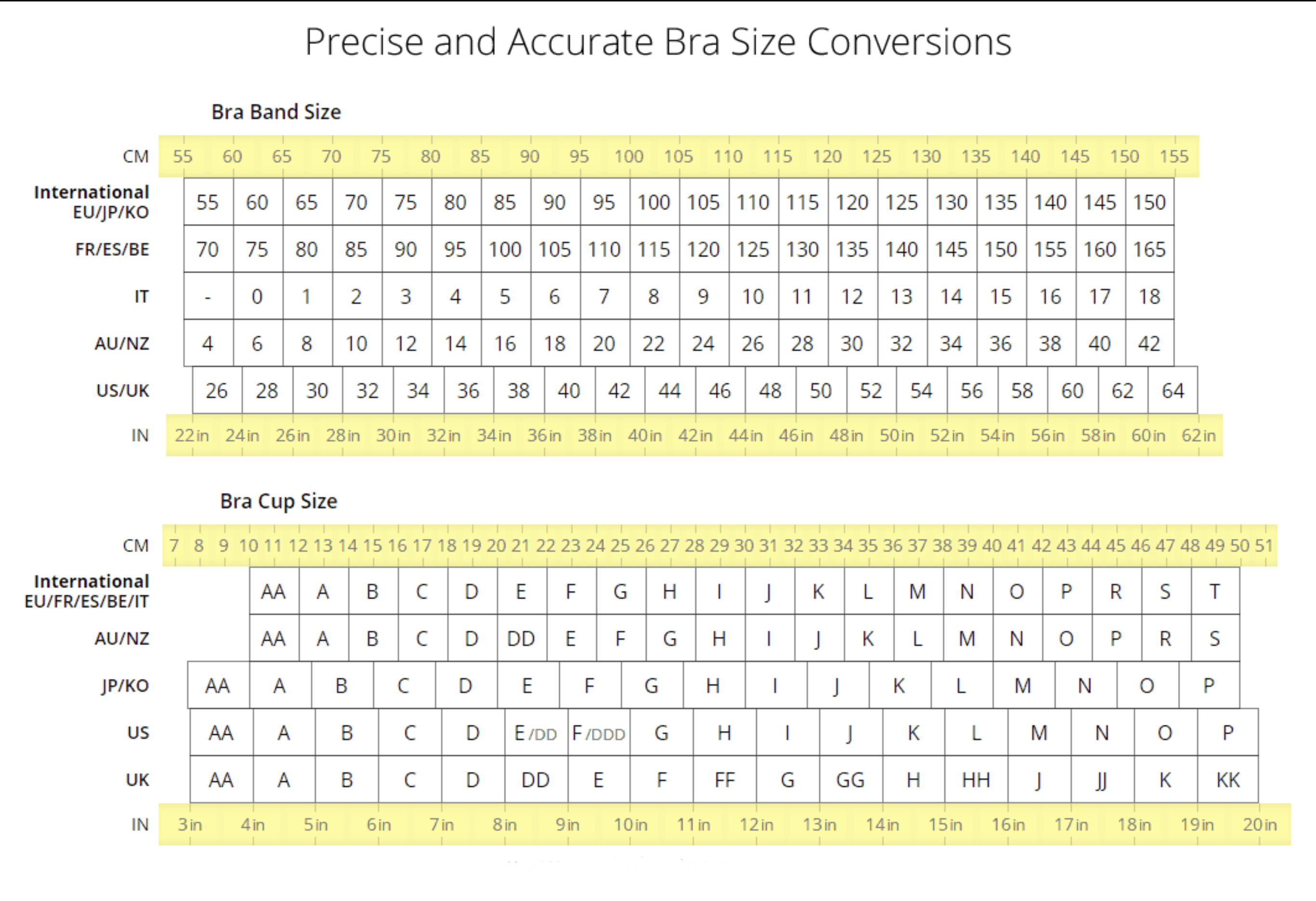
Scenario: A client comes to you for a fitting. She is frustrated. She confidently states, "I'm a 34B," because that's what a popular high-street brand's online calculator told her (her "first watch"). However, she recently bought a 34B from a different designer based on that information, and it fits terribly (her "second watch"). Now she is completely unsure of her size and what to believe.
This is Segal's Law in action. Her initial certainty has been replaced by confusion. The solution isn't to find a "third watch" (another chart) but to abandon the "watches" altogether and look at the "sun"—the physical evidence of the fit on her body.
A blog post by lingerie designer Laurie van Jonsson articulates this problem and the solution perfectly.
A wrong fitting bra and how to solve it - Van Jonsson Design
This post from a fellow designer directly addresses the confusion caused by non-standardized sizing and conflicting fitting advice, advocating for a fit-first approach.
Read the introduction to this blog post. Notice how it immediately validates the client's confusion: "It doesn’t help...". The author's advice is to let go of the number and instead focus on what constitutes a correct fit for each individual bra.
The video below provides a powerful visual demonstration of why relying on a single data point like "cup size" is so misleading.
“Same Cup” Different Size?! Bra Math Explained & Why Cup Sizes Make NO SENSE Without Band Size
In this video, "Same Cup” Different Size?!, creator Roxanne Miller brilliantly demonstrates the core principle of bra sizing that confuses so many: a cup letter is meaningless without the band number. This is the mechanism behind the "two watches" problem in bra fitting.
Watch these key segments to see Segal's Law visualized: The Premise: The video opens by stating the core problem—these bras have the same cup letter but are vastly different sizes. The Consequence: The presenter explains how this confusion leads to many women wearing the wrong size, resulting in poor support and discomfort. Visual Proof: Watch as she tries on a 38K bra that is clearly too large in the band, demonstrating that even with the "correct" cup letter, the fit is wrong because the other variable (the band) is incorrect. The band is so loose it offers no support. The Synthesis: The explanation from "I'm a K-cup won't tell you anything" summarizes the point perfectly: the number and the letter are interdependent. One without the other is a faulty watch.
The Resolution:
As a fitter, you guide the client away from the conflicting "watches" (the 34B from brand X, the 32C from brand Y). You establish a new standard of truth based on observable evidence. Using the principles from the Van Jonsson Design blog, you assess the fit based on clear, physical criteria:
- Is the band parallel to the floor?
- Does the center gore lie flat against the sternum?
- Is all breast tissue fully encased in the cups without spillage or gaping?
By doing this, you are teaching the client to abandon the false certainty of abstract sizing numbers and instead trust the concrete evidence of a proper fit. She moves from being "never sure" to being certain about what a good fit feels like, which is a far more useful and reliable measure.
Application 2: Conflicting Advice in a Vee Relationship
Now, let's apply Segal's Law to the complex social dynamics of a vee relationship. Your background as a social researcher gives you a unique lens on how individuals navigate social norms and personal values.

Scenario: A wife is the hinge in a vee relationship with her husband and her male lover. She is trying to balance the needs of her established marriage with the needs of her newer relationship. She seeks advice from two trusted friends.
-
The First Watch: Her first friend, who is happily monogamous, advises her from a traditional perspective. "Your marriage must always come first. Your husband is your primary partner, and any other relationship must be secondary. It's about protecting your core commitment." This advice offers a clear, hierarchical rule. It gives her a sense of certainty and social validation. The time is 12:00.
-
The Second Watch: Her second friend, who is an experienced polyamorist, offers a different perspective. "Treating partners as 'primary' and 'secondary' can be unethical and hurtful. You should strive to meet the needs of both partners with equal consideration and respect. It's about equity and open communication." This advice offers a clear, egalitarian rule. It also feels right and aligns with her non-monogamous values. The time is 12:05.
The wife now has two watches showing different times. She is "never sure." If she follows the first friend's advice, she risks damaging her relationship with her lover and acting against her own values. If she follows the second friend's advice, she risks destabilizing a marriage that relies on a sense of primacy. The conflicting advice creates analysis paralysis.
The Resolution:
Segal's Law illuminates her dilemma. The certainty offered by each friend's advice was an illusion based on a single, biased perspective. The conflict between them reveals a deeper truth: there is no universal "right time" or one-size-fits-all rule for relationships.
The path forward is for the wife to stop looking at the external "watches." She must turn inward, to her own relationship system. This involves:
- Acknowledging the Uncertainty: Recognizing that the confusion is a signal that a simple, imported rule won't work.
- Facilitating Internal Dialogue: Bringing the conflict to her partners. Instead of asking "Which rule should I follow?", she asks "How can we, the three of us, create a system that honors both the security of the marriage and the validity of the other relationship?"
- Creating a "Third Chronometer": The solution is not to average the two pieces of advice, but to create a unique, internally-consistent set of agreements. This is the synthesis we discussed in the last lesson. Their custom-built agreements—about time allocation, emotional support, and decision-making—become their own, hyper-accurate "chronometer." It tells the right time for them, because they built it together.
Conclusion
Segal's Law is a principle about the transition from blissful ignorance to informed confusion. While unsettling, this confusion is a necessary step toward genuine understanding.
Key Takeaways:
- A single source of information ("one watch") provides confidence but may be dangerously inaccurate.
- Conflicting sources ("two watches") create uncertainty, but they also reveal the complexity and potential for error in any measurement system.
- The solution is to move beyond relying on external, often flawed, reference points and to develop a more robust method for determining the truth, grounded in direct evidence (the physical fit of a bra) or internal consensus (negotiated relationship agreements).
In our next lesson, we will explore Gilbert's Law: "The biggest problem in work is that no one tells you what to do." We will shift from navigating conflicting signals to the challenge of acting in the complete absence of them, a situation that demands an even greater degree of internal direction and initiative.