Welcome to the third lesson in our module on Power, Ethics, and Governance. Our last discussion on Duverger's Law focused on how systemic rules, like a "winner-take-all" market, can cause power to concentrate in the hands of a few dominant players. Today, we shift our focus from these emergent properties of systems to the explicit, conscious choices of the actors within them.
This lesson centers on Gerson's Law: "One should take unfair advantage out of every possible situation, having no concern for ethics." This is a starkly cynical and pragmatic principle. Your goal is to apply this law to critically evaluate ruthless competitive tactics in the lingerie industry and to identify self-serving behavior that disregards ethical norms within the dynamics of a vee relationship.
The Philosophy of Advantage: Gerson's Law and Machiavellian Realism
Gerson's Law is not a complex strategic doctrine; it is a simple, amoral decision rule. It advises that ethics are irrelevant when an opportunity for personal gain presents itself. This perspective is a modern echo of the political realism famously articulated by Niccolò Machiavelli.
To understand the psychological underpinnings of this worldview, let's begin with a video that explores how Machiavellian principles apply to the competitive modern world.
How Machiavelli’s Psychological Principles Influence Business Success
This video from Dark Psychology Codex, "How Machiavelli’s Psychological Principles Influence Business Success," frames the business world as a battlefield where understanding and exploiting human nature are key to winning. It provides the perfect philosophical backdrop for Gerson's Law.
Please focus on these key segments: The battlefield analogy: This section argues that business is an invisible war for influence, where principles of power are manuals for survival. Machiavelli's origin: This part explains that The Prince was a brutally honest guide on how power is won and held, making his name synonymous with winning at all costs. The ends justify the means: This is the most crucial part. It discusses the controversial idea that a leader must sometimes perform ruthless acts (like predatory pricing) to achieve a greater good for their organization. This is the core logic that Gerson's Law operates on.
The video argues that in high-stakes environments, a leader who is always bound by conventional morality will be crushed by those who are not. Gerson's Law is the most distilled version of this belief: it dispenses with even the pretense of a "greater good" and focuses purely on self-interest. It is the strategy of a player who defects in every round of a non-cooperative game, assuming the potential rewards outweigh the risks.
Application 1: "Unfair Advantage" in the Lingerie Industry
The fashion industry, particularly the "fast fashion" segment, is a textbook example of Gerson's Law in action. The most prominent tactic is design plagiarism, where large companies systematically copy the creative work of smaller designers to profit from their innovation without incurring the design cost.

This practice of "style piracy" is so ingrained in the industry that it has created what scholars call a "low-IP equilibrium." A fascinating paper explores how this dynamic works, arguing that this seemingly destructive behavior paradoxically fuels the industry's growth.
[PDF] The Piracy Paradox - Virginia Law Review
This article from the Virginia Law Review analyzes why the fashion industry thrives despite rampant design copying. It presents a counter-intuitive argument that aligns perfectly with a critical evaluation of Gerson's Law.
Please read the following sections: First, familiarize yourself with the context in the section Fashion's Low-IP Equilibrium. This explains why copyright and patent law offer little protection to fashion designs, creating the environment where Gerson's Law can flourish. Next, read the core theoretical argument in the section titled Induced Obsolescence. This section explains how widespread copying (piracy) accelerates fashion cycles by making trends accessible to the masses, which in turn devalues them for early adopters and drives demand for new designs. This is the "paradoxical benefit" of a Gerson-like strategy at the industry level.
The "Piracy Paradox" paper shows an entire industry ecosystem that has, in effect, institutionalized Gerson's Law. Each firm that copies a design is "taking unfair advantage." The result is a highly competitive, fast-moving industry where the constant cycle of innovation and obsolescence drives consumption.
However, the application of Gerson's Law in the lingerie industry can take far more sinister forms, moving from copying designs to exploiting people. The case of Victoria's Secret reveals a corporate culture where the well-being of models was secondary to maintaining a specific, often unhealthy, brand image.
Brave supermodel exposes the dark side of Victoria's Secret | 60 Minutes Australia
This 60 Minutes Australia investigation, "Brave supermodel exposes the dark side of Victoria's Secret," details the human cost of ruthless, brand-focused tactics.
Watch these segments to see Gerson's Law applied to people: A culture of abuse: Bridget Malcolm recounts being told to use cocaine, being sexually assaulted, and facing a culture of misogyny and body shaming—all examples of the company and its agents taking advantage of their power. The pressure to be skinny: Here, Malcolm describes the extreme physical and mental toll of the pressure to meet the brand's size requirements, highlighting how the company's "unfair advantage" was its control over the models' careers. Silencing victims: This part reveals the use of non-disclosure agreements (NDAs) to silence employees who complained about sexual harassment, a clear tactic to protect the company's interests with no ethical concern for justice.
In this context, Gerson's Law is not just a business strategy; it is a framework for exploitation. The "unfair advantage" is the immense power imbalance between the global brand and the individual models. The "disregard for ethics" is the willingness to sacrifice their physical and mental health for profit and brand image.
Application 2: Self-Serving Behavior in Vee Relationships
In interpersonal dynamics, Gerson's Law manifests as emotional manipulation. A person applying this "law" seeks to fulfill their own desires (for attention, sex, freedom, control) by exploiting a partner's trust, emotions, or insecurities, without ethical concern for the harm caused.
The following article provides a detailed inventory of these manipulative tactics.
Cheaters Can Be Masters at Emotional Manipulation
This article from EmotionalAffair.org catalogs the tools of emotional manipulation. These tactics are the relational equivalent of the "ruthless competitive tactics" seen in business.
Please read these three parts: Start with the definition, which frames manipulation as an exploitative and deceptive way to change another's behavior for the manipulator's benefit. Next, review the extensive list under the heading common techniques. Pay attention to tactics like rationalization, guilt-tripping, playing the victim role, and projecting blame. These are all methods of taking "unfair advantage" of a partner's conscience or desire for harmony. Finally, note the author's admission in the section "How to Deal with Emotional Manipulation": "I must admit...". This is a frank acknowledgment of applying Gerson's Law for self-preservation and to avoid consequences.
In a vee relationship, these tactics can be deployed by any of the three parties to gain an advantage. Consider the decision tree from your resource list as a structural metaphor for the strategic choices involved.
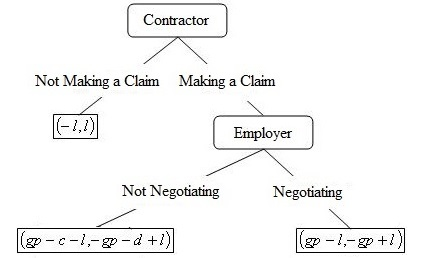
Let's map this onto a vee relationship (husband, wife, wife's lover):
- The Wife's Play: She might use minimization and lying by omission to downplay the seriousness of an issue with her lover to her husband. Her goal is to maintain harmony and avoid conflict (a benefit to her), but she does so by taking unfair advantage of her husband's trust and denying him the ability to give informed consent. Her payoff is
(gp), while the husband bears the emotional cost. - The Husband's Play: He might use playing the servant role ("I'm only making these rules for the good of our family") or guilt-tripping ("After all I'm doing to support you, you can't do this one thing for me?") to impose restrictions that primarily serve his comfort and control rather than the relationship's health. He takes unfair advantage of his "supportive" position.
- The Lover's Play: He could use seduction and feigning innocence to extract emotional and physical resources from the wife while having no long-term commitment. He takes advantage of her vulnerability and the complexity of the vee structure to maximize his benefit while minimizing his accountability.
In all these cases, the actor is applying Gerson's Law: they see an opportunity to gain something by disregarding ethical norms of honesty, transparency, and care for their partners. From a game theory perspective, they are choosing to defect because they calculate that the personal reward is worth the risk or the damage to the other players.
Conclusion
Gerson's Law articulates a brutally pragmatic and self-serving approach to human interaction. While cynical, it serves as a powerful critical lens for evaluating behavior in competitive and power-imbalanced systems.
Key Takeaways:
- Gerson's Law as Applied Machiavellianism: It is the principle of acting in pure self-interest, taking any available "unfair advantage" without being constrained by ethics.
- In the Lingerie Industry: This manifests as ruthless competitive tactics, ranging from widespread design copying—which paradoxically fuels the industry—to the severe human exploitation of models for brand enhancement.
- In Relationship Dynamics: It manifests as emotional manipulation, where partners use tactics like blame-shifting, guilt-tripping, and lying to achieve their own goals at the expense of their partners' emotional well-being and autonomy.
In our next lesson, we will examine Doctorow's Law, which states: "Any time someone puts a lock on something you own, against your wishes, and doesn't give you the key, they're not doing it for your benefit." This will continue our exploration of power and control, shifting from the unethical actions of individuals to the unethical systems and restrictions they create.