Welcome back. In our last lesson, we adapted Asimov's Laws to create a hierarchical ethical framework for navigating complex relationship decisions. This provided a logical, rules-based system for governance. Today, we shift from the "hard" logic of rules to the "soft" power of psychology. We will explore how beliefs and expectations are not just passive observations but active forces that can shape reality.
Your learning outcome for this lesson is to apply the Pygmalion and Galatea Effect to demonstrate how setting high expectations can boost a client's confidence in a lingerie fitting and elevate satisfaction within a vee relationship. These effects describe a self-fulfilling prophecy where higher expectations placed upon people lead to an increase in their performance.
The Expectation Engine: How Beliefs Become Reality
The core idea of the Pygmalion effect is that our expectations of others can profoundly influence their behavior. This isn't magic; it's a causal chain of subtle cues and behavioral changes. A classic experiment with lab rats provides a stark illustration of this principle.
The Power of Expectations | Invisibilia | NPR
This short NPR video from the "Invisibilia" series offers a concise and memorable introduction to the power of expectations, starting with the foundational research by Robert Rosenthal.
Please watch the first part of the video, which covers the following key points: The rat experiment, which demonstrates how experimenters' beliefs about rats' intelligence—even when false—dramatically affected their performance. The mechanism behind the effect, explaining how expectations translated into subtle, performance-altering behaviors like gentler handling. The human parallel, where psychologist Carol Dweck explains how this dynamic influences everything from IQ scores to athletic speed.
As the video shows, the experimenters who believed their rats were "smart" treated them differently, and this treatment created better-performing rats. This phenomenon, named after the Greek myth of Pygmalion who fell in love with a statue he carved, is a powerful force in management, education, and personal relationships.
For a more formal exploration, let's turn to a classic article from the Harvard Business Review that introduced this concept to the world of management.
[PDF] Pygmalion n Management - Augsburg University
This article by J. Sterling Livingston provides the foundational business case for the Pygmalion effect, using compelling case studies.
Please read the following sections: Start with the introduction, which clearly defines the law: subordinates' performance tends to rise or fall to meet their manager's expectations. Next, read the section on Impact on Productivity. Pay close attention to the Metropolitan Life Insurance experiment, noting how the "super-staff" excelled and the "low producer" group declined based on the expectations set for them. Finally, review the section titled The Power of Expectations. This part is crucial as it explains that expectations are communicated more through non-verbal behavior and treatment than through explicit words.
These resources introduce two distinct but interconnected effects that form a continuous loop.
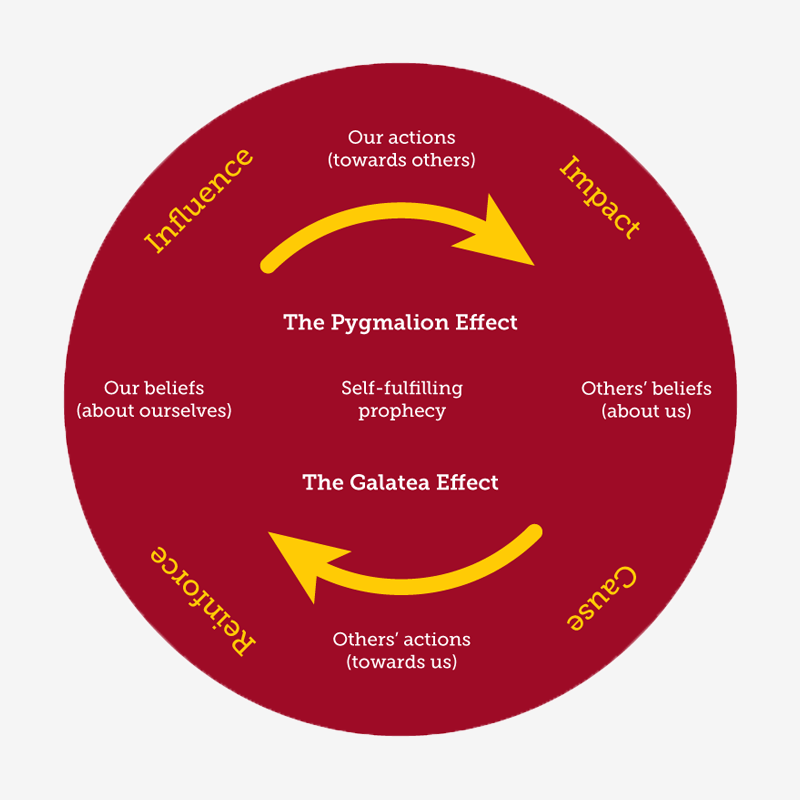
- The Pygmalion Effect: The process by which one person’s high expectations of another lead to high performance in that other person. In the diagram, this is the top half of the cycle: our beliefs about others shape our actions, which in turn impact their beliefs about themselves.
- The Galatea Effect: The process by which an individual’s own high self-expectations lead to high performance. This is the power of self-belief, which is often ignited by the Pygmalion effect. In the diagram, this is the bottom half: others' actions toward us reinforce our self-concept, causing us to live up (or down) to the prophecy.
Given your background in systems analysis, you can model this as a feedback loop where the output (performance) is fed back as an input (reinforced belief), creating a cycle that can either spiral upwards into success or downwards into failure.
Application 1: The Lingerie Fitting as a Confidence Catalyst
The fitting room is a potent environment for the Pygmalion effect. A client often arrives with a host of insecurities and negative self-expectations. Your role as a designer and fitter is not just to find a technical solution (a well-fitting bra) but to actively reshape the client's self-perception.
Pygmalion in Action: The Fitter's Mindset
Your belief in the client's potential is the starting point. If you see the fitting as a collaborative search for the perfect expression of the client's beauty, rather than a frustrating attempt to "fix" her "flaws," your entire demeanor changes. As the HBR article noted, it's the non-committal, indifferent treatment that communicates low expectations.
- High-Expectation Language: "Let's find the design that best showcases your shape," versus "Let's see if we can find something that works for you."
- High-Expectation Actions: Handling the garments with care, speaking about them with passion, focusing on the craftsmanship and the intended feeling ("This one is designed for incredible confidence").
Activating the Galatea Effect: From "Not Yet" to "Power Piece"
Your goal is to shift the client's internal monologue. This is where Carol Dweck's work on "growth mindset" offers a practical tool.
The power of believing that you can improve | Carol Dweck | TED
In this highly influential TED talk, psychologist Carol Dweck explains the difference between a "fixed mindset" and a "growth mindset" and, crucially, how to cultivate the latter.
Please focus on these two segments: The power of "Not Yet", where Dweck contrasts how children with fixed versus growth mindsets react to failure. Praise wisely, which provides a direct method for fostering a growth mindset by focusing on process, strategy, and effort rather than innate talent.
Instead of praising an attribute the client feels is fixed ("You have a great figure"), praise the process ("See how this specific seam construction creates the exact silhouette we were aiming for?"). This reframes the outcome as a result of smart strategy, not luck. A bra that "doesn't work" isn't a failure of the client's body, but simply a "not yet" in the search for the right design solution.
This brings us to how you frame your products.

The "Power Piece" is an explicit Pygmalion prompt. The marketing—"For instant confidence. Wear it when you want to feel unstoppable"—sets a powerful expectation. When you, as the expert, endorse this ("This is your power piece"), you transfer that expectation to the client. When she puts it on and feels the effect you predicted, her own self-belief is ignited. She is no longer just a person wearing a bra; she is embodying the "unstoppable" person she was expected to become. That is the Galatea effect.
Application 2: Idealization as a Self-Fulfilling Prophecy in a Vee Relationship
In a vee relationship, where stability depends on managing complex emotions and logistics, the partners' underlying beliefs about one another are critical. Positive expectations can act as a stabilizing force, while negative ones can trigger the downward spiral described in the HBR article.
The Husband's Expectation as a Buffer
Consider a vee with a wife (the Hinge), her husband (Arm 1), and her lover (Arm 2). A common point of failure is the husband's anxiety about his wife's other relationship. The Pygmalion effect suggests that if the husband holds a high expectation—believing his wife is capable, ethical, and fully committed to their dyad even as she explores another connection—his actions will reflect this trust. He will communicate openly, respect her autonomy, and celebrate her happiness. These actions, born of high expectations, have a profound impact on the wife.
The Power of "Positive Illusions"
This relational dynamic is powerfully described in research on "positive illusions." A landmark study by Murray, Holmes, and Griffin provides an empirical basis for this phenomenon, which you, with your statistical background, will find particularly compelling.
[PDF] The Self-Fulfilling Nature of Positive Illusions in Romantic ...
This research paper demonstrates empirically that idealizing one's partner is not a form of blindness, but a 'prescient' act that helps create a more satisfying and stable relationship.
As you read, focus on how these concepts map directly onto the Pygmalion/Galatea dynamic: Read the abstract for a full summary of the findings. Note the conclusion that idealization has "a variety of self-fulfilling effects." Next, read the section Constructing Security. This introduces the "projected illusions" effect (Pygmalion) and the "reflected illusions" effect (Galatea), linking them to relationship happiness. Then, read the section outlining the self-fulfilling prophecy mechanisms. Pay special attention to the reflected appraisal hypothesis, which is the academic term for the Galatea effect in this context. Focus on the section Basking in Reflected Glory: Changing Models of Self. This provides direct evidence that being idealized by a partner leads to positive changes in one's own self-concept. Finally, read the conclusion Love Blind or Prescient? which powerfully summarizes that positive expectations actively create the desired reality.
The paper demonstrates that when the husband "idealizes" his wife's ability to manage the vee (a "projected illusion"), he treats her with more confidence and security. This treatment allows her to "bask in reflected glory," internalizing his positive view and seeing herself as more competent and secure in her role (the "reflected appraisal" or Galatea effect). Her satisfaction increases, her stress decreases, and she performs her hinge role more effectively, thereby validating the husband's initial high expectation. Love, in this sense, is "prescient"—it sees the potential and helps bring it into being.
As a relationship analyzer, you can use this framework to diagnose dysfunctional loops. If a partner has low expectations, they will act with suspicion and anxiety. This will likely degrade the other partner's confidence and performance, "proving" the initial low expectation right and creating a negative, self-perpetuating cycle. The intervention is to consciously break the loop by helping partners cultivate and communicate higher, more generous expectations.
Conclusion
Today we moved from the logic of rules to the psychology of belief. The Pygmalion and Galatea effects show that expectations are not passive predictions; they are active ingredients in creating outcomes.
Key Takeaways:
- The Pygmalion and Galatea effects form a feedback loop: Your high expectations for others (Pygmalion) can trigger their own high self-expectations (Galatea), leading to improved performance that reinforces your original belief.
- Communication is key, but often non-verbal: The way you treat someone—with attention, respect, and confidence—communicates your expectations more powerfully than words alone.
- In lingerie fitting, it transforms a technical task into a confidence-building exercise. By framing products and the fitting process around positive expectations and a "growth mindset," you can actively enhance a client's self-image.
- In relationships, "positive illusions" or idealization can be self-fulfilling. Believing in your partner's best self and highest potential encourages them to live up to that image, fostering greater satisfaction and stability.
In our next lesson, we will shift focus again, from the social psychology of belief to evolutionary psychology. We will explore the Westermarck Effect, an innate psychological mechanism that creates sexual disinterest between people raised in close proximity, and analyze its implications in modern family and relationship structures.