In our previous lessons on the Peter and Dilbert Principles, we examined how organizational hierarchies can malfunction, either by accidentally promoting people to their level of incompetence or by strategically promoting them to contain the damage they cause. Today, we shift our focus to a different, yet related, form of systemic dysfunction described by Putt's Law.
This lesson centers on the fundamental disconnect between technical knowledge and managerial control. Your objective is to apply Putt's Law to diagnose this split in two distinct environments: first, within the structure of a lingerie company, and second, within the relational dynamics of a "Vee" polyamorous structure. This will continue our exploration of organizational dynamics, moving from individual incompetence to structural schisms.
Putt's Law: The Great Divide
Where the Peter and Dilbert principles focus on the competence of the individual, Putt's Law focuses on the structure of the hierarchy. It posits a fundamental separation between those with hands-on knowledge and those with decision-making power.
To understand its origins and distinction from other principles, we'll turn to the original paper by the pseudonymous Archibald Putt.
[PDF] The Successful Technocrat - I: Putt's Law
This article introduces Putt's Law by first explaining why technical hierarchies are different from others. It argues that the difficulty in judging a technical manager's competence, combined with the tendency of true experts to avoid management ("creative incompetence"), leads to a "competence inversion."
Read the entire text. Pay close attention to the argument that for technical managers, there is often no clear way to judge their performance. Then, focus on the formal statement of the law itself, which appears near the end of the document: "Technology is dominated...".
As the paper states, Putt's Law is formally defined as: "Technology is dominated by two types of people: those who understand what they do not manage, and those who manage what they do not understand."
This creates a natural, often adversarial, tension within an organization. On one side, you have the experts with deep, tacit knowledge who lack the authority to direct strategy. On the other, you have the managers who control resources and set goals but lack a granular understanding of the technology they are directing.
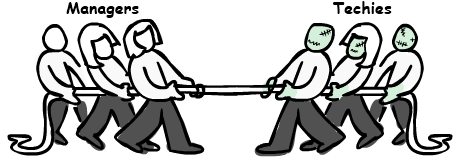
Let's break this down in your specified contexts.
Application 1: The Lingerie Company
Consider a mid-sized lingerie company. The organization is a complex system involving design, manufacturing, and sales. Putt's Law manifests clearly here.
Those who understand what they do not manage:
These are the company's technical experts, or "techies."
- The Pattern Maker: She has decades of experience in pattern grading. She understands, on an intuitive level, how adjusting a curve by two millimeters will affect the tension on a bra's underwire and the resulting lift. She knows that a particular lace will lose its elasticity after a certain number of washes.
- The Fit Technician: He can diagnose fit issues with a glance, identifying a "wrinkling cup" not as a size issue, but as a problem with the apex curve being too projected for the client's breast shape.
- The Senior Seamstress: She knows which machine needle to use with a delicate silk charmeuse to prevent puckering and can feel by hand if the tension in an elastic strap is off by a few grams.
These individuals possess the core "technology" of lingerie creation. However, they do not manage the budget, the production schedule, or the strategic direction of the brand.
Those who manage what they do not understand:
These are the managers, often with backgrounds in business, finance, or marketing.
- The Brand Manager: He decides to launch a new "eco-friendly" line and, to meet a price point, directs the use of a new recycled polyester fabric. He doesn't understand that this fabric has a lower modulus of elasticity, which will require a complete regrading of all patterns to maintain the same level of support.
- The Production Head: Focused on minimizing cost-per-unit, she switches the supplier for the hook-and-eye closures to save five cents per garment. She doesn't understand that the new supplier's hardware has a slightly sharper edge, leading to customer complaints about scratching.
The "techies" see these decisions as ignorant and damaging to product quality. The "managers" see the techies as resistant, inflexible, and not focused on the "big picture" of profitability. The central challenge of leadership in such an environment is bridging this gap.
A good leader recognizes this divide and works to empower the experts, rather than overriding them. This video on managing technical teams offers valuable insight into this dynamic.
A Guide To Managing Technical Teams
This video provides practical advice for leaders of technical teams, emphasizing the shift from being a top performer to being an enabler of others.
Watch the key segments that illustrate the principles of good management in a Putt's Law environment: The shift in role: The speaker explains that being a good developer doesn't make you a good leader. The leader's job: He defines the leader's role as amplifying the team's performance, not doing all the work. The micromanagement trap: Through a sailing anecdote, he shows how micromanaging disempowers experts and makes the manager a bottleneck. Allowing for mistakes: He explains the necessity of letting the team learn through controlled failure.
The video's core message is that effective managers in a technical setting succeed by trusting their experts and focusing on outcomes, not methods. They manage by enabling those who do understand.
Application 2: The Vee Relationship Hinge
Now, let's map this law onto the complex interpersonal system of a Vee relationship. In your specified scenario, a wife is in relationships with both her husband and a male lover. She is the "hinge" of the Vee.
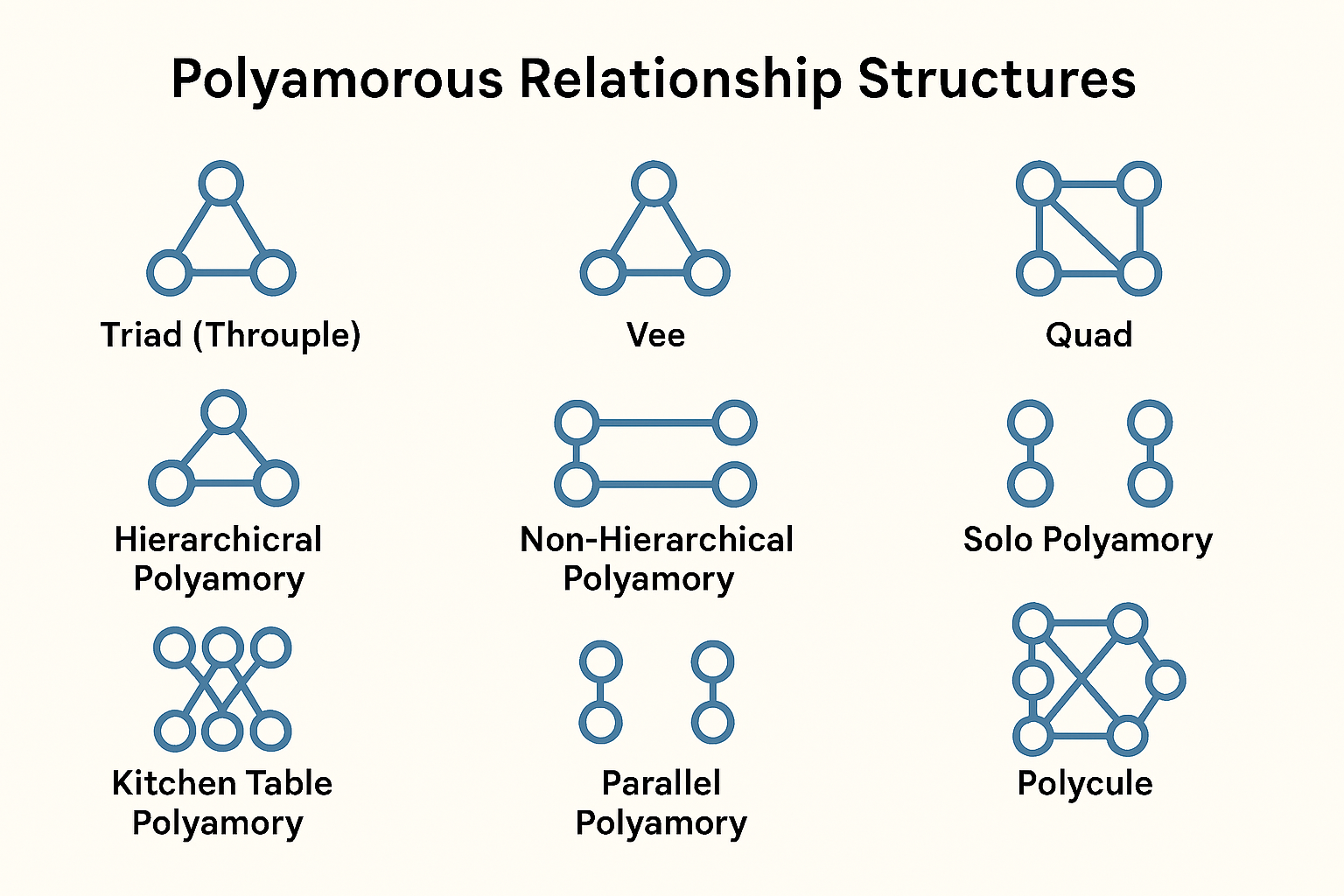
In this relational architecture, the hinge functions as the manager, and the arms function as the technical experts of their respective dyads.
The Hinge (Wife): Manages what she does not fully understand.
She is the sole manager of the entire system. Her responsibilities include:
- Resource Allocation: Managing the finite resources of her own time, emotional energy, and attention between two partners.
- Information Flow: Acting as the conduit for information, deciding what needs to be shared between her two relationships to ensure transparency without violating privacy.
- System Stability: Monitoring the emotional state of both partners and making interventions (e.g., scheduling a check-in, offering reassurance) to maintain equilibrium.
However, there are crucial dynamics she manages but cannot fully understand from an experiential perspective. She cannot know what it truly feels like to be the husband, waiting at home while she is on a date with her lover. She can empathize, she can listen, and she can respond to his stated needs, but she does not have his subjective experience. She is managing an emotional reality that is not her own.
The Arms (Husband & Lover): Understand what they do not manage.
Each man is a "technical expert" on his own dyadic relationship with the wife.
- The husband intimately understands the specific texture of his jealousy, his feelings of security based on their shared history, and the unique comfort he derives from their domestic routines. He has deep, "technical" knowledge of the Husband-Wife dyad.
- The lover intimately understands the specific thrill of their new relationship energy (NRE), the particular intellectual connection they share, and the unique dynamics of their time together. He is an expert on the Lover-Wife dyad.
However, neither of them manages the overall system. The husband doesn't manage the wife's schedule with her lover. The lover doesn't manage the wife's emotional commitments to her husband's family. They are experts in their domain but lack control over the larger structure.
This creates the classic Putt's Law tension. The husband might feel his needs aren't being met ("My 'technical' data on my emotional state is being ignored!") while the wife feels she is making the best possible "managerial" decision for the health of the entire system.
This concept of asymmetrical labor and knowledge is detailed with exceptional clarity in the following analysis of Vee structures. Your background in statistics and systems analysis will make this approach particularly resonant.
asymmetrical emotional labor in non-monogamy vee structure ∗ relationship
This article uses a systems-thinking approach to dissect the inherent labor imbalance in a Vee relationship, framing the hinge as the central processor in a relational network.
Please read the following sections to see a quantitative and qualitative breakdown of the hinge's managerial role: First, read the introduction, "The inevitable topology of the vee," which establishes the structural basis for the asymmetry. Next, read the sections under "defining the labor components" that break down the hinge's work into cognitive overhead and affective calibration. Finally, read the section "How does the geometric arrangement...", which uses information theory to explain the "cognitive switching cost" borne only by the hinge—a perfect example of managing a dynamic the arms don't experience.
The article's concepts of "cognitive switching cost" and "dual-dyad management" perfectly articulate how the hinge is performing managerial labor that is invisible to the "techie" arms. The hinge is managing the interplay of two systems whose internal workings she can only observe from the outside.
Conclusion
Putt's Law offers a powerful lens for analyzing dysfunction in any system where knowledge and control are separated. It moves beyond blaming individuals and instead points to a structural flaw.
Key Takeaways:
- Putt's Law: States that technology-driven systems are dominated by experts who lack power and managers who lack expertise.
- In a Lingerie Company: This manifests as a conflict between skilled pattern makers or fitters (who understand garment engineering) and managers who make strategic decisions based on budgets and marketing goals without grasping the technical implications.
- In a Vee Relationship: The hinge acts as the "manager," allocating resources and maintaining system stability. The arms act as "technical experts" on their individual relationships. The hinge manages dynamics (like a partner's subjective emotional state) that she cannot fully experience or understand, while the arms understand their own experience intimately but do not control the overall system.
In our next lesson, we will explore Conway's Law, which takes this idea a step further. It states that the design of any system inevitably reflects the communication structure of the organization that built it. This will provide a direct link between the organizational dynamics we've discussed and the final products—or relationships—they produce.