In our last lesson, we explored Godwin's Law, diagnosing the point at which productive debate collapses into rhetorical warfare. This focused on a deliberate, if dysfunctional, communication choice. Today, we turn our attention to a more passive but equally pervasive form of communication failure: the simple, inevitable decay of information as it passes from sender to receiver.
Your goal for this lesson is to apply Lem's Law to design communication systems that anticipate and mitigate the reality that people often don't read, understand, or retain information. We will apply this principle to create more effective bra care instructions for your clients and more resilient agreements within a vee relationship.
Lem's Law is a cynical but pragmatic observation: "No one reads; if someone does read, he doesn't understand; if he understands, he immediately forgets." Rather than viewing this as a statement on human intelligence, we will treat it as a fundamental design constraint, much like accounting for friction or noise in a physical or statistical system. People are busy, distracted, and have finite cognitive resources. Effective communication design acknowledges this from the outset.
The principles for overcoming this challenge are well-studied in fields like public health, where clear communication is critical.
Clear & Simple | National Institutes of Health (NIH)
This guide from the National Institutes of Health (NIH), while focused on health literacy, provides an excellent, data-driven framework for communicating any complex information effectively. It operationalizes the solution to Lem's Law.
First, read the introduction and the section on key considerations to understand the problem. Focus on the list of how audiences process information, from concrete thinking to difficulty with instructions. Next, jump to the principle "Organize topics in the way the person will use them." Read the paragraphs explaining how to structure information, such as placing important points first and presenting information in "chunks." This addresses the "forgetting" aspect of the law. Then, review the checklist under Content/Style. Pay close attention to the recommendations for using simple, direct language and concrete examples. This directly counters the "not understanding" part of Lem's Law. Finally, read the short section on how to handle specialized vocabulary. The 'need-to-know' concept is a critical filtering tool.
The core takeaway is that the burden of clarity lies with the creator of the communication, not the recipient. Let's apply this framework.
Application 1: Lingerie and Bra Care Instructions
Scenario: You've designed a beautiful, delicate lingerie set using expensive lace and a unique underwire construction. A client purchases it, throws it in a hot wash cycle with her jeans, and is furious when the wire warps and the lace tears. She leaves a negative review, stating the product is "cheaply made."
This is a classic failure mode predicted by Lem's Law.
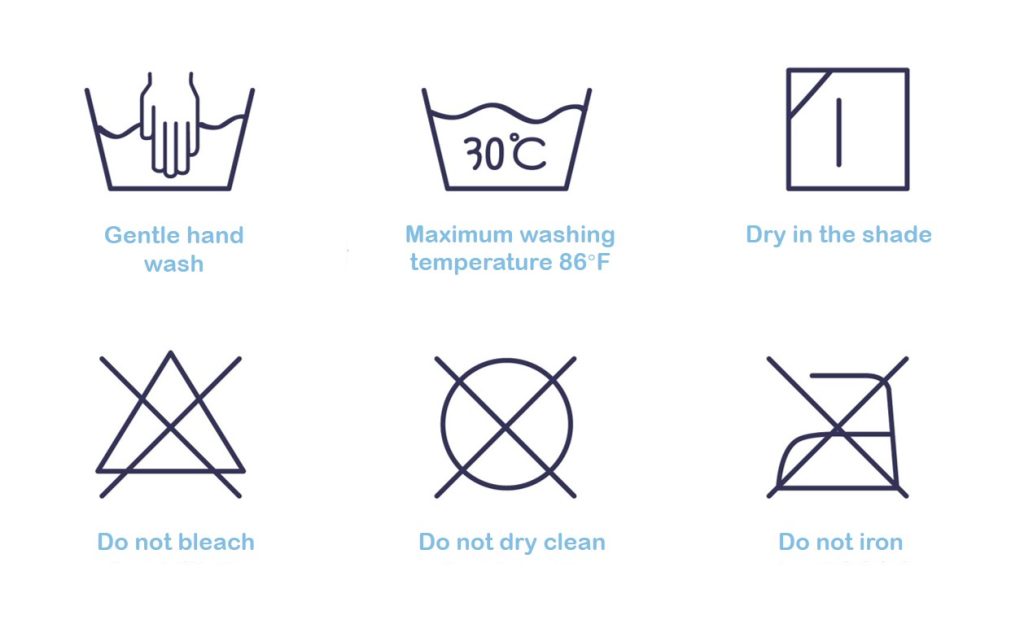
- "No one reads": The client likely ignored the tiny, legally required care tag sewn into the band.
- "If they read, they don't understand": Even if she glanced at it, would she instantly know what these standard symbols mean?
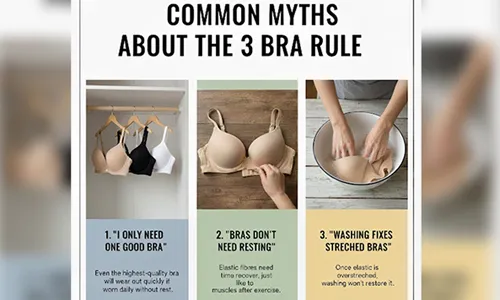
- "If they understand, they forget": On laundry day, faced with dozens of items, the specific instructions for your bra are forgotten. The default, convenient behavior (machine washing) takes over. This is reinforced by common myths, such as the idea that washing can fix a garment that has already been damaged.
Designing for Lem's Law
Instead of relying on a system you know is faulty, you can design a communication strategy that anticipates these failure points, using the principles from the NIH guide.
-
Prioritize Ruthlessly (The "Need-to-Know"): What are the 1-2 behaviors that prevent 90% of damage? For delicate lingerie, it is likely:
- Hand wash in cool water.
- Lay flat to dry; do not wring or tumble dry.
This is your core message. Everything else is secondary.
-
Use Multiple, Optimized Channels: A single point of failure (the tag) is insufficient.
- Packaging: Include a small, beautifully designed, thick card with the purchase. On one side, a glamorous photo of the product. On the other, your two core instructions, presented with clear icons and simple text: "Hand Wash Cold" and "Lay Flat to Dry."
- The Tag Itself: Redesign the tag. Instead of just symbols, use minimal text:
HAND WASH ONLY / DRY FLAT. - Digital Follow-up: Send a post-purchase email titled "A 30-second guide to keeping your lingerie beautiful." The email contains a 30-second silent video loop showing hands gently swishing the bra in a basin, followed by it being laid on a towel. Below it, the same two core rules in large, clear text.
-
Make It Concrete and Visual: Instead of abstract symbols, use direct language and visuals.
- Poor: A crossed-out washing machine symbol.
- Better: "Machine washing will destroy the delicate lace and bend the underwire."
- Best: A simple pictogram of a washing machine with a large red 'X' over it, next to a happy checkmark over a basin with hands.
By implementing this multi-channel, visually-driven, and highly-focused system, you are no longer depending on your client to read, understand, and remember. You are designing a system where the correct information is unavoidable, easy to digest at a glance, and reinforced through repetition.
Application 2: Vee Relationship Agreements
Scenario: In your vee relationship (Husband H, Wife W, Lover L), H and W have a long, thoughtful conversation and draft a detailed Google Doc outlining their agreements. Topics include scheduling, overnight stays with L, and communication protocols. Two months later, W spontaneously invites L to stay over on a night previously understood to be reserved for H&W. H feels betrayed, referencing "the agreement." W responds, "I don't remember it being that rigid. I thought we said we'd be flexible."
Lem's Law is operating at full force in the emotional and cognitive complexity of the relationship.
- "No one reads": The comprehensive document, created with good intentions, is filed away and never reviewed. Daily life takes over.
- "If they read, they don't understand": Terms like "flexibility," "priority," or "quality time" are abstract and can be interpreted differently by people in different emotional states. W's interpretation of "flexibility" at the moment was different from H's memory of the principle.
- "If they understand, they forget": Cognitive load and emotional stress drastically impair memory. The specific details of a complex agreement made weeks ago are easily lost or distorted.
Designing for Lem's Law
As an efficiency expert, you know that a system that relies on perfect memory and consistent interpretation under stress is a failed system. You need to build a framework for your relationship that anticipates and mitigates Lem's Law.
Navigating Nontraditional Relationships with Care
This article from a psychology group specializing in polyamory provides excellent, concrete tools that function as real-world solutions to Lem's Law in relationships.
Start by reading the section Why Polyamory Demands Different Support. This sets the stage by explaining why generic advice fails in complex systems. Next, read about Building Communication Skills, focusing on the idea that these are learnable skills and that unclear boundaries are a common failure point. Then, carefully study the proposed tools. Read about "Container Check-Ins" (a structured communication method) and "Time Management: Specificity Over Good Intentions" (using concrete tools like shared calendars). Finally, read the sections on "Repair Agreements" and "Building the Foundation Through Difficult Conversations". The key insight is defining rules before a crisis, as explained in the sentences from "The critical piece is...".
The tools in this article are essentially design patterns for Lem-proof relationship agreements.
-
Combat "Forgetting" with Structured Repetition: The "Container Check-In" is the perfect antidote to forgetting. A scheduled, recurring meeting (e.g., bi-weekly for 30 minutes) to review what's working and what's not forces the agreements back into working memory. It turns a static document into a dynamic, living process.
-
Combat "Not Understanding" with Concreteness: The principle of "Specificity Over Good Intentions" is key.
- Abstract Agreement (Fails Lem's Law): "We will reserve 3 nights a week for our quality time."
- Concrete System (Passes Lem's Law): A shared Google Calendar where H&W block out their three nights in advance at the start of each week. The rule is now an external, visible artifact, not an interpretation stored in memory. It moves the agreement from the abstract to the operational.
-
Combat "Not Reading" with Prioritization and Accessibility: The 10-page document is too dense. Create a "Vee Dashboard." This is a single page (digital or physical) that lists only the top 5-7 critical, non-negotiable agreements.
- Example: "Sexual health: Condoms are used for all new partners until three full rounds of STI testing are complete."
- Example: "The master bedroom is reserved for H&W only."
This dashboard is the "need-to-know" of your relationship. It should be easily accessible and reviewed during every check-in. This makes the most important information impossible to ignore.
By building these systems—regular check-ins, shared concrete tools like calendars, and a prioritized summary of core rules—you are designing a relationship architecture that does not depend on flawed human memory. You are creating clarity and mutual accountability.
Conclusion
Lem's Law is a humbling reminder that even the most carefully crafted message or agreement is likely to fail if it ignores the realities of human attention and memory. By treating this not as a personal failing but as a system constraint, we can design more robust and effective communication.
Key Takeaways:
- Lem's Law ("No one reads; if they read, they don't understand; if they understand, they forget") is a practical design principle for all communication.
- To counter it in product design (like bra care), prioritize the most critical information, use multiple channels, and rely on clear, concrete visuals over abstract symbols or text.
- To counter it in complex relationship agreements, replace static documents with dynamic processes (like regular check-ins) and abstract principles with concrete, shared tools (like calendars and dashboards). The goal is to externalize the agreement so it's not dependent on individual memory under stress.
In our next lesson, we'll look at a related communication pitfall. We've just discussed how to design messages to be understood, but what happens when the act of correction itself introduces new errors? We'll explore this irony by applying Muphry's Law.