Welcome to our next lesson on the principles of communication and information integrity. In our previous session, we examined Postel's Law, learning the value of being liberal in what we accept and conservative in what we send. That principle provides a framework for building robust systems that can handle ambiguity. Today, we will explore what happens when ambiguity is replaced by a direct attempt to erase information altogether.
This leads us to the Streisand Effect, the paradoxical phenomenon where an attempt to suppress, hide, or censor information inadvertently causes it to become more widely known. Your goal is to apply this effect to predict the outcome of two scenarios: an attempt to remove a negative lingerie review from the internet, and an attempt to hide a significant event within a vee relationship.
The Anatomy of a Backfire
The Streisand Effect is one of the most famous examples of a self-inflicted public relations disaster. It demonstrates that in the modern information ecosystem, control is often an illusion, and forceful attempts to exert it can backfire spectacularly.
To start, let's watch a short video that explains the origin of the term and the core mechanics of the effect.
The Streisand Effect Explained
This video from the channel Georg Rockall-Schmidt provides a clear and entertaining introduction to the Streisand Effect.
Watch the first part, which uses a high school analogy to build intuition, followed by the origin story involving Barbra Streisand herself.
The incident described in the video involved this specific photograph from the California Coastal Records Project, which was intended to document coastal erosion.

This dramatic increase in attention illustrates a fundamental principle of human psychology and information dynamics. To formalize this, we can turn to a scholarly analysis of the phenomenon.
[PDF] The Streisand Effect and Censorship Backfire - Brian Martin
This academic paper by Sue Curry Jansen and Brian Martin provides a robust framework for understanding why and how these backfires occur.
First, read the Introduction to get the specific details of the Streisand case and see how the effect applies in diverse contexts, from ordinary citizens to governments. Next, focus on the section titled "Censorship and Backfire Dynamics." Read the part describing the five methods powerful groups use to reduce public outrage over an unjust action (like censorship). These are key to predicting when a Streisand Effect is likely.
The five tactics for reducing outrage mentioned in the paper are:
- Covering up the action.
- Devaluing the target.
- Reinterpreting the events (lying, minimizing, blaming).
- Using official channels to give an appearance of justice.
- Intimidating or rewarding people involved.
The Streisand Effect is what happens when these tactics fail. The attempt at suppression becomes a more compelling story than the original information, creating a powerful "David versus Goliath" narrative that mobilizes public interest and activism.
The following infographic provides an excellent visual summary of this process.
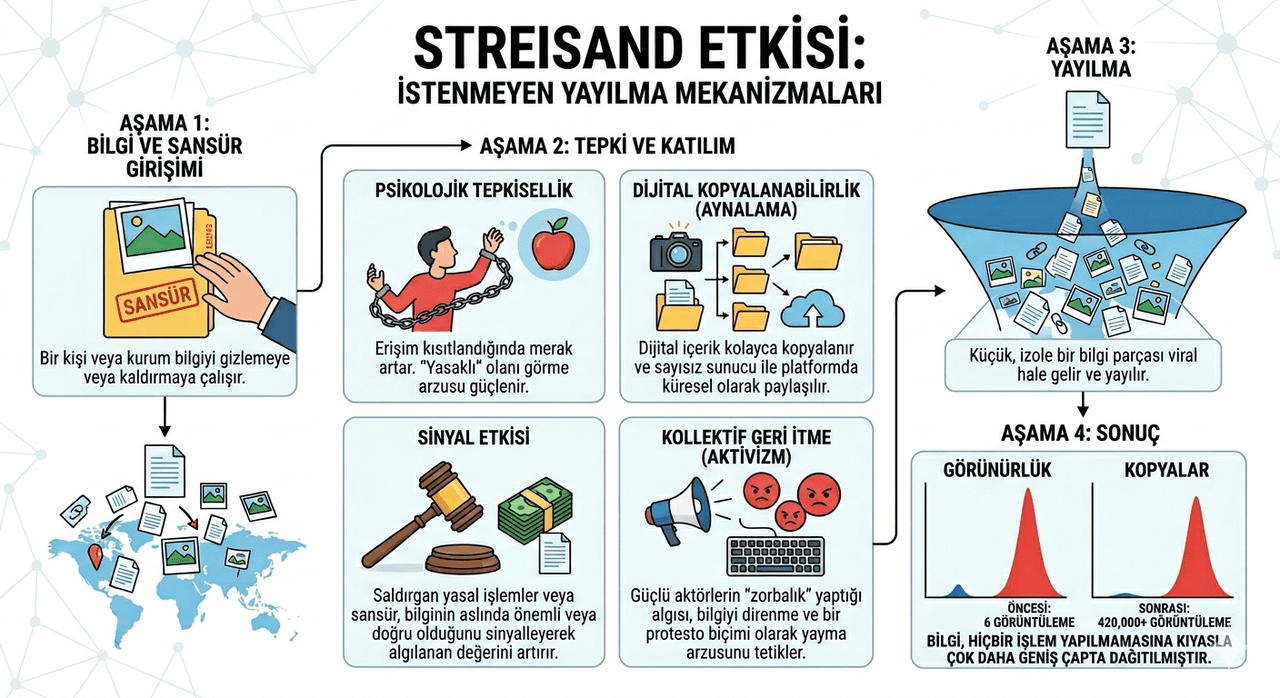
Now, let's apply this framework to our scenarios.
Application 1: The Negative Lingerie Review
Scenario: A lingerie boutique you design for receives a scathing review on a popular fashion blog. The review, titled "Beautiful Design, Terrible Quality," claims a new bra model fell apart after one wash and includes photos of the damaged product. The boutique owner, furious and concerned about their brand's reputation, has their lawyer send a cease-and-desist letter to the blogger, demanding the immediate removal of the article and threatening a lawsuit for defamation.
Prediction: Based on the Streisand Effect, this is a textbook case of a strategy that will almost certainly backfire and amplify the damage.
-
The Suppression Attempt: The owner is using tactics 4 (official channels - a legal letter) and 5 (intimidation - threat of a lawsuit) to suppress the negative information. In doing so, they are also devaluing the blogger's experience (tactic 2) and attempting to reinterpret the event as defamation rather than a quality control issue (tactic 3).
-
The Probable Backfire:
- Exposure: The blogger, rather than being silenced, now has a much more interesting story to tell: "Lingerie Brand Tries to Silence Critic with Legal Threats." They will likely publish the cease-and-desist letter.
- Mobilization: The blog's audience, and potentially a much wider audience, will rally around the blogger. The narrative shifts from a simple product review to a fight for free speech against a corporate bully.
- Amplification: The original review, which might have been seen by a few thousand readers, is now shared across social media as part of the bigger story about the censorship attempt. Other customers who had similar experiences may now feel empowered to come forward. The issue escalates from a single negative data point to a potential class of product failures.
This real-world dynamic is perfectly captured in the following video by business owner Louis Rossmann, who experienced this firsthand.
In this video, Louis Rossmann discusses his experience with a contractor who tried to have a negative video review removed from YouTube.
First, watch the introduction where he explains that his critical video was removed due to a privacy complaint. Then, listen to his analysis of why this strategy fails, starting from his own life experience with suppression. Finally, pay close attention to his direct message to the contractor, explaining that the better approach is repentance and making things right, not attempting to erase the past.
As Rossmann explains, the attempt to delete the information doesn't work. It only makes people post it "more and more and more." The rational approach for the boutique owner would have been to engage with the negative review transparently, perhaps by offering a replacement and publicly addressing their quality control process. By choosing suppression, they invite a far greater level of scrutiny.
Application 2: Secrecy in a Vee Relationship
Scenario: In our vee relationship (Wife W, Husband H, Lover L), W and L have a major argument about their future plans. It's emotionally intense, but they eventually work through it and reach a resolution. Afterwards, they agree not to tell H about the conflict, believing it would cause him unnecessary anxiety and that since it's "resolved," it's no longer relevant. They actively hide that the argument ever happened.
Prediction: This is a private, interpersonal version of the Streisand Effect. While it won't go viral on the internet, the attempt at suppression will likely amplify the emotional fallout within the relationship.
First, it's crucial to distinguish between healthy privacy and damaging secrecy.
Autonomy, Privacy, and Transparency in Polyamorous Relationships
This article from Cleveland Sex Therapy clearly defines the difference between privacy and secrecy in a polyamorous context.
Focus on the section Privacy vs. Secrecy. Note the examples provided under "Secrecy," particularly "Concealing Emotional Shifts," and the justification for why it's harmful.
The scenario of hiding the argument falls squarely into the category of secrecy. The key insight is that the "damage" isn't the information itself, but the impact of withholding it.
-
The Suppression Attempt: W and L are colluding to cover up information they believe would be disruptive. This requires active maintenance: carefully choosing words, avoiding related topics, and managing their own emotional expressions around H.
-
The Probable Backfire:
- Information Leakage: The effort of maintaining the secret creates its own signals. H, being intimately connected to W, is likely to sense the emotional residue—the lingering tension, the forced casualness, the subtle avoidance. In a system of close relationships, such information rarely stays perfectly contained.
- The Narrative Shift: When H eventually learns about the argument (either through a slip of the tongue or by directly asking about the tension he senses), the original conflict is no longer the primary issue. The focus shifts to the act of concealment. The new, much larger problem is the breach of trust and the creation of a secret alliance between W and L that excludes H.
- Amplification of Damage: Instead of a potentially difficult but manageable conversation about W and L's future, the relationship now faces a crisis of trust and communication. The perceived injustice is not the argument, but the censorship of H from a key emotional event in his wife's life. The attempt to "protect" him by hiding the information results in a much deeper wound.
The alternative, as the Rossmann video suggests, is transparency. A difficult conversation about the argument is far less damaging in the long run than the inevitable fallout from the discovery of a secret.
A Note on Nuance: When Suppression Succeeds
It's important to recognize that the Streisand Effect is not an infallible law of nature. As your statistics background would suggest, it's a probabilistic outcome, not a deterministic one. The Jansen and Martin paper you read earlier also discusses cases where censorship is successful. This typically happens when the censoring entity has overwhelming power, can completely control information channels, and can effectively intimidate or silence any opposition before a backfire can gain momentum (e.g., successful state censorship or corporate NDAs that are never challenged). However, in an open environment like the internet or a relationship built on trust, attempting suppression is an exceptionally high-risk strategy.
Conclusion
Today we've explored the Streisand Effect, a powerful demonstration of how information dynamics can defy our intentions.
Key Takeaways:
- The Streisand Effect describes the counterproductive result of trying to suppress information, which often leads to its massive amplification.
- The mechanism is driven by psychological reactance and the creation of a more compelling narrative around the act of censorship itself.
- In business, aggressively trying to silence negative feedback is a high-risk strategy that can turn a small problem into a public relations catastrophe.
- In relationships, secrecy acts as a form of suppression. The act of hiding information often causes more damage than the information itself, leading to a breakdown of trust that is far harder to repair.
In our next lesson, we will continue our exploration of communication dynamics by examining Godwin's Law, which describes the tendency for online conversations to devolve. We'll analyze what this reveals about the nature of argumentation and how to recognize when a productive discussion has collapsed.