In our last lesson, we examined Humphrey's Law and saw how conscious over-analysis can sabotage a well-practiced skill or a cherished ritual. Today, we shift our focus from the internal world of analysis to the powerful external influence of expectations. We will explore the Pygmalion and Galatea Effect, a principle that reveals how our beliefs about others can become self-fulfilling prophecies.
Your goal for this lesson is to apply this effect to your two specified contexts: first, to show how a lingerie fitter's high expectations can boost a client's confidence and transform her self-perception, and second, to demonstrate how a partner's positive expectations can elevate relationship satisfaction and preempt conflict in a vee relationship.
The Expectation Effect
The core idea of the Pygmalion Effect is that higher expectations placed upon people lead to an increase in their performance. The name comes from the Greek myth of Pygmalion, a sculptor who fell in love with a statue he carved, which was then brought to life. In psychology, it describes the process by which one person's expectations can essentially "sculpt" the behavior of another.
A fantastic introduction to this concept comes from an NPR Invisibilia segment, which details the foundational experiments by psychologist Bob Rosenthal.
The Power of Expectations | Invisibilia | NPR
This video from NPR explains the origin of research into the expectation effect, starting with a clever experiment involving lab rats and then extending the findings to humans.
Please watch from the beginning until the description of the rat experiment, where researchers' beliefs about rats being "smart" or "dumb" directly influenced the animals' performance. Then, continue watching the next segment, which applies this principle to people and explains how subtle, nonverbal cues communicate our expectations and can affect everything from a student's IQ to a soldier's speed.
As the video illustrates, this isn't magic or telekinesis. The expectations in our minds translate into subtle but powerful changes in our behavior: our tone of voice, our body language, the amount of attention we give, and the type of feedback we offer. The recipient of these cues unconsciously adjusts their own beliefs and behaviors in response, ultimately fulfilling the initial expectation. This creates a feedback loop, which can be visualized as a cycle.
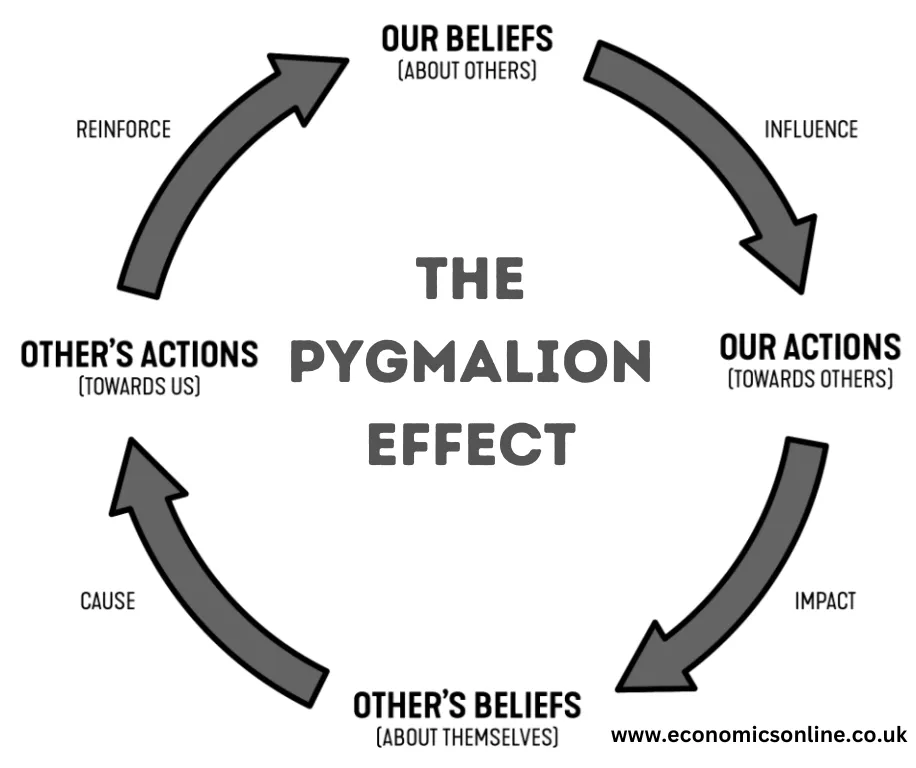
When an individual internalizes the high expectations placed upon them and their performance improves as a result, this is often called the Galatea Effect. Galatea is the name of the statue in the myth; the effect is named for her "coming to life" under the influence of Pygmalion's belief.
Application 1: Sculpting Confidence in the Fitting Room
Let's apply this to your lingerie design context. A client enters your boutique to be fitted for a bra. Her posture is slumped, and she expresses significant self-doubt: "I don't think anything really works for my shape," "I just want something that hides everything," "I doubt I can pull off something that looks like that." She has low expectations for herself.
Here is how you, as the fitter, can use the Pygmalion Effect to initiate the Galatea Effect in her:
-
Our Beliefs (The Fitter's High Expectation): You disregard her negative self-assessment. Your professional experience allows you to see her potential. You believe, "This client has a great shape for a plunge bra; she is going to look and feel incredible once we find the right fit."
-
Our Actions (Communicating the Expectation): You project this belief through your actions.
- Verbal: Instead of agreeing with her doubts, you reframe. "I understand how you feel, but I see your shape differently. I'm excited to show you what's possible." You use confident, positive language: "I have the perfect piece in mind that will create the exact cleavage effect you're looking for," or "Your proportions are actually ideal for this style."
- Non-verbal: You maintain engaged eye contact, have open and encouraging body language, and handle the lingerie with an air of reverence, as if it's an amazing tool you're about to use for a stunning transformation. You select beautiful, bold options, not just "safe" ones.
-
Other's Beliefs (The Client's Internalization - The Galatea Effect): The client is being treated not as a "problem" to be solved, but as a canvas for something beautiful. The cognitive dissonance between her self-perception and your professional confidence in her potential begins to shift her beliefs. She starts to think, "Maybe she's right. Maybe I can look good in this."
-
Other's Actions (Fulfilling the Prophecy): She tries on the bra with a little more hope and a little less dread. As she looks in the mirror and sees the result—a result you confidently predicted—her posture changes. She stands taller. Her expression shifts from doubt to surprise, and then to pleasure. Her actions (and improved self-image) now reinforce your initial belief. You have sculpted not just her silhouette, but her confidence.
Application 2: Setting Expectations in a Vee Relationship
Now, let's turn to the vee relationship of Alex (husband), Bella (wife and hinge), and Charles (Bella's lover). The Pygmalion Effect is a powerful force in navigating the complex emotions of polyamory.
The podcast Multiamory discusses this exact phenomenon in the context of non-monogamous relationships.
169 - Unapolygetic - Multiamory
This podcast transcript discusses how coming into a sensitive conversation with a partner while expecting a negative reaction can inadvertently create that very outcome.
Please read the segment where the hosts discuss the self-fulfilling prophecy. Pay close attention to how they describe the transmission of expectations through subtle cues and wording choices, and how this can create tension where none existed.
As the transcript highlights, your expectation shapes the interaction from the outset. Imagine Bella needs to talk to Alex about her plans to go away for a weekend with Charles.
-
Scenario A (Negative Expectation): Bella fears Alex will be jealous and upset. She anticipates a difficult conversation. She begins with, "Honey, we need to talk... now, don't get mad, but..." Her tone is anxious, her body language is defensive. Alex, who might have been fine, immediately picks up on these cues. He thinks, "Why is she acting so weird? She must be hiding something or feel guilty. Maybe I should be worried." Bella's negative expectation has created a tense and suspicious atmosphere, making a negative reaction from Alex far more likely.
-
Scenario B (Positive Expectation): Bella operates from the belief that Alex is a supportive partner who genuinely finds joy in her happiness (compersion). She trusts him. She begins the conversation openly and warmly: "I have some exciting news! Charles and I are thinking of a weekend trip next month. I'd love to find dates that work for everyone and hear your thoughts." Her tone is collaborative, her body language relaxed. By treating Alex as the secure, supportive partner he aspires to be, she empowers him to step into that role. He feels respected and included, not managed or preemptively judged. He is far more likely to respond positively, fulfilling her positive expectation.
A Crucial Distinction: Pygmalion vs. Michelangelo
While the Pygmalion effect is powerful, there's a related, more collaborative concept that is vital in personal relationships: the Michelangelo Phenomenon.
The key difference lies in whose ideal is being sculpted.
- Pygmalion Effect: You sculpt someone toward your ideal for them.
- Michelangelo Phenomenon: You help sculpt someone toward their own ideal for themselves. You see the "angel in the marble" that they want to be and help chip away the excess stone.

The following academic text clarifies this distinction and its importance for relationship well-being.
[PDF] The Michelangelo Phenomenon in Close Relationships
This chapter from a book on self and relationships provides a formal definition of the Michelangelo Phenomenon and directly contrasts it with the Pygmalion Effect.
First, read the section that defines the phenomenon. This will introduce you to the concepts of "partner perceptual affirmation" (seeing the best in your partner as they define it) and "partner behavioral affirmation" (acting in ways that draw out that best self). Next, and most importantly, read the section titled "Partner Affirmation and the Pygmalion Phenomenon." This part directly answers the question: "Whose ideal is sculpted—the self’s or the partner’s?"
As the text explains, "foisting your own ideals onto the self" can be maladaptive, even if your intentions are good. In Scenario B with our vee relationship, Bella's positive expectation works so well because it aligns with Alex's own ideal for himself as a supportive, non-jealous husband. She is not just imposing her desire on him (Pygmalion); she is affirming who he wants to be (Michelangelo).
In the lingerie fitting, the effect is positive because the fitter's ideal (for the client to look stunning) is aligned with the client's latent ideal for herself. The problem with the Pygmalion effect arises when the ideals are in conflict. Forcing a client who wants a modest, comfortable fit into a revealing corset because you think she should be more daring is a negative application of Pygmalion and will likely fail.
Conclusion
The Pygmalion and Galatea Effect demonstrates that our expectations are not passive observations; they are active forces that shape reality. By holding high, positive expectations for others, we can empower them to achieve more and become better versions of themselves.
Key Takeaways:
- The Pygmalion Effect is the process where one person's expectations influence another's performance.
- The Galatea Effect is the internalization of those expectations, leading to a change in self-belief and behavior.
- This dynamic operates through subtle verbal and non-verbal cues that create a self-fulfilling prophecy, which can be either positive or negative.
- The related Michelangelo Phenomenon occurs when you affirm and help draw out a person's own ideal self, which is generally more beneficial for personal and relational well-being than imposing your own ideal (Pygmalion).
In our next lesson, we will move from the social psychology of expectation to a hypothesis from evolutionary psychology. We will explore the Westermarck Effect, which posits an innate mechanism for sexual disinterest among those raised in close proximity during childhood, and analyze its implications.