Welcome back. In our previous lesson on Gresham's Law, we examined how "bad" currency drives out "good," a principle we applied to understand why lower-quality bras might see more use and how superficial communication can displace deep connection. We continue our exploration of economic and geographic principles today by looking at a law that models the forces of attraction between social and commercial centers.
This lesson focuses on Reilly's Law of Retail Gravitation. Our goal is to apply this law to predict which lingerie stores are most likely to attract clients based on their size and distance, and to model how larger polyamorous communities exert a "gravitational pull" on potential new members. At its core, this law uses an analogy to Newtonian physics to quantify how people are drawn to different locations, a concept that proves surprisingly versatile.
The Gravity Model Framework
Reilly's Law is a specific instance of a broader class of "gravity models" used throughout the social sciences. These models are based on the intuitive idea that the interaction between two places increases with their "size" (like population or economic activity) and decreases with the distance between them. Given your background in statistics and modeling, you'll recognize this as a powerful way to approximate complex aggregate human behavior.
To ground our understanding, let's start with a general overview of the gravity model framework.
The gravity model for social systems - arXiv
This paper provides an excellent modern overview of gravity models.
Please read the Abstract and the Introduction for a conceptual foundation. Then, carefully review the section on the building blocks of the model. Focus on how any system of spatial interaction can be broken down into four key components: Origins: Where the flow (of people, trade, etc.) comes from. Destinations: Where the flow is going. "Size" or "Mass": A measure of the importance or attractiveness of the origins and destinations (e.g., population, GDP, retail floor space). Distance: The friction or cost that separates the origin and destination (e.g., physical distance, travel time).
The general mathematical form of the gravity model discussed in the paper is:
Where:
- is the flow from origin to destination .
- and are the "sizes" of the origin and destination.
- is the distance between them.
- are parameters that tune the model.
Reilly's Law is a pioneering application of this thinking to retail. Let's see how it works in practice.
Application 1: Defining a Lingerie Boutique's Trade Area
Imagine you are a consultant for a lingerie brand trying to understand the competitive landscape. A key question is: from how far away will a boutique draw its clients? Reilly's Law allows us to calculate the "breaking point" between two competing retail centers—the point at which a customer is equally attracted to both.
Let's define our components:
- Destinations: Two lingerie boutiques, 'a' and 'b'.
- Attractiveness (): We'll use the population of the towns they are in as a proxy for the size of the potential market and general retail attractiveness, as is traditional in Reilly's model. Let's say town 'a' has a population of 250,000 and town 'b' has 100,000.
- Distance (): The total distance between the two towns is 75 km.
The formula to find the breaking point distance () from the larger city 'a' is:
This formula is derived by setting the "gravitational pull" of both cities as equal and solving for the distance.

As the calculation in the image shows, the breaking point is 45.9 km from town 'a'. Any client living within this 45.9 km radius is, all else being equal, in town 'a's "gravity well." Those living beyond it are pulled toward town 'b'. By performing this calculation with all surrounding competitor towns, you can draw a map of a boutique's primary trade area.
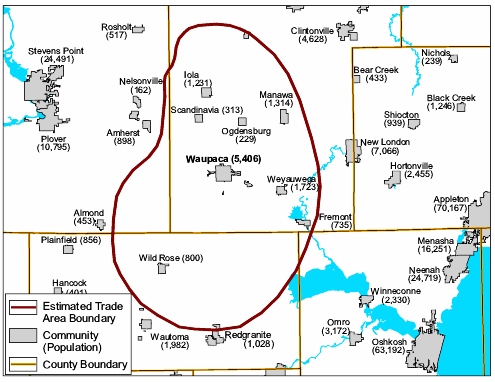
Of course, population and distance aren't the only factors. A more sophisticated model would account for other variables.
[PDF] Converse's Breaking-Point Model Revised - aabri
This paper summarizes the principles of Reilly's original work.
Please read point 9 in the numbered list, which begins here. This highlights the secondary factors that can modify the primary pull of population and distance.
For your lingerie boutique, these "secondary factors" are critical. The attractiveness () might be better represented by the number of brands stocked, the reputation of its fitters, or the quality of the store environment, rather than just the town's population. Likewise, "distance" might be better measured in travel time or perceived psychological effort rather than kilometers.
Application 2: Modeling Attraction to Polyamorous Communities
Now, let's transpose this model to social dynamics. Consider an individual who is new to polyamory and is looking to connect with a community. They live between two cities:
- City A: A large metropolis with a well-established, diverse polyamorous community of about 1,000 active members.
- City B: A smaller city with a newer, growing community of about 150 members.
Which community exerts a stronger pull? Instead of a deterministic breaking point, a probabilistic approach is more suitable for modeling social choice. This version, often called the Huff Model, calculates the probability that an individual will choose a given destination.
Let's define our components:
- Destinations: Community A and Community B.
- Attractiveness (): The number of active members in each community (, ).
- Origin: The individual's location.
- Distance (): Geographic distance to the typical event location in each city.
The "attractiveness" score () for each community from the individual's location is calculated as . The probability of choosing community A is then:
This is where the parameters (nu) and (gamma) from the general gravity model become crucial for capturing the nuances of the situation. Your statistical expertise will find this parameterization natural.
The gravity model for social systems - arXiv
This paper explains the probabilistic application of gravity models and the role of its parameters.
First, read the section Applying the gravity model, which describes how attractiveness scores can be used to determine regions of influence or to calculate choice probabilities (the Huff Model). Then, review the section on Parameter interpretation.
Let's interpret the parameters in the context of polyamorous communities:
-
The Attractiveness Exponent ():
- If , the attraction is linear. A community twice as large is twice as attractive.
- If , there are increasing returns to scale (a network effect). A community twice as large is more than twice as attractive. This seems highly plausible in this context. A larger community offers a much wider variety of potential partners, more frequent and diverse events (e.g., discussion groups, mixers, educational workshops), and greater social proof, making the pull disproportionately stronger. For example, if , Community A (1000 members) isn't just ~6.7 times more attractive than B (150 members), its raw attraction score is times greater.
-
The Distance Exponent ():
- If is low (e.g., 0.5), distance is a weak deterrent. People are willing to travel. This might apply for major annual events or for finding a very specific type of connection.
- If is high (e.g., 2), distance is a strong deterrent. The friction of travel rapidly diminishes attraction. This is more likely for regular, casual participation like weekly munches or social gatherings. A community that is twice as far away becomes four times less attractive.
By estimating or assuming values for and , you can build a sophisticated model of social gravitation that predicts how individuals might distribute their attention and energy between competing social hubs.
Conclusion
Reilly's Law and its modern extensions in gravity models provide a quantitative framework for understanding attraction in competitive landscapes. The core insight—that pull increases with size and decreases with distance—is simple, but the model's flexibility allows for significant nuance.
Key Takeaways:
- Gravity Models: Social interactions can be modeled using an analogy to physics, where the flow between two points is a function of their size and the distance separating them.
- Breaking Point Application: In retail, Reilly's Law can be used to calculate a deterministic boundary defining a store's primary trade area by finding the point of equal attraction between it and a competitor.
- Probabilistic Application: For social choices, the model can be used to calculate the probability of an individual choosing one destination over others. This allows for a more nuanced analysis that depends on key parameters.
- Parameter Interpretation: The exponents for attractiveness () and distance () are crucial. They quantify non-linear effects, such as network effects () or high sensitivity to travel friction ().
In our next lesson, we will move to the Ramsey Problem. This will shift our focus from spatial competition to optimal pricing, exploring how a firm can set prices across different products to meet its revenue needs while minimizing distortions in consumption—a classic problem in microeconomics and operations research.