Welcome to our new module, "Economic Principles and Market Competition." In our previous lessons, we delved into the integrity of communication and information. Now, we shift our focus to the strategic logic that governs competition and resource allocation. As we previewed, our first topic is a foundational concept from game theory and economics that explains a seemingly counterintuitive phenomenon you've likely observed in the marketplace.
Today's learning outcome is to apply Hotelling's Law to explain why lingerie shops often cluster together and why non-monogamous dating platforms tend to converge on similar features. This law, also known as the principle of spatial competition, provides a powerful model for understanding why competitors often minimize differentiation, both geographically and in their product offerings. Given your background in game theory, the concept of a Nash Equilibrium driving this outcome will be a central theme.
The Principle of Minimum Differentiation
Hotelling's Law describes a dynamic where competitors, in an attempt to maximize their market share, will gravitate towards a central point in the market space. This "space" can be a physical location, like a beach or a street, or an abstract one, like a spectrum of product features or political ideologies.
The result is that competitors become more similar, not more different. This is often socially inefficient—customers on the peripheries would be better served if businesses spread out—but it is a stable, competitive equilibrium.
To start, let's watch a quick, intuitive explanation of the core idea using the classic example of ice cream vendors on a beach.
Why do competitors open their stores next to one another? - Jac de Haan
This TED-Ed video, "Why do competitors open their stores next to one another?", provides a clear and concise animated walk-through of Hotelling's model.
Watch the full video. Pay close attention to the distinction between the "socially optimal" solution, where vendors spread out for customer convenience, and the Nash Equilibrium, where they cluster together due to competitive pressure.
The video illustrates the step-by-step logic that leads to clustering. Each vendor has a "profitable deviation" available to them as long as they are not at the center. Moving closer to the competitor allows them to retain their "hinterland" market while stealing a portion of the central market. This process continues until they are back-to-back, at which point any move would cede market share.
This process is visually captured in the classic four-panel diagram.
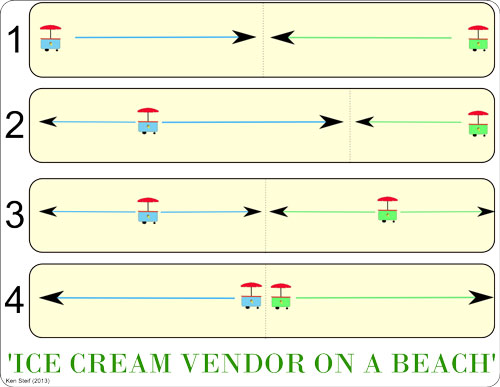
Now, for a more rigorous treatment that you'll appreciate from your studies in game theory, let's examine the formal proof. The following video breaks down how to demonstrate that the only stable equilibrium in this game is for both players to locate at the exact median.
Game Theory 101 (#40): Hotelling's Game and the Median Voter Theorem
This video from the "Game Theory 101" series formally analyzes Hotelling's Game.
First, watch the section explaining the derivation of the unique Nash Equilibrium. The logic proceeds by first establishing that in any equilibrium, each vendor must capture exactly half the market. It then eliminates all other possible configurations (equidistant from the center, same location off-center) by showing a profitable deviation exists, leaving only the central clustering as the stable outcome. Then, watch the application to the Median Voter Theorem. This is a crucial extension of the concept from physical space to an ideological "feature space," which will be directly relevant to our second application.
Application 1: The Clustering of Lingerie Shops
Let's apply this directly to the first part of our learning outcome. Why do you so often find several lingerie boutiques, or even departments within larger stores, located in the same mall or on the same shopping street?
Imagine a city's main shopping district is a one-mile stretch of road (our "beach").
- Socially Optimal Distribution: For customer convenience, two lingerie shops,
AandB, might locate at the 1/4 mile and 3/4 mile marks, respectively. Each would be in the center of their half of the market, minimizing the maximum travel distance for any customer. ShopAserves everyone from 0 to 1/2, and ShopBserves everyone from 1/2 to 1. They each get 50% of the market. - The Competitive Incentive: This setup is not a Nash Equilibrium. The owner of Shop
A(at 1/4) realizes that if they move to just left of ShopB(e.g., at 3/4 minus epsilon), they will capture the entire market from 0 up to their new location, which is almost 75% of the total market. - The Inevitable Convergence: A more realistic move is for Shop
Ato leapfrog to the center (1/2 mile mark). It now serves all customers on its left (a 1/4-mile segment) plus half the customers between it and ShopB(at 3/4). Its market share increases. In response, ShopBis incentivized to also move toward the center to reclaim its share. This strategic "arms race" for location ends only when both shops are located adjacent to each other at the center. At this point, they split the market 50/50 again, but neither has an incentive to move. A move to the left or right would mean voluntarily giving up customers to the competitor.
This clustering, while suboptimal for shoppers at the far ends of the district, is the logical endpoint of spatial competition. For a detailed read on this phenomenon and its real-world implications, you can review the following text.
The Paradox of Proximity: Why Competing Shops Cluster Together
This article from Economics Declassified provides a clear, text-based summary of the model and its consequences.
Start by reading the introduction to understand the core model and its key assumption. Then, review the section "Case 2: Introducing Competition" which describes the strategic moves leading to central clustering. Finally, read the sections on the Nash Equilibrium and its real-world implications, which explain why this outcome is stable yet socially inefficient, and how it creates "hubs" that attract more buyers overall.
Application 2: Convergence of Dating App Features
Now let's apply Hotelling's Law to an abstract "feature space," as presaged by the Median Voter Theorem. The "location" is not a point on a beach, but a position on a spectrum of user preferences. This explains why many products in a category, including dating apps, tend to become more similar over time.
Scenario: Consider the market for non-monogamous and polyamorous dating. We can model the primary user preference on a single dimension, from "Primarily Seeking Casual/Sexual Connections" at one end to "Primarily Seeking Committed/Romantic Polyamorous Relationships" at the other.
-
Initial Niche Strategy: Two new apps enter the market. App
Casanovapositions itself at the "casual" end, with features optimized for quick matching and hookups. AppPolyFindpositions itself at the "committed" end, with features for detailed profiles, relationship structure definitions (like vees, triads), and long-term compatibility. Each app has a distinct, loyal user base. -
The Competitive Incentive: The developers of App
Casanovarealize they are missing out on users who start out seeking casual connections but then desire something more. They introduce "Relationship Intent" filters and "Deeper Conversation Prompts." They haven't abandoned their core, but they've moved toward the center of the feature space. This allows them to retain their base while poaching users from the "soft" end ofPolyFind's market. -
The Inevitable Convergence: The
PolyFindteam sees this and fears losing users who feel the app is "too serious" for initial exploration. They introduce a "Discovery" mode that is more swipe-based and add features for "short-term dating." They also move toward the center. -
The Nash Equilibrium: Over time, both apps end up occupying the middle ground. They both offer a blend of features supporting a wide range of intentions, from casual to committed. They become less differentiated and compete for the "median user"—the person who is open to a range of outcomes. This is why many mainstream and niche dating apps eventually converge on a similar set of features.

This convergence is a perfect example of Hotelling's Law in a feature space. Instead of serving the extreme ends of the user preference spectrum, platforms cluster in the middle to compete for the largest segment of the market, leaving niche users at the fringes underserved—precisely what the model predicts.
Conclusion
Hotelling's Law provides a powerful, if cynical, model of competitive strategy. It reveals that the logical outcome of competition based on a single dimension—be it location or a key product feature—is not vibrant diversity but rather a convergence toward the middle.
Key Takeaways:
- Hotelling's Law (Principle of Minimum Differentiation): Competitors will tend to cluster at the median point of a market space to maximize their share.
- Nash Equilibrium: This clustering is a stable equilibrium because neither competitor can improve their position by unilaterally deviating.
- Physical Application: It explains why competing businesses like lingerie shops, gas stations, and car dealerships are often located next to each other, creating retail "hubs."
- Abstract Application: It also explains why products become more similar over time, as companies compete for the "median voter" or "median consumer" by converging on a similar set of features, as seen in dating apps and political platforms.
In our next lesson, we will continue our exploration of economic principles by examining Gresham's Law, which states that "bad money drives out good." We will apply this to analyze how low-quality inputs, whether in manufacturing or communication, can displace high-quality ones in a system.