Welcome back. In our last lesson, we explored the inner workings of deep neural networks, establishing that they are multi-layered systems that process information hierarchically, much like a factory assembly line. We now have a solid foundation for both traditional Machine Learning methods and the basic structure of Deep Learning models.
This lesson directly addresses a crucial question in modern AI: what is the real difference between Machine Learning and Deep Learning? We will move beyond simple definitions to conduct a detailed comparison. Your goal is to understand the key trade-offs between these two approaches, focusing on their distinct requirements for data, their handling of features, their typical use cases, and the practical criteria for choosing one over the other for a given project.
The Great Divide: Feature Engineering
The most fundamental difference between traditional Machine Learning (ML) and Deep Learning (DL) lies in how they handle features—the input variables or attributes that a model uses to make predictions.
In traditional ML, a significant amount of effort is spent on feature engineering. This is a manual process where data scientists use their domain knowledge to select, transform, and create the features they believe are most predictive. For example, in our student score prediction scenario, we might have engineered a feature like study_hours_to_previous_score_ratio.
Deep Learning, on the other hand, excels at automatic feature extraction. The layers of the neural network learn a hierarchy of features directly from the raw data. The initial layers learn simple features (like edges in an image), and subsequent layers combine these to learn more complex features (like shapes, and then objects).
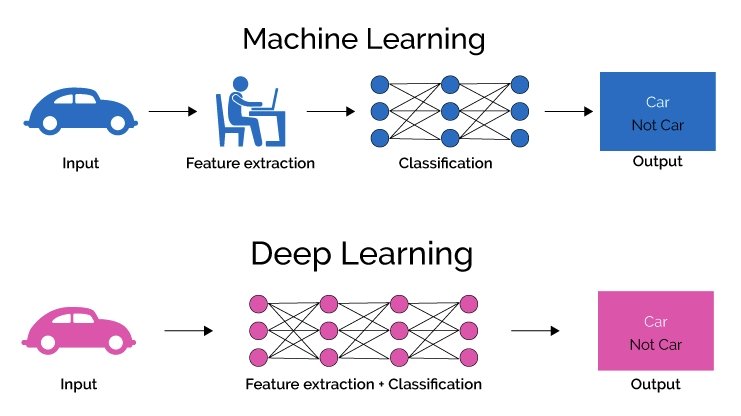
This distinction is the key to understanding why DL is so powerful for certain tasks. The video from codebasics provides a clear explanation using an image classification example.
Machine Learning vs Deep Learning
This video discusses the criteria for choosing between ML and DL, starting with the most important one: feature complexity.
Watch the segment that contrasts simple vs. complex features. Pay close attention to the cat vs. dog classification example. It perfectly illustrates how DL models can learn to identify visual features like "pointy ears" and "whiskers" from raw pixels, a task that would be incredibly difficult to do with manual feature engineering.
The IBM Technology video we looked at briefly in the last lesson also makes this point very well, contrasting human-supervised feature determination with DL's ability to learn from unstructured data automatically. If you wish to review, the key segment is between 00:05:09 and 00:06:21.
Data, Performance, and Hardware
The ability of deep learning models to learn complex features comes at a cost. These models have millions of parameters (the weights and biases) that need to be tuned during training. To do this effectively and avoid simply memorizing the training data, they require massive amounts of data.
Traditional ML algorithms, in contrast, can often achieve peak performance with much smaller, structured datasets.
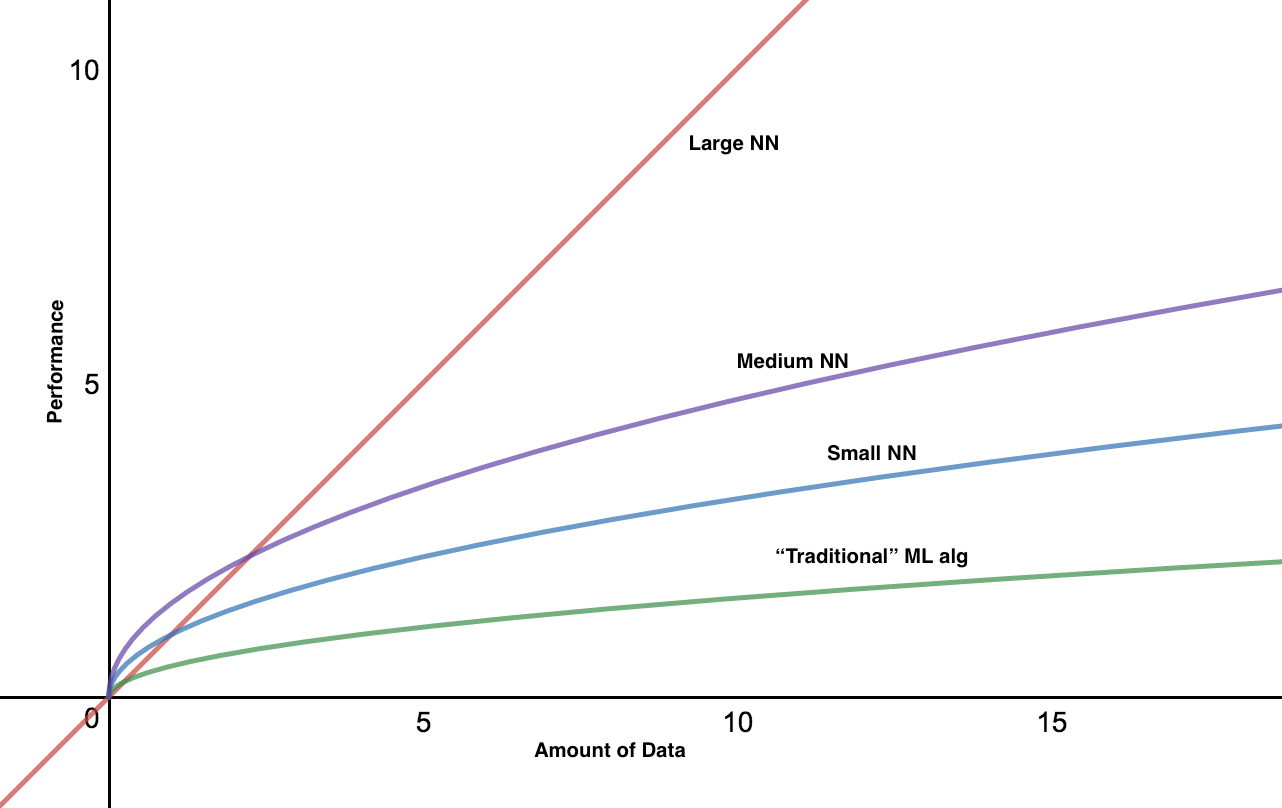
As the graph shows, with small amounts of data, traditional ML can sometimes even outperform DL. However, as the dataset grows, the performance of deep learning models, especially large ones, scales in a way that traditional models cannot match.
This hunger for data, combined with model complexity, leads to another key difference: computational requirements.
- Traditional ML: Models are generally less complex and can be trained on standard CPUs in a reasonable amount of time.
- Deep Learning: Training is computationally intensive and often requires specialized hardware like GPUs (Graphics Processing Units). Given your background in electrical engineering, you'll recognize that GPUs are designed for massive parallel processing, which is ideal for the matrix multiplications that are at the heart of neural network computations. Training a large DL model can take days or even weeks.
The following articles from Syracuse University's iSchool and DataCamp provide excellent summaries of these key differences.
Deep Learning vs Machine Learning: Key Differences
This article provides a concise breakdown of the core distinctions between ML and DL.
Under the heading "Key Differences Between Machine Learning and Deep Learning," read the subsections on Data requirements and Feature engineering, and also the subsection on Speed and resources. These sections reinforce the points we've just discussed about data volume and hardware needs.
Interpretability: The "Black Box" Problem
Another critical point of contrast is interpretability, which is our ability to understand why a model made a specific prediction.
Many traditional ML models, like linear regression or decision trees, are quite transparent. You can examine the model's coefficients or trace the path of decisions to understand the logic. This is crucial in fields where accountability is paramount, such as finance (explaining a loan denial) or medicine (justifying a diagnosis).
Deep learning models, with their millions of interconnected parameters, are often referred to as "black boxes." While we can measure their accuracy, tracing the exact path from input to output to understand the "reasoning" is extremely difficult. This lack of interpretability can be a major drawback.
Deep Learning vs Machine Learning: Key Differences
Let's revisit the same article to understand the concept of interpretability.
Find the subsection "Interpretability" and read it carefully. It explains why ML models are generally more transparent and why the "black box" nature of DL can be a disadvantage.
Q&A Checkpoint
Based on what we've discussed, take a moment to consider this question:
Why might a bank prefer a "traditional" ML model (like logistic regression) over a more powerful Deep Learning model for deciding on loan applications, even if the DL model is slightly more accurate?
Think about the trade-off between performance and explainability. A bank not only needs to make accurate decisions but also often needs to legally justify those decisions to customers and regulators. The high interpretability of a traditional model allows them to do exactly that.
A Practical Guide: When to Use Which?
So, how do you decide which approach to use for a project? The choice depends on a trade-off between the problem's complexity, the data you have, the resources you can afford, and the need for interpretability.
The DataCamp article provides a fantastic comparative guide. Pay special attention to the summary table, as it would be an excellent resource for a presentation slide.
Deep Learning (DL) vs Machine Learning (ML): A Comparative Guide | DataCamp
This guide provides a comprehensive comparison and practical decision criteria.
First, under the heading "Deep Learning vs Machine Learning: Key Similarities and Differences," read the entire section from "Functioning" to "Output". Crucially, study the comparison table in detail. This table neatly summarizes the key differences we've covered. Then, read the section "Decision Criteria" which starts right after the use cases. It synthesizes everything into four key factors to consider.
Here is a summary of the decision-making process:
Choose traditional Machine Learning when:
- Data: You have a small to medium-sized, structured dataset.
- Features: The features are well-understood and can be engineered manually.
- Resources: You have limited computational power (standard CPUs).
- Interpretability: Explaining the model's decisions is critical.
- Examples: Predicting house prices from a spreadsheet, classifying customer churn based on account data, forecasting sales.
Choose Deep Learning when:
- Data: You have a very large dataset.
- Features: The problem involves unstructured data (images, audio, text) and complex patterns that are difficult to engineer by hand.
- Resources: You have access to powerful GPUs or cloud computing platforms.
- Interpretability: Raw predictive performance is the top priority, and "black box" behavior is acceptable.
- Examples: Image recognition for self-driving cars, natural language translation, voice assistants, medical image analysis.
Conclusion
In this lesson, we dissected the critical differences between traditional Machine Learning and Deep Learning. While DL is a subfield of ML, its approach and requirements are distinct.
Key Takeaways:
- Feature Engineering: ML requires manual feature engineering; DL performs automatic feature extraction through its layers.
- Data & Hardware: ML works well with smaller datasets and standard CPUs. DL thrives on massive datasets and requires powerful GPUs.
- Performance: ML performance plateaus with more data, while DL performance continues to scale.
- Interpretability: ML models are often transparent and easy to interpret. DL models are typically "black boxes," making them hard to explain.
- The Choice: The decision to use ML or DL is a strategic one, balancing problem complexity, data availability, computational resources, and the need for interpretability.
In our final lesson, we will synthesize everything we've learned. We will analyze several real-world case studies, mapping them to the specific ML or DL techniques we've discussed. This will culminate in a framework for how to approach and select a viable AI project from scratch.