Welcome to your first lesson in the "Foundations of AI" module. Since your goal is to prepare material for an introductory presentation, this lesson will equip you with the foundational concepts and analogies needed to clearly define Artificial Intelligence (AI) and explain how Machine Learning (ML) fits into the picture. We will unpack these ideas using everyday examples and a core analogy comparing rule-based systems to learning-based systems, culminating in a clear answer to a classic question: "Is a calculator a form of AI?" This will provide a solid starting point for the rest of your presentation.
1. What is Artificial Intelligence?
Let's begin by establishing a broad understanding of Artificial Intelligence. At its core, AI is a field of computer science dedicated to creating systems capable of performing tasks that normally require human intelligence. This can include things like understanding language, recognizing objects in an image, making decisions, and playing complex games.
A key point to convey is that AI is not a single technology but a wide-ranging goal. The very definition of what qualifies as "intelligent" is a moving target.
AI and Machine Learning: The Differences | Sierra Circuits
To understand this "moving target" concept, let's look at an article from Sierra Circuits.
In the section under the heading "Artificial Intelligence (AI):," pay close attention to the author's point about the pocket calculator. This historical example perfectly illustrates how our perception of AI evolves as technology advances.
As you read, you saw that a simple pocket calculator was once considered a form of AI because automating mathematical calculations was a groundbreaking achievement. Today, we take it for granted. This happens because once a technology becomes common, we tend to no longer see it as "intelligent." This phenomenon is often called the "AI effect." Modern AI includes far more sophisticated applications, such as voice assistants like Siri and Alexa, or programs that can defeat grandmasters at chess.
2. The Shift from Rules to Learning
So, how do we build these "intelligent" systems? For a long time, the primary approach was to write a massive set of explicit, hand-crafted rules. This is known as traditional programming or a rule-based system.
Imagine trying to write a program to identify a cat in a photo using this method. You'd have to write rules like:
IFthe object has pointy ears,ANDIFit has whiskers,ANDIFit has fur,THENit is a cat.
This approach is incredibly brittle. What about a cat with folded ears (a Scottish Fold) or a hairless cat (a Sphynx)? Your program would fail. It's impossible to write rules for every possible variation.
This limitation led to a paradigm shift towards a new approach: Machine Learning (ML). The following video provides a fantastic analogy to explain this shift.
How AI Really Works (No Math, Just Logic)
This video from the "Simple Things" channel, titled "How AI Really Works," explains the core logic of modern AI without getting lost in the math. It introduces an excellent analogy that directly aligns with your learning outcome.
Watch the segment from the beginning of the explanation on traditional programming to the end of the "toddler" analogy. Notice how it contrasts teaching with explicit rules versus teaching with examples. This is the central idea you'll want to communicate in your presentation.
As the video explains, instead of giving the computer the rules, we give it the "answer key." We show it thousands of labeled examples (this is a cat, this is not a cat) and let it figure out the patterns on its own. This is the essence of Machine Learning. It is a subfield of AI focused on building systems that learn directly from data.
3. Visualizing the Relationship Between AI and ML
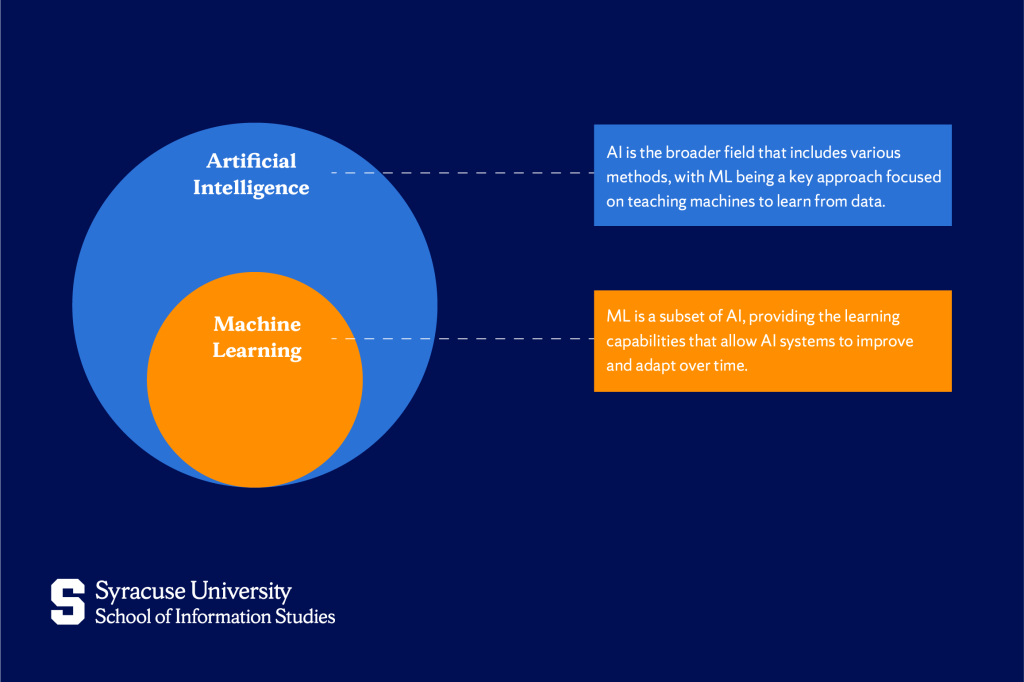
It's crucial to be clear that AI and Machine Learning are not interchangeable terms. ML is the most common and powerful method used today to achieve AI.
The relationship is hierarchical. AI is the broad, overarching goal, and ML is a specific, powerful subset of techniques used to reach that goal. The following diagrams are perfect for illustrating this concept in your presentation.

4. Revisiting the Calculator: Deterministic vs. Probabilistic
Now we can answer the question "Is a calculator AI?" with a much deeper understanding.
We've established that a calculator isn't considered AI today because it's a common tool. But there's a more fundamental, technical reason: a calculator is a deterministic system. It operates based on a fixed set of pre-programmed rules. When you input 2 + 2, the output will always be 4. There is no learning, no prediction, and no uncertainty.
Modern AI systems, powered by Machine Learning, are probabilistic. They make predictions based on patterns learned from data. When you ask a voice assistant a question, it predicts the most likely correct response. When a spam filter flags an email, it's calculating the probability that the email is junk based on features it has learned from millions of other emails.
The following article explores this distinction in detail.
Why AI is Not Like a Calculator - Plagiarism Today
The article "Why AI is Not Like a Calculator" from Plagiarism Today offers a robust argument that you can adapt for your presentation. It highlights the critical differences between these two types of tools.
Please read the sections titled "The Problem with AI" and the paragraphs that follow, down to the sentence ending here. Focus on the key differences the author points out: Mistakes and "Hallucinations": Calculators don't make mistakes (only users do), whereas AI systems can generate incorrect or nonsensical information. Bias: AI systems can reflect biases present in their training data. Substitution for Knowledge: Using a calculator doesn't require you to understand multiplication deeply to get the right answer. In contrast, using an AI tool effectively requires deep domain knowledge to validate its output. This point about "vibe coding" might be a fun, relatable anecdote for your student audience.
So, the definitive answer is no, a calculator is not a form of modern AI. It's a rule-based, deterministic tool that performs calculations. It does not learn from data, make predictions, or adapt its behavior over time.
Checkpoint for Your Audience
As you build your presentation, it's a great idea to pause and engage the students. Here’s a question you could pose to them at this point:
Question: Think about the autocorrect feature on your smartphone. When you first got your phone, it might have made strange corrections. Over time, it seems to get better at knowing what you mean, even learning your specific slang or frequent typos.
Is autocorrect more like a simple calculator (a rule-based system) or more like an AI powered by Machine Learning? Why?
This question prompts students to apply the core concepts of the lesson. A good answer would highlight that because the system adapts and learns from the user's personal data (their typing habits), it demonstrates the principles of Machine Learning.
Conclusion
In this lesson, we established the fundamental definitions that will anchor the rest of your presentation.
Key Takeaways:
- Artificial Intelligence (AI) is the broad scientific field focused on creating machines that can perform tasks requiring human intelligence.
- Machine Learning (ML) is a subfield of AI that gives computers the ability to learn patterns from data without being explicitly programmed.
- The key difference in approach is explicit rules vs. learning from examples. This is like the difference between giving a computer a detailed instruction manual for every possible scenario versus showing it thousands of examples and letting it write its own manual.
- A calculator is not considered a form of modern AI because it is a deterministic, rule-based device. In contrast, ML-powered AI systems are probabilistic, making predictions and decisions based on learned patterns.
In our next lesson, we will build on this foundation by exploring the three main "styles" of machine learning: supervised, unsupervised, and reinforcement learning. We'll continue using simple analogies to make these concepts intuitive and easy to understand for your audience.