Welcome to the next lesson in our exploration of the body's fluid balance. In our previous session, we established the first major division of total body water into two principal domains: the intracellular fluid (ICF) and the extracellular fluid (ECF). You'll recall that for a standard 70 kg individual, the approximately 42 liters of total body water are split into about 28 liters of ICF (inside the cells) and 14 liters of ECF (outside the cells).
Today, we will dissect that 14-liter ECF volume further. The ECF is not a single, uniform pool of fluid; it's the body's internal environment, and like any environment, it has distinct regions with specific characteristics and functions. Our learning outcome for this lesson is to describe the subcompartments of the ECF: plasma, interstitial fluid, and transcellular fluid. Understanding these divisions is crucial for grasping how nutrients reach cells, how waste is removed, and how blood pressure and tissue hydration are maintained.
The Major Regions of the Extracellular "Sea"
The vast majority of the ECF is divided into two main components, separated by the walls of your capillaries:
- Plasma: The fluid portion of your blood, contained within the blood vessels.
- Interstitial Fluid (ISF): The fluid that directly bathes your cells, filling the spaces, or "interstices," between them.
A helpful rule of thumb is that the ECF volume is divided between the interstitial fluid and plasma in a roughly 3:1 ratio.
- Interstitial Fluid makes up about three-quarters (3/4) of the ECF.
- Plasma makes up about one-quarter (1/4) of the ECF.
Applying this to our 14 L of ECF:
- ISF Volume ≈ 3/4 × 14 L = 10.5 L
- Plasma Volume ≈ 1/4 × 14 L = 3.5 L
The following video provides a concise overview of this division and also introduces the third, smaller subcompartment we will discuss.
Body Fluid Compartments | ICF | ECF | General Physiology
Please watch the section of this video from Byte Size Med that breaks down the ECF. It clearly illustrates the relationship between plasma, interstitial fluid, and the capillary membrane that separates them.
Focus on the segment from the ECF division. Note the relative volumes (3/4 vs 1/4) and the introduction of the transcellular compartment.
Now, let's examine each of these compartments in more detail.
Plasma: The Intravascular Highway
Plasma is the only fluid compartment that exists as a large, continuous volume in one location—within the circulatory system. As the liquid matrix of blood, its primary role is transport. It carries blood cells, proteins, hormones, nutrients, and waste products throughout the body.
The most critical difference between plasma and interstitial fluid is its high concentration of proteins, particularly albumin. These large protein molecules are generally unable to pass through the capillary walls, so they remain within the vascular space where they play a crucial role in maintaining osmotic pressure.
The image below, which we've seen before, visually represents these volumes for a typical adult.

To solidify the definition of plasma, please review the following text.
Fluid Physiology: 2.1 Fluid Compartments
This excerpt from "Fluid Physiology" provides a clear, technical definition of plasma and its unique characteristics compared to other fluid compartments.
In the section "2.1.4 Extracellular Fluid", find the paragraph that begins with the bolded word "Plasma". Please read this short paragraph, which defines plasma and notes its high protein content and transport function.
Interstitial Fluid (ISF): The Cellular Environment
If plasma is the highway, the interstitial fluid is the local network of streets and pathways that directly serves every cell. The ISF surrounds all cells, acting as the essential intermediary for the exchange of substances between the blood and the intracellular fluid. Oxygen and nutrients diffuse from the blood, through the ISF, and into the cells. Conversely, metabolic waste products diffuse from the cells, through the ISF, and into the blood to be carried away.
Because it is formed by filtration from plasma across the capillary endothelium, the ISF is often described as an ultrafiltrate of plasma. Its composition is very similar to plasma, with one major exception: it has a very low protein concentration.
Fluid Physiology: 2.1 Fluid Compartments
This section of "Fluid Physiology" describes the nature and function of the interstitial fluid.
Just above the section on plasma you just read, find the paragraph starting with the bolded term "Interstitial fluid (ISF)". Read this description to understand its role as the link between the ICF and the intravascular compartment.
Transcellular Fluid: The Specialized Compartment
While plasma and interstitial fluid account for the vast majority of the ECF, there is a third, smaller subcompartment known as transcellular fluid. This is a collection of specialized fluids that are produced by the transport activity of epithelial cells, enclosing them in epithelial-lined cavities.
Examples of transcellular fluid include:
- Cerebrospinal fluid (CSF)
- Synovial fluid in joints
- Pleural fluid (in the lung cavity)
- Peritoneal fluid (in the abdominal cavity)
- Aqueous humor of the eye
- Secretions of the gastrointestinal (GI) tract
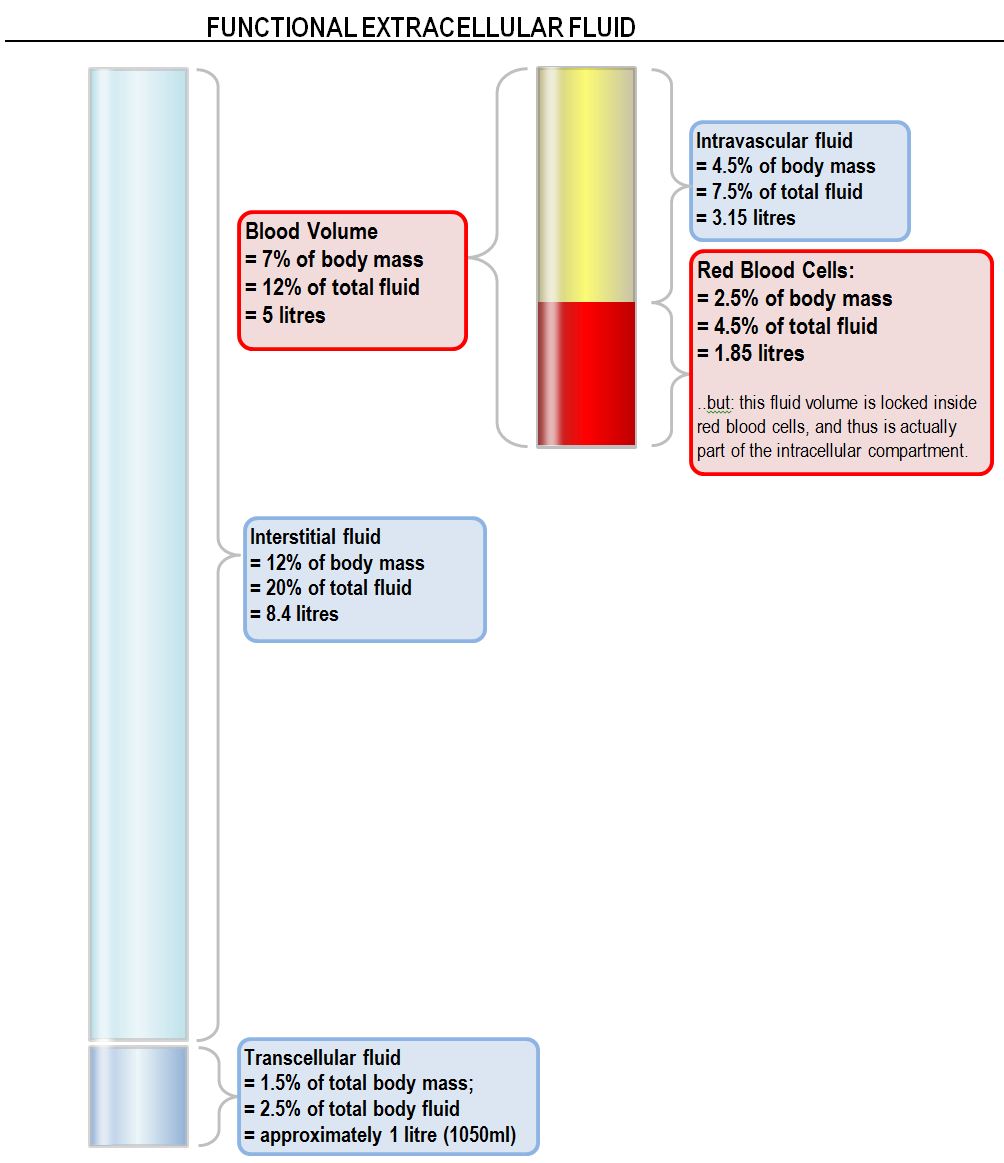
The total volume of transcellular fluid is small, typically only 1-2 liters. However, it is functionally very important. Unlike plasma and ISF, the composition of transcellular fluids can be dramatically different from one another, tailored to their specific functions.
Fluid Physiology: 2.1 Fluid Compartments
This final excerpt from "Fluid Physiology" formally defines the transcellular compartment and lists its components.
In the same article, locate the paragraph beginning with "Transcellular fluid". Read this definition, paying attention to the examples provided.
A Comprehensive View and "Slow" Compartments
It's important to recognize that some ECF is not rapidly exchangeable with the main "functional ECF" (plasma + ISF). A significant amount of water is trapped in bone and dense connective tissue. While it contributes to the total ECF volume, this fluid is mobilized very slowly and is less involved in the acute, moment-to-moment fluid shifts that are clinically important.
The following image provides a slightly different but very useful breakdown, explicitly showing transcellular fluid and clarifying how blood volume relates to the fluid compartments.
To bring all three concepts together, a final summary from another resource can be very helpful.
Body Fluid Compartments: Intracellular vs Extracellular | Osmosis
This summary from Osmosis provides a concise recap of the ECF subcompartments, reinforcing what we've just covered.
Please find the "Key Takeaways" section at the end of the article. Read the paragraph that begins "The extracellular compartment...". This text neatly summarizes the three subcompartments: plasma, interstitial, and transcellular.
Conclusion
In this lesson, we have moved beyond the simple ICF/ECF division to explore the distinct regions within the extracellular fluid.
Here are the key takeaways:
- The Extracellular Fluid (ECF), which is 1/3 of total body water, is primarily subdivided into plasma and interstitial fluid (ISF).
- Plasma is the intravascular, protein-rich fluid component of blood, making up about 1/4 of the ECF.
- Interstitial fluid is the extravascular fluid that bathes the cells. It is an ultrafiltrate of plasma, is low in protein, and constitutes about 3/4 of the ECF.
- Transcellular fluid is a smaller, specialized compartment of fluids secreted into epithelial-lined cavities (e.g., CSF, synovial fluid), with a highly variable composition.
You now have a detailed map of where water resides in the body. However, knowing the location of the fluid is only part of the story. The next crucial question is: what keeps the fluid in these compartments, and what forces cause it to move between them? In our next lesson, we will begin to answer this by defining osmolarity and osmolality and explaining how osmotic and hydrostatic pressures govern the movement of water.