Hello! Welcome to your first lesson. This course is designed to help you master AI tools like Google Gemini for your work in corporate finance and for your future startup ambitions.
We'll start with the most fundamental skill: crafting effective prompts. Just like in programming where clear logic produces the desired output, in AI, a well-structured prompt is the key to getting high-quality, relevant results. Today, we'll focus on transforming your interactions with AI from simple Q&A to strategic conversations.
This lesson addresses the first learning outcome of our course: Use role-based and context-setting prompts to get more relevant and structured responses from AI chatbots. By the end of our 60 minutes, you'll have a clear framework to instruct AI models to act as experts and understand the specific scenario you're working in, dramatically improving the quality of their outputs.
From Vague Questions to Clear Instructions
When we start using AI chatbots, most of us ask simple questions, like "Explain market risk." The AI gives a generic, textbook-style answer. To get results that are truly useful for your work in finance or for building a startup, you need to provide the AI with better instructions.
A powerful prompt isn't just a question; it's a brief. It tells the AI not just what to do, but how to do it, who it should be, and why you need it. Google recommends a simple but effective four-part framework for this.
To see this framework in action, please watch the first minute of the following video. It introduces the core components of a great prompt.
How to Write Prompts for Google Gemini Fast
This video, 'How to Write Prompts for Google Gemini Fast' by Bryan Collins, summarizes Google's own guide to prompting. Pay close attention to the four key parts of a prompt that he introduces.
From the beginning, watch the opening segment. Focus on the names and definitions of the four components: Persona, Task, Context, and Format.
As the video explained, the four key components of a strong prompt are:
- Persona: Who you want the AI to be.
- Task: What you want the AI to do.
- Context: The background information and goal.
- Format: The structure of the desired output.
Think of it as briefing a new team member. You'd tell them their role on the project (Persona), what their deliverable is (Task), the project's background and objectives (Context), and how you want the final report to look (Format).
This image provides a great visual summary of these components, which it calls the "Anatomy of a Prompt."
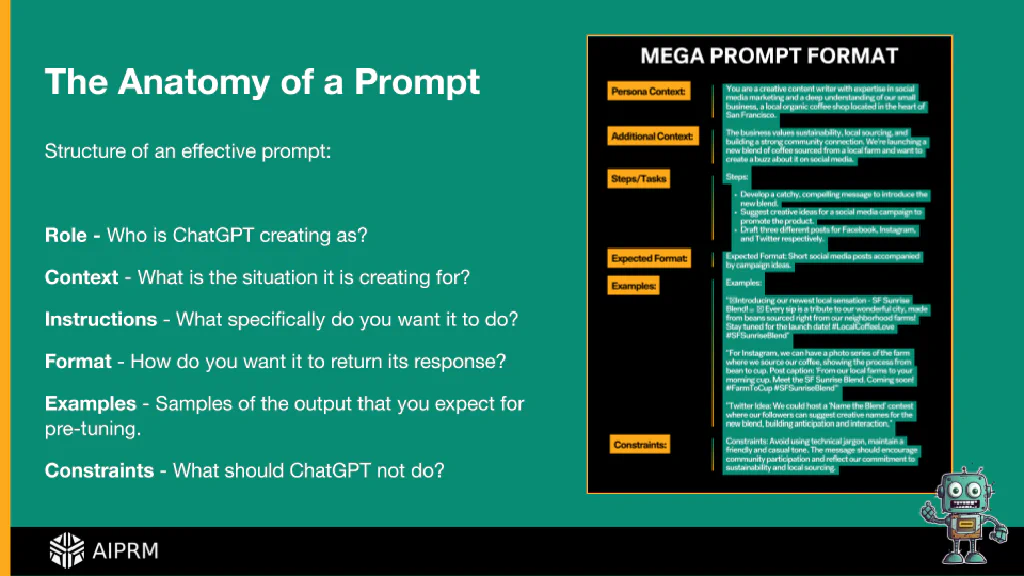
Let's dive deeper into the two most transformative elements from this framework: Persona and Context.
1. Persona: Assigning an Expert Role
Assigning a persona (or role) is one of the quickest ways to improve an AI's response. Instead of getting a generalist answer, you get an expert one. By telling Gemini "Act as a...", you focus its vast knowledge on a specific domain, leading to more sophisticated vocabulary, relevant insights, and a professional tone.
Watch this short clip, which clearly explains the impact of adding a persona.
Google's 9 Hour AI Prompt Engineering Course In 20 Minutes
In this segment from 'Google's 9 Hour AI Prompt Engineering Course In 20 Minutes,' instructor Tina Huang demonstrates how adding a persona immediately makes the AI's response more specific and useful.
About a minute and a half in, watch the persona example. Notice how the simple addition of 'act as an anime expert' changes the output from a generic list to a categorized, more thoughtful one.
For your work, instead of a generic prompt like:
Summarize the risks of a leveraged buyout.
You can use a persona-driven prompt:
Act as a seasoned M&A analyst from a top-tier investment bank. Summarize the key financial and operational risks of a highly leveraged buyout for a company in the manufacturing sector.
The second prompt will yield a far more nuanced and industry-specific analysis.
2. Context: Providing the "Why" and "For Whom"
If persona tells the AI who to be, context tells it everything else it needs to know to do the job properly. The more relevant context you provide, the less the AI has to guess.
Key elements of context include:
- Background: What essential information does the AI need? (e.g., "I am analyzing Tesla's 2023 annual report...")
- Goal: What is the ultimate purpose of this task? (...to identify its main strategic challenges for an investment committee.")
- Audience: Who are you creating this for? ("The audience is familiar with finance but not with the EV industry.")
- Constraints: Any rules to follow? ("Keep the summary under 300 words and focus only on points raised in the 'Risk Factors' section of the report.")
To see how these elements come together in a practical scenario, let's look at an official example from Google's own prompting guide.
A quick-starthandbook for effective prompts
The 'Gemini for Google Workspace Prompting Guide 101' provides excellent, work-oriented examples. This one shows how a manager plans a team offsite, using persona and context to get a useful agenda.
Please read the section titled 'Prompt iteration example' under 'Use case: Plan agendas' on page 8. Below the section heading, read the first scenario. Notice how the initial prompt clearly defines the persona ('executive administrator'), the context (newly formed team, location), and the task ('Plan activities').
This example shows that by providing rich context upfront, the initial output is already a strong starting point, ready for refinement.
Activity: Putting It All Together
Now, let's apply this framework to a scenario relevant to your work in corporate finance. This exercise will highlight the difference between a simple prompt and a well-structured one. You will use Google Gemini Pro for this.
Scenario: You need to draft a memo for your team about the implications of rising interest rates on corporate capital structure.
Step 1: The Vague Prompt (2 minutes)
First, go to Gemini and enter a simple, one-line prompt.
Explain the effect of rising interest rates on capital structure.
Review the output. It will likely be correct but generic—the kind of information you'd find on a financial education website. It's not tailored to your specific professional needs.
Step 2: The Structured Prompt (8 minutes)
Now, let's craft a prompt using the Persona, Task, Context, and Format (PTCF) framework. Copy and paste the following into Gemini:
Persona:
You are a corporate treasurer and strategic advisor with 20 years of experience, advising the CFOs of large, publicly traded industrial companies.Task:
Write a concise internal memo analyzing how a sustained period of high-interest rates should influence our company's capital structure strategy for the next 24 months.Context:
Our company is in the industrial manufacturing sector with a moderate debt level. The audience for this memo is the senior finance leadership team, so you can assume deep financial literacy. The goal is to move beyond the obvious ('debt is more expensive') and provide actionable strategic considerations. The tone should be authoritative, pragmatic, and forward-looking.Format:
`Structure the memo as follows:
- A brief Executive Summary (2-3 sentences).
- Three key strategic recommendations in a numbered list. Each recommendation should include a brief 'Rationale' subsection explaining the 'why' behind it.`
Step 3: Compare the Outputs (5 minutes)
Compare the response from the structured prompt to the one from your vague prompt. Notice the differences in:
- Depth and Specificity: The second output should offer specific strategies (e.g., re-evaluating debt covenants, shifting from floating to fixed-rate debt, prioritizing internal cash flow for funding) rather than just stating general principles.
- Tone and Language: The persona should produce a professional, confident tone suitable for a senior audience.
- Structure: The output is already organized into a usable format, saving you time on editing and formatting.
This exercise demonstrates that taking an extra minute to structure your prompt can save you significant time and dramatically increase the quality of the AI's "first draft."
Conclusion
Congratulations on completing your first lesson! You've learned the fundamental principle of effective prompting: moving from simple questions to structured instructions.
Here are the key takeaways:
- Structure is Everything: The quality of your AI output is directly proportional to the quality of your prompt.
- Use the PTCF Framework: A reliable way to build a great prompt is to define the Persona, Task, Context, and Format.
- Assign an Expert Persona: Tell the AI who to be to get responses with the right expertise, tone, and vocabulary.
- Provide Rich Context: Give the AI the necessary background, goals, and constraints to ensure the output is relevant and fit for purpose.
This skill is the foundation for everything we'll do in this course. As you get comfortable with it, you'll find yourself using AI less like a search engine and more like a capable, specialized assistant.
In our next lesson, we'll explore chain-of-thought prompting. This technique allows you to guide the AI through complex, multi-step problems, a skill that's especially powerful for tasks like debugging code, developing financial models, and creating detailed strategic plans.